
Table of Contents
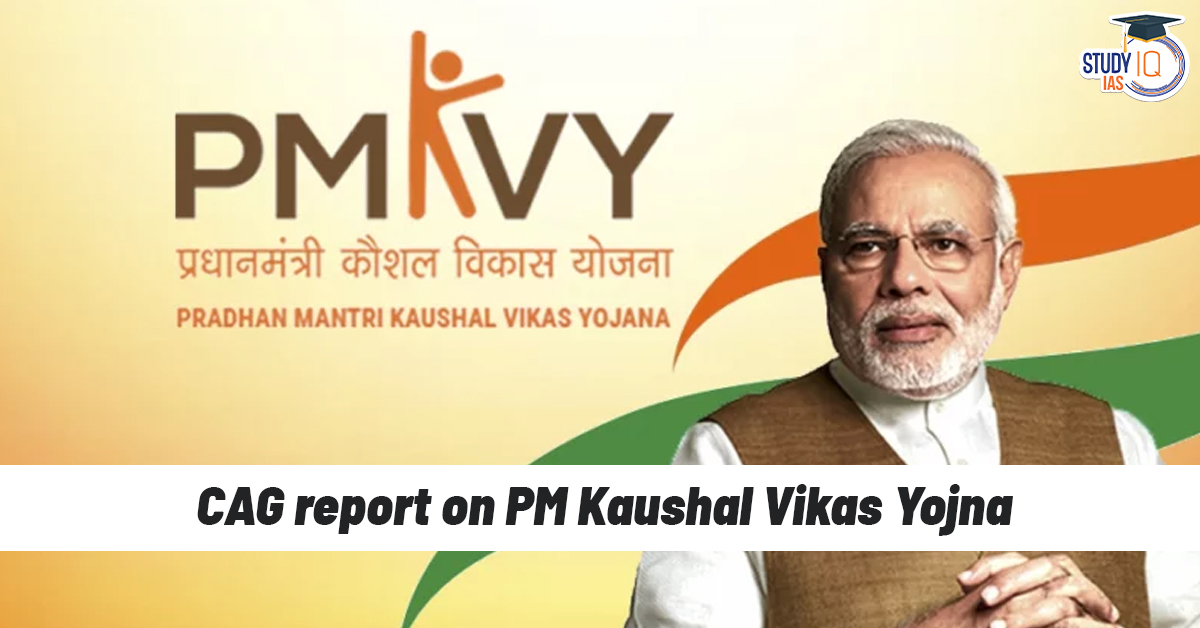
The Comptroller and Auditor General (CAG) of India, in its performance audit of the Pradhan Mantri Kaushal Vikas Yojana (PMKVY), has highlighted serious gaps in the implementation of India’s flagship skill development scheme. Covering three phases of the scheme from 2015 to 2022, the report raises concerns over financial irregularities, weak monitoring, poor quality control, and limited employment outcomes, questioning the effectiveness of PMKVY in addressing unemployment and skill mismatch.
The findings are particularly important for UPSC and other competitive exams, as they touch upon governance, public finance accountability, and outcomes of welfare schemes.
What is Pradhan Mantri Kaushal Vikas Yojana (PMKVY)?
PMKVY is a centrally sponsored flagship scheme launched in 2015 under the Ministry of Skill Development and Entrepreneurship (MSDE). It is implemented through the National Skill Development Corporation (NSDC).
Objectives of PMKVY
-
Provide short-term skill training to youth
-
Enhance employability and job readiness
-
Promote Recognition of Prior Learning (RPL)
-
Align workforce skills with industry requirements
Scope of the CAG Audit
The CAG audit examined:
-
PMKVY Phase I (2015–16)
-
PMKVY Phase II (2016–20)
-
PMKVY Phase III (2020–22)
The audit focused on:
-
Financial management
-
Beneficiary identification
-
Functioning of training centres
-
Certification and assessment processes
-
Employment outcomes after training
Key Findings of the CAG Report on PMKVY
1. Serious Financial Irregularities
One of the most alarming findings was the use of dummy or invalid bank account numbers, including entries such as “11111111111”, for transferring government funds. This indicates:
-
Weak financial controls
-
Poor verification of beneficiary bank details
-
High risk of fund diversion and misuse
Additionally, payments for training and certification were pending for over 34 lakh candidates, reflecting administrative inefficiency.
2. Fake and Duplicate Beneficiaries
The CAG found instances where:
-
The same photograph was used for multiple beneficiaries
-
Such cases were especially prominent in Bihar and Uttar Pradesh
This points to:
-
Inadequate Aadhaar-based authentication
-
Weak beneficiary verification mechanisms
-
Possible creation of fake beneficiaries to inflate training numbers
3. Non-Operational Training Centres
Several training centres were found to be:
-
Closed or non-functional
-
Yet still shown as active in official records
-
Paid for training activities without proper physical verification
This highlights the absence of regular inspections and ground-level monitoring.
4. Poor Quality of Certification and Assessment
The report also flagged:
-
Skill certification by employers who did not qualify as ‘Best-in-Class’
-
Inadequate standards for assessors and training partners
-
Compromised credibility of PMKVY certificates
As a result, many certificates failed to improve actual employability.
5. Weak Focus on Employment Outcomes
Despite training millions of candidates:
-
Placement tracking was poor
-
Long-term employment data was unreliable
-
The scheme focused more on numerical targets than sustainable jobs
The audit noted that skill training did not necessarily translate into gainful employment, defeating the core objective of PMKVY.
Governance and Implementation Gaps
The CAG report highlighted systemic governance issues, including:
-
Over-reliance on self-reported data from training providers
-
Inadequate coordination between the Centre, States, and private partners
-
Limited use of technology for real-time monitoring
-
Weak accountability mechanisms within NSDC and MSDE
Impact of the CAG Findings
Economic Impact
-
Inefficient use of public funds
-
Low return on investment in skill development
-
Persistent unemployment and underemployment
Social Impact
-
Loss of trust among youth in government schemes
-
Reduced acceptance of PMKVY certificates by employers
Institutional Impact
-
Questions credibility of large-scale welfare programmes
-
Highlights challenges in outcome-based governance
Way Forward: Reforms Suggested
To improve the effectiveness of PMKVY, the following reforms are essential:
1. Strengthen Digital and Biometric Verification
-
Mandatory Aadhaar-based biometric attendance
-
AI tools to detect duplicate photographs and fake entries
2. Outcome-Based Funding
-
Link payments to job placement, retention, and wage levels
-
Incentivise quality outcomes rather than enrolment numbers
3. Improve Monitoring and Inspections
-
Regular physical audits of training centres
-
Public dashboards with real-time data transparency
4. Enhance Certification Quality
-
Strict accreditation of assessors and employers
-
Alignment of skills with industry demand and local labour markets
5. Independent Evaluation
-
Third-party audits and impact assessments
-
Feedback loops from employers and trainees
Conclusion
The CAG report on Pradhan Mantri Kaushal Vikas Yojana underscores a crucial lesson: skill development cannot succeed without strong governance and accountability. While PMKVY was conceived as a transformative initiative to harness India’s demographic dividend, weak implementation, financial lapses, and poor outcome orientation have limited its impact.
For India to truly benefit from its youth population, future skill programmes must prioritise quality, transparency, and employment outcomes over headline numbers.
 Shaheed Diwas 2026: History, Significanc...
 Mahad Satyagraha 1927, History and Signi...
 Punjab–Rajasthan River Dispute: Raviâ€...







 WhatsApp





