
Table of Contents
Context
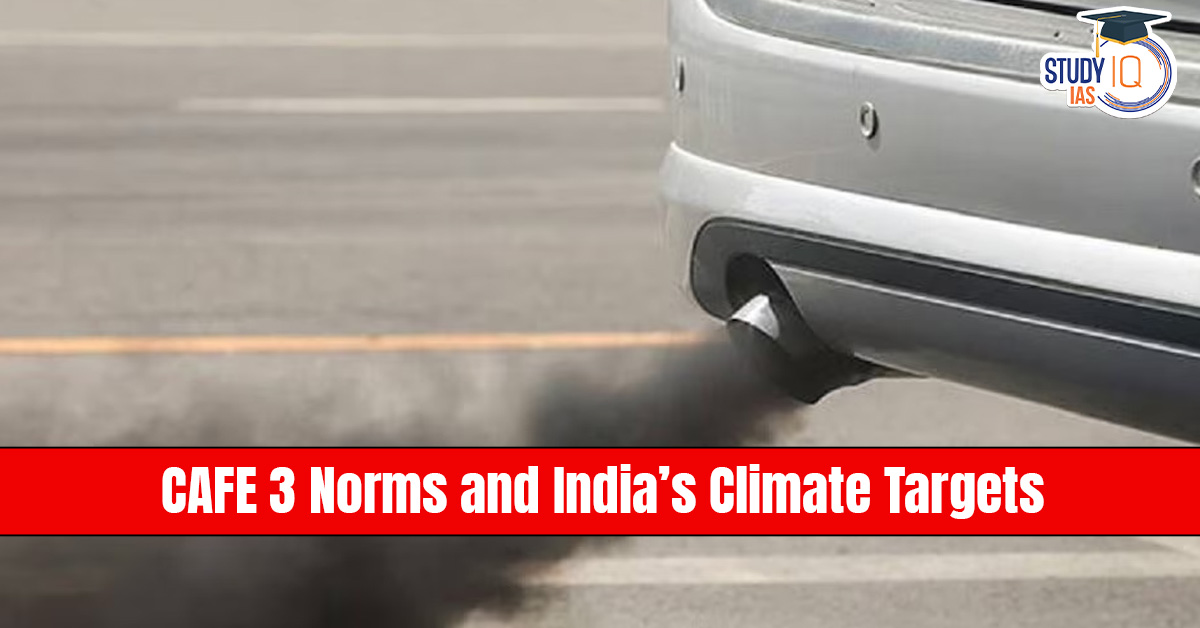
- The Prime Minister’s Office (PMO) recently reviewed the proposed Corporate Average Fuel Efficiency (CAFE)-3 norms for passenger vehicles, which are scheduled to take effect from 2027.
|
What is CAFE? |
| ● It was started from 2017 to set a limit on average fuel consumption and CO2 emissions of a manufacturer’s overall fleet.
● Aim: It aims to push carmakers to improve their overall fuel efficiency and reduce emissions. ● Instead of regulating each vehicle individually, CAFE mandates that the average emissions of all vehicles sold by a manufacturer must remain below a specified limit. ● The CAFE 2 began in 2022 and the next phase CAFE 3 is all set to start from April 2027. ● Implementation: It is implemented in India by Bureau of Energy Efficiency (BEE) under Ministry of Power in coordination with Ministry of Heavy Industries ● Core Objective: To further tighten CO₂ emission limits (g/km) and establish fleet-wide fuel efficiency standards |
Key Features of the Revised Draft of CAFE-3 Norms
- Removal of Small-Car CO₂ Waiver: Earlier drafts allowed a relaxation of 0 g CO₂/km for small cars (below 909 kg and 1200 cc engine capacity).
- The revised draft removes this benefit, meaning small cars must now meet stricter emission targets like other vehicles.
- Flatter Weight-Based Emission Slope: The “emission slope” (which adjusts allowed emissions based on vehicle weight) has been reduced from 002 to 0.00153 initially, gradually declining to 0.00128 by the fifth year.
- This reduces the advantage heavier vehicles previously had and tightens overall compliance requirements.
- Lower Permissible Emissions for Heavier Vehicles: Under the revised slope, heavier cars (SUVs, larger sedans) will now be allowed lower emissions than earlier proposed, pushing manufacturers to improve engine efficiency or adopt cleaner technologies.
- Reduced Flexibility for Automakers: The revised formula narrows the margin manufacturers had to balance high-emission and low-emission vehicles within their fleet.
- Companies must now redesign product strategies to meet stricter fleet-wide averages.
- Indirect Push Toward Electric & Hybrid Vehicles: Stricter emission limits make it harder for conventional petrol/diesel vehicles to comply.
This encourages companies to introduce electric vehicles (EVs), hybrids, or lightweight designs to meet average emission targets. - Phased Tightening Over Five Years: Instead of one abrupt cut, the emission slope gradually tightens each year.
- This provides a transition window for manufacturers to adapt technology and production processes.
|
Read More Notes |
|
| Environment Notes | Art and Culture Notes |
| Science and Tech | History Notes |
| Geography Notes | Indian Polity Notes |
| General Knowledge | International Relation |
|
Explore StudyIQ Courses |
|
 International Polar Bear Day 2026: Impor...
 Recent Defence Expansion in India: Moder...
 What is El Niño Labelling and Why It Ma...










 WhatsApp





