
Table of Contents
Context
A shrine of the 17th-century Sufi poet Bulleh Shah was vandalised by miscreants in Mussoorie, Uttarakhand, sparking widespread outrage and calls for the protection of Sufi heritage.
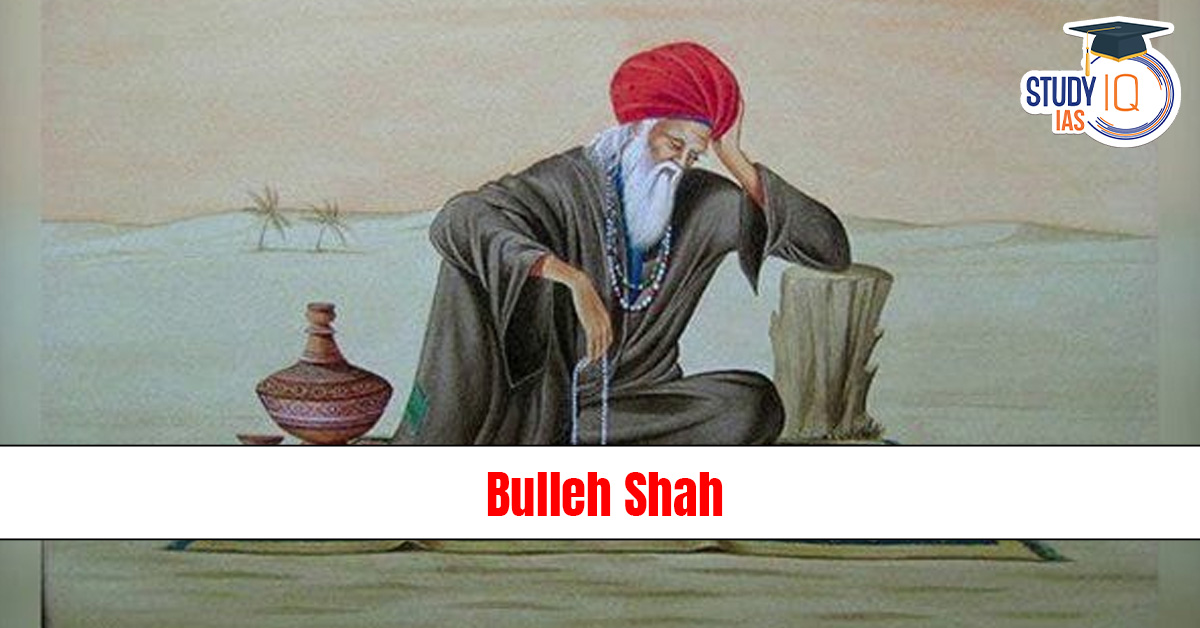
About Bulleh Shah
Early Life and Education
- Bulleh Shah was born as Syed Abdullah Shah Qadri in 1680 in the Punjab region (in present-day Pakistan), in an upper-caste Syed family with ancestors from Uch Gilaniyan, Bahawalpur.
- His father, Shah Muhammad Dervish, a teacher and preacher, gave him early education in languages and spiritual texts.
- He later pursued higher learning in Kasur, a prominent scholarly centre, and subsequently in Batala and Lahore under the Qadiri Sufi tradition, particularly guided by Shah Inayat Qadri, a liberal Sufi philosopher.
Philosophical and Literary Contributions
- Poetic innovation: Bulleh Shah is regarded as one of the greatest Punjabi poets.
- He wrote extensively in Punjabi using colloquial language, making profound spiritual concepts accessible to ordinary people.
- His corpus includes kafis (classical form of Sufi poetry) and other poetic forms.
- His poetry focused on universal love (ishq), divine oneness, humanism, social equality, and self-realisation.
- He was critical of shallow religiosity, caste discrimination, and social hierarchies, advocating compassion, inner awakening and unity beyond religious identities.
- Cultural impact: Bulleh Shah’s work enriched Punjabi literature by elevating folk idioms and metaphors, influencing musical and devotional traditions across South Asia.
- His verses have inspired songs and cultural performances and remain popular in both classical and contemporary renditions.
|
Sufism |
|
|
Read More Notes |
|
| Environment Notes | Art and Culture Notes |
| Science and Tech | History Notes |
| Geography Notes | Indian Polity Notes |
| General Knowledge | International Relation |
|
Explore StudyIQ Courses |
|
 Distinct Enumeration of DNTs in Census 2...
 Top 10 Richest Indians 2026 Full List Ne...
 The Transgender Persons (Protection of R...











 WhatsApp





