
Table of Contents
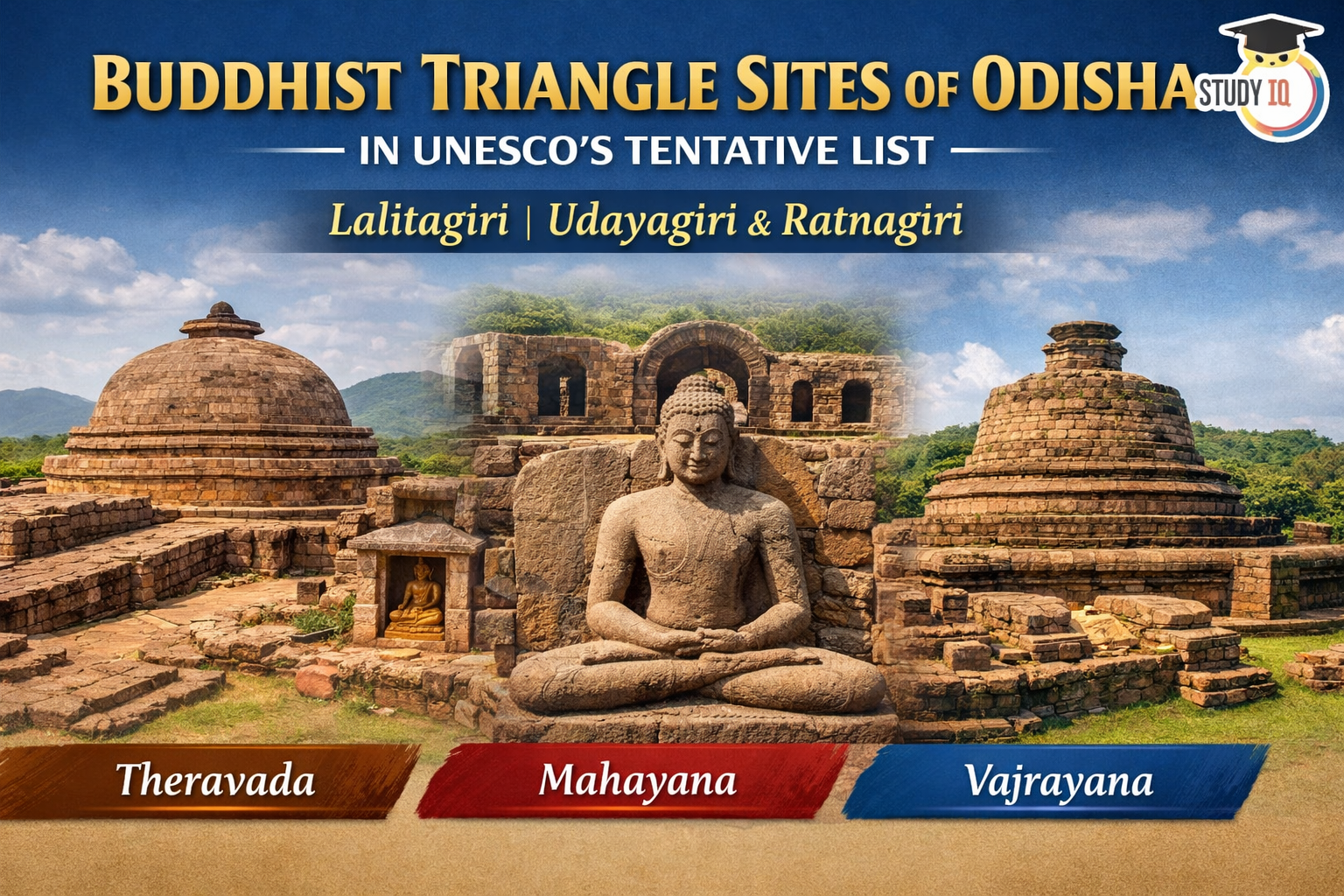
India has nominated three important Buddhist heritage sites of Odisha – Lalitagiri, Udayagiri and Ratnagiri, located in the Assia hill range, for inclusion in the UNESCO World Heritage List. These sites have been added to UNESCO’s Tentative World Heritage Sites List, marking a major step towards global recognition of Odisha’s Buddhist legacy.
Together, they form the Buddhist Triangle of Odisha, representing the continuous evolution of Buddhism from Theravada (Hinayana) to Mahayana and Vajrayana traditions over more than a thousand years.
Buddhist Site of Lalitagiri, Cuttack, Odisha
Location:
-
Nandapahad hillock, Assia hill range
-
Birupa River valley
Chronology:
-
Continuously occupied from 2nd to 13th century CE
Epigraphy:
-
Terracotta sealing reads:
“Sri Chandraditya Vihara Samagra Arya Bhikshu Sanghasa” -
Confirms Lalitagiri as an important Buddhist monastic centre.
Archaeological Findings:
Theravada (Hinayana) Phase
-
Structural remains of monastic settlement
-
Apsidal Chaityagriha
-
Four monasteries
-
Massive stupa containing relic caskets:
-
Outer casket: Khondalite stone
-
Inner caskets: Steatite, Silver and Gold
-
Mahayana & Vajrayana Phase
-
Sculptures and images of:
-
Buddha
-
Vajrapani
-
Manjusri
-
Aparajita
-
Tara
-
Jambhala
-
Hariti
-
Significance:
Lalitagiri is a rare site showing the complete evolution of Buddhist schools – from Theravada to Mahayana and Vajrayana. It highlights strong artistic and doctrinal synthesis.
Buddhist Site of Udayagiri, Jajpur, Odisha
Location:
-
Crescent-shaped hill in Assia hill range
-
Right bank of Birupa River
-
Also called “Sunrise Hill”
Chronology:
-
1st to 13th century CE
Major Excavations:
(a) Madhavapura Mahavihara
-
Burnt-brick remains of a huge monastic complex
-
High Mahastupa
-
Seated Dhyani Buddhas in cardinal directions
-
Inscribed with Buddhist creeds
(b) Simhaprastha Mahavihara
-
Burnt-brick double-storeyed monastery
-
Pradakshinapatha around sanctum
(c) Chaityagriha Complex
-
Large chaityagriha
-
Shows structural transformation of chaitya architecture over time
Significance:
Udayagiri stands as a major centre of Buddhist monastic architecture and reflects the transition from Mahayana to Vajrayana traditions.
Buddhist Site of Ratnagiri, Jajpur, Odisha
Location:
-
Assia hill range
-
Left bank of Kelua River (a distributary of Brahmani River)
-
Known as the “Hill of Jewels”
Chronology:
-
4th to 12th century CE (based on palaeographical evidence)
Patronage:
-
Flourished under the Bhaumakara Dynasty (8th–10th century CE)
-
Queen Karpurashri, consort of Karnadeva Kesari, resided here
-
Rare evidence of female royal patronage in Buddhist history
Epigraphy:
-
Terracotta sealing:
“Sri Ratnagiri Mahavihariya Arya Bhikshu Sanghasa” -
Confirms Ratnagiri’s identity and Mahavihara status
Archaeological Features:
-
Mahastupa
-
Chaityagriha
-
Viharas
-
Shrines
-
Stupas
-
Rich sculptural remains
Significance:
Ratnagiri was one of the major Vajrayana centres of eastern India and a stronghold of Tantric Buddhism.
History of Buddhism in Odisha
Odisha emerged as a major Buddhist centre after the decline of Mauryan influence. The region flourished under local dynasties and maritime trade networks, becoming a bridge between India and Southeast Asia. The Buddhist Triangle reflects:
-
Long continuity of Buddhist practice
-
Co-existence of multiple Buddhist schools
-
Strong monastic traditions
-
Artistic excellence
About the Bhaumakara Dynasty
The Bhaumakara Dynasty (8th–10th century CE) played a crucial role in promoting Buddhism in Odisha.
Historical Evidence:
-
Mentioned by Arab geographer Ibn Khordadbeh (820–913 CE)
-
Shows Odisha’s prominence in international trade and cultural exchange
Religious Contribution:
-
Promoted religious tolerance
-
Supported Vajrayana Buddhism
-
Encouraged syncretic artistic traditions
Syncretism:
-
Buddhist and Brahmanical elements co-existed
-
Seen in:
-
Sculptural overlaps between Vajrayana deities and Hindu gods
-
Shared iconography and artistic styles
-
Why the Buddhist Triangle is UNESCO-Worthy
-
Represents over 1000 years of Buddhist evolution
-
Shows transition:
-
Theravada → Mahayana → Vajrayana
-
-
Unique cultural landscape of hills and rivers
-
Rich archaeological and epigraphic evidence
-
Rare example of female royal patronage
-
Symbol of India’s religious tolerance and cultural synthesis
Conclusion
The inclusion of Lalitagiri, Udayagiri and Ratnagiri in UNESCO’s Tentative List acknowledges Odisha’s role as a major centre of Buddhism. Together, these sites preserve the story of spiritual growth, artistic brilliance and philosophical development of Buddhism in eastern India.
The Buddhist Triangle of Odisha stands as a living testimony to India’s ancient heritage and its enduring influence on the Buddhist world.
 High-Energy Proton Accelerator in Visakh...
 International Rail Coach Expo 2026 Inaug...
 Algorithmic Sovereignty Should Be Indiaâ...











 WhatsApp





