
Table of Contents
Context
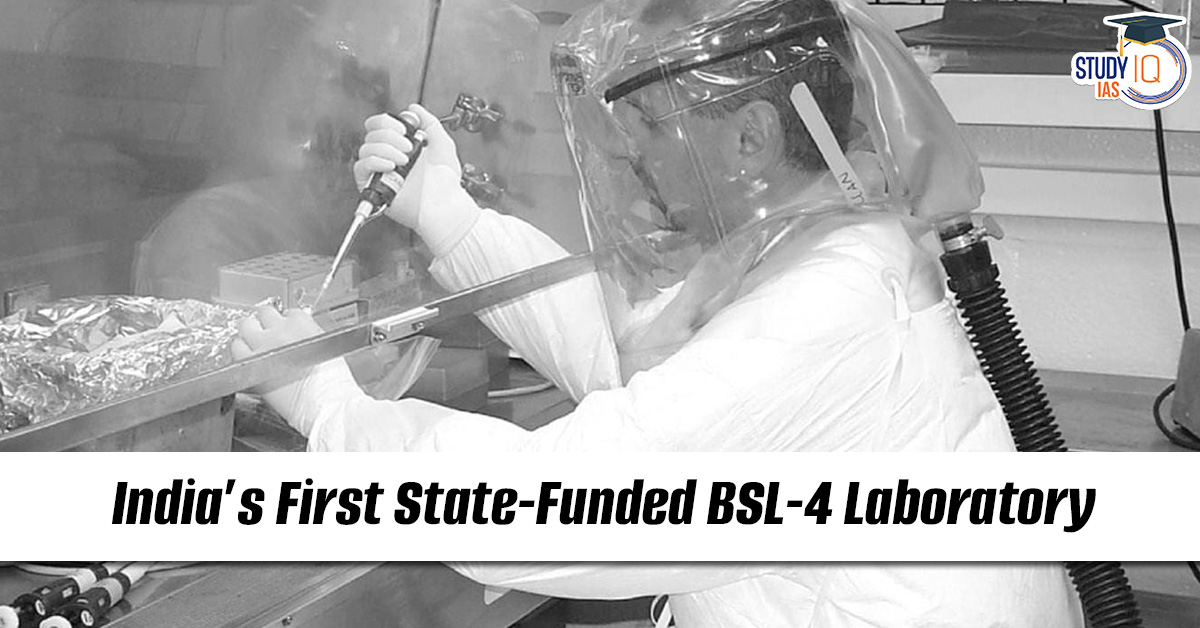
India has taken a major step toward strengthening biosecurity with the foundation stone laying of its first state-funded Bio-Safety Level-4 (BSL-4) biocontainment laboratory in Gandhinagar, Gujarat.
About India’s State-Funded BSL-4 Facility
- It will be the second civilian BSL-4 facility in India and the first fully funded and controlled by a state government.
- Implemented under the Gujarat State Biotechnology Mission (GSBTM)
- To function under the Gujarat Biotechnology Research Centre (GBRC), which previously played a key role in decoding India’s early SARS-CoV-2 genome
- The facility is being developed in compliance with international biosafety norms prescribed by the Centers for Disease Control and Prevention (CDC), National Institutes of Health (NIH), Department of Biotechnology (DBT), and Indian Council of Medical Research (ICMR).
- The laboratory complex will include:
- BSL-4, BSL-3, and BSL-2 laboratories for human pathogens
- ABSL-4 and ABSL-3 laboratories for animal and zoonotic disease research
- Advanced utilities, waste decontamination systems, and biosecurity infrastructure
Need for a State-Level BSL-4 Laboratory
- Enhances national preparedness against pandemics and biosecurity threats.
- Enables real-time response to emerging and re-emerging infectious diseases
- Strengthens India’s capacity to study zoonotic diseases, where animal-to-human transmission is critical.
- Reduces dependence on limited central facilities, easing research bottlenecks.
- Supports indigenous development of vaccines, diagnostics, and therapeutics.
Global & National Context of High-Containment Labs
- India:
- One civilian BSL-4 lab currently operational at National Institute of Virology (Pune)
- A defence BSL-4 facility established by Defence Research and Development Organisation (DRDO) in Gwalior
- Limited ABSL-4 capability, with ICAR-NIHSAD slated for upgradation
- India has also expanded its broader biosafety ecosystem through:
- Virus Research and Diagnostic Laboratory (VRDL) network under the Ministry of Health
- BSL-2 and BSL-3 labs across ICMR, DBT, ICAR, CSIR, and DST-supported institutions
- Globally: Around 69 BSL-4 laboratories are operational or under development worldwide, concentrated in advanced economies due to high costs and safety requirements.
About Biosafety Laboratories
| Biosafety Level (BSL) | Containment Level | Typical Pathogens Handled | Primary Uses & Applications |
| BSL-1 | Basic containment; minimal risk to humans and environment | Non-pathogenic or well-characterised microbes (e.g., E. coli K-12) | Teaching laboratories, basic microbiology research, routine training, and educational demonstrations |
| BSL-2 | Moderate containment; agents pose moderate health risk | Common infectious agents causing mild to moderate disease (e.g., influenza virus, hepatitis A, Salmonella) | Clinical diagnostics, routine microbiology research, vaccine research (non-high risk), and handling patient samples |
| BSL-3 | High containment; serious or potentially lethal pathogens, usually airborne | Tuberculosis (Mycobacterium tuberculosis), SARS-CoV-2, avian influenza, plague | Research on airborne pathogens, advanced diagnostics, vaccine and drug development, outbreak investigation |
| BSL-4 | Maximum containment; extremely dangerous and exotic pathogens with no known treatment | Ebola, Marburg, Nipah, Lassa fever, Crimean-Congo Hemorrhagic Fever | Research on deadly viruses, development of vaccines and therapeutics, high-risk pathogen surveillance, national biosecurity and biodefence |
 Navigating Uncharted Waters: What Next f...
 Astronaut Reentry Explained: How Spacecr...
 Missile Interceptors Explained: Role in ...











 WhatsApp





