
Table of Contents
Context
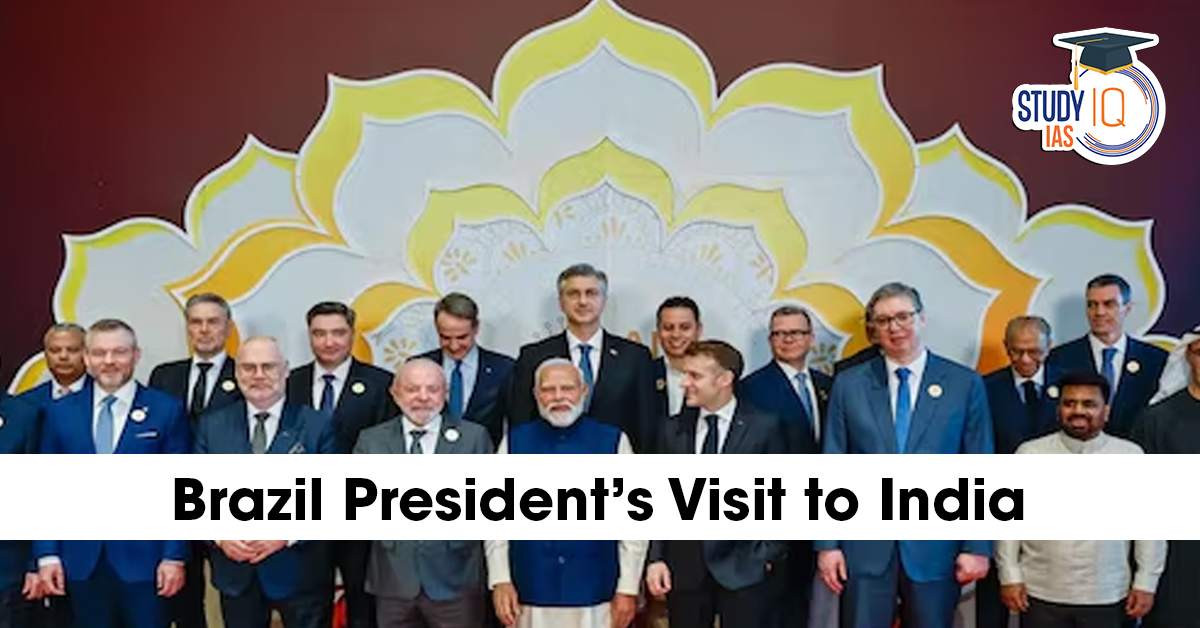
Brazilian President Luiz Inácio Lula da Silva’s February 2026 State visit to India marked a significant deepening of the India–Brazil Strategic Partnership.
More About the Visit
The 2026 visit comes amid:
- Heightened U.S. tariff tensions affecting both countries.
- Growing calls for reform of the United Nations Security Council.
- Expanded coordination within BRICS and G20.
- India assumes BRICS Chairship in 2026
- Intensifying geopolitical competition between major powers.
Key Outcomes of Lula’s 2026 Visit
- Exchange of Ten Agreements:Ten agreements were signed covering critical minerals, digital cooperation, health, MSMEs, entrepreneurship, traditional knowledge and media. These agreements institutionalise cooperation in high-growth and strategic sectors rather than focusing only on commodity trade.
- Joint Declaration on Digital Partnership for the Future: For structured cooperation in Artificial Intelligence, Digital Public Infrastructure (DPI), data governance and emerging technologies
- MoU on Rare Earths and Critical Minerals: To cooperate in exploration, mining, processing and recycling of rare earth and critical minerals.
- MoU in Mining for the Steel Supply Chain: strengthening cooperation in iron ore, steel production and sustainable mining practices
- MoU on Electronic Certificates of Origin (e-CoO): It enables mutual recognition of digital certificates of origin for traded goods. I
- Trade Target: $20 Billion in Five Years: Both leaders committed to raising bilateral trade beyond $20 billion. Currently, trade is diversified but still heavily commodity-driven (oil, agricultural goods, sugar, meat, and iron ore). The new target signals intent to:
- Expand value-added exports.
- Increase industrial and technology trade.
- Improve market access and regulatory alignment.
- Digital Public Infrastructure (DPI) Cooperation: India and Brazil agreed to establish a Centre of Excellence for Digital Public Infrastructure in Brazil.
- This cooperation is also strategically important as digital sovereignty becomes a core geopolitical issue.
- Critical Minerals & Rare Earths Partnership: Both India and Brazil possess reserves of lithium, niobium, rare earth elements and other strategic minerals essential for EV batteries and semiconductors. By collaborating, the two countries aim to:
- Reduce dependence on concentrated global suppliers.
- Build resilient supply chains.
- Support energy transition ambitions.
- Defence and Strategic Synergy: Defence cooperation was described as steadily expanding. This includes military training exchange, Defence industry collaboration and maritime cooperation in the Indian and South Atlantic Oceans.
Importance of India–Brazil Relations for the Global South
- Coordinated economic diplomacy: President Lula advocated that countries facing U.S. tariffs should negotiate collectively rather than individually. Collective bargaining yields better outcomes.cFor India and Brazil, both affected by U.S. tariff measures, this suggests:
- Strengthening negotiating blocs within BRICS and G20.
- Enhancing South-South trade resilience.
- Reducing vulnerability to unilateral economic pressure.
- Cross-Continental South-South Axis: India (Asia) and Brazil (Latin America) represent two major democratic developing economies. Their coordination bridges continents and enhances cross-regional solidarity.
- Leadership in Multilateral Reform:Both countries reiterated the need for urgent reform of the UN Security Council and supported permanent membership expansion, including India and Brazil.
- g. This shared advocacy under the G4 framework strengthens the reform movement and challenges outdated global governance structures.
- Development Model Exchange: Brazil has drawn lessons from India’s macroeconomic management and forex reserve accumulation strategies. Conversely, India benefits from Brazil’s expertise in Agro-industrial efficiency and Biofuel innovation This exchange reflects pragmatic knowledge-sharing within the Global South.
- Multipolar World Vision: Both leaders emphasised an inclusive multipolar order. This avoids Cold War-style bloc politics and strengthens rule-based cooperation. Their joint messaging reinforces strategic autonomy in global diplomacy.
|
Read More Notes |
|
| Environment Notes | Art and Culture Notes |
| Science and Tech | History Notes |
| Geography Notes | Indian Polity Notes |
| General Knowledge | International Relation |
|
Explore StudyIQ Courses |
|
 Freedom of Speech and Parliamentary Priv...
 Proteins as Quantum Sensors: New Advance...
 Illegal Use of Satellite Phones: Securit...










 WhatsApp





