
Table of Contents
Context
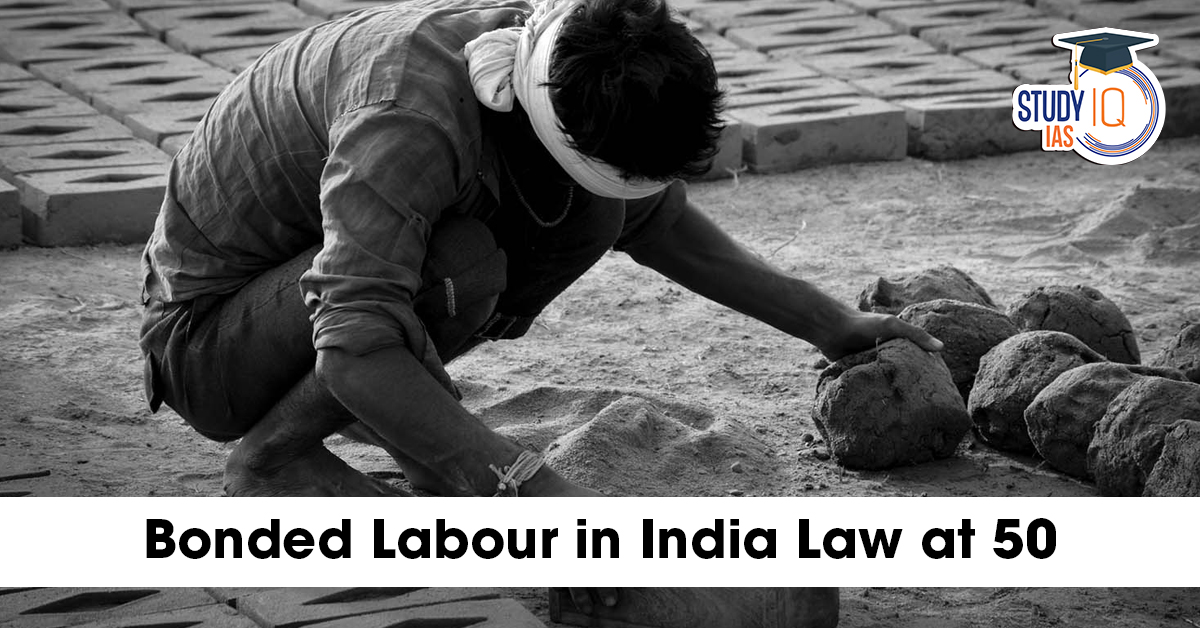
The Bonded Labour System (Abolition) Act, 1976 completes 50 years on February 9, 2026, yet bonded labour continues in many parts of India, reflecting gaps between law and practice.
What is Bonded Labour?
- Debt-led exploitation: A person is forced to work to repay a loan, with wages manipulated so the debt never ends.
- Loss of freedom: Workers cannot leave employment, change jobs, or negotiate wages.
Legal Framework
Bonded Labour System (Abolition) Act, 1976
- Abolition of bonded labour: Declares all forms of bonded labour illegal, with retrospective effect from 1975.
- Protection of vulnerable groups: Aimed mainly at Scheduled Castes, Scheduled Tribes, migrants, and the poor.
- State responsibility: District Collectors are tasked with identification, rescue, and rehabilitation.
Scale of the Problem
- India’s burden: Global Slavery Index 2023 estimates 11 million people in India living in modern slavery.
- Rescues since 1978: Nearly 2.96 lakh bonded labourers rescued nationwide.
- Tamil Nadu trend: Official rescues declined from 523 (2019–20) to 120 (2024–25), though activists say underreporting is high.
Changing Nature of Bonded Labour
- Sectoral shift: Earlier common in agriculture and brick kilns; now seen in textiles, construction, hotels, factories, and resorts.
- New methods: Workers trapped through advance payments, labour contractors, and migration rather than hereditary bondage.
- Inter-state migration: Migrant workers face isolation, language barriers, and weak local support systems.
Human Impact
Adult Workers
- Harsh living conditions: Long working hours, poor food, denial of medical care, and social isolation.
- Family exploitation: Women and children often work without wages to “adjust” family debt.
Children
- Trafficking disguised as help: Children lured on the promise of medical aid or income for families.
- Education loss: Long breaks from schooling lead to poor learning outcomes and long-term poverty.
Rehabilitation and Compensation
- Immediate relief: ₹30,000 initial assistance and a release certificate.
- Final compensation: ₹1–3 lakh after court conviction.
- Ground reality: Delays in trials mean victims wait years, increasing risk of falling back into bondage.
Implementation Gaps
- Reluctance to register cases: Authorities often use general labour laws instead of bonded labour provisions, diluting seriousness.
- Slow justice: Even with Tamil Nadu’s 2019 SOP, charge sheets still take around a year.
- Poor coordination: Weak information-sharing between police and labour departments delays compensation.
- No central database: Lack of a state-level tracking system causes beneficiaries to be missed.
| Parliamentary Standing Committee recommendations (2024–25) |
| ● Convictions are crucial: Without convictions, full rehabilitation benefits cannot be released.
● Need for fast-track courts: Recommended for districts with high incidence to reduce delays. ● Stronger monitoring: Called for better enforcement of the rehabilitation scheme. |
Way Forward
- Early identification: Proactive inspections in high-risk sectors and migrant transit points like railway stations.
- Faster trials: Dedicated courts to reduce long-pending cases.
- Comprehensive rehabilitation: Timely compensation, housing, skill training, and education support.
- Inter-state coordination: Source and destination States must jointly protect migrant workers.
- Data-driven governance: Create a real-time database tracking rescues, cases, and payments.
|
Read More Notes |
|
| Environment Notes | Art and Culture Notes |
| Science and Tech | History Notes |
| Geography Notes | Indian Polity Notes |
| General Knowledge | International Relation |
|
Explore StudyIQ Courses |
|
 Tropical Cyclone Narelle Red Sky Western...
 Wildlife Crime Control Bureau (WCCB): Ro...
 Hope Island in News: Significance, Locat...













 WhatsApp





