
Table of Contents
Context
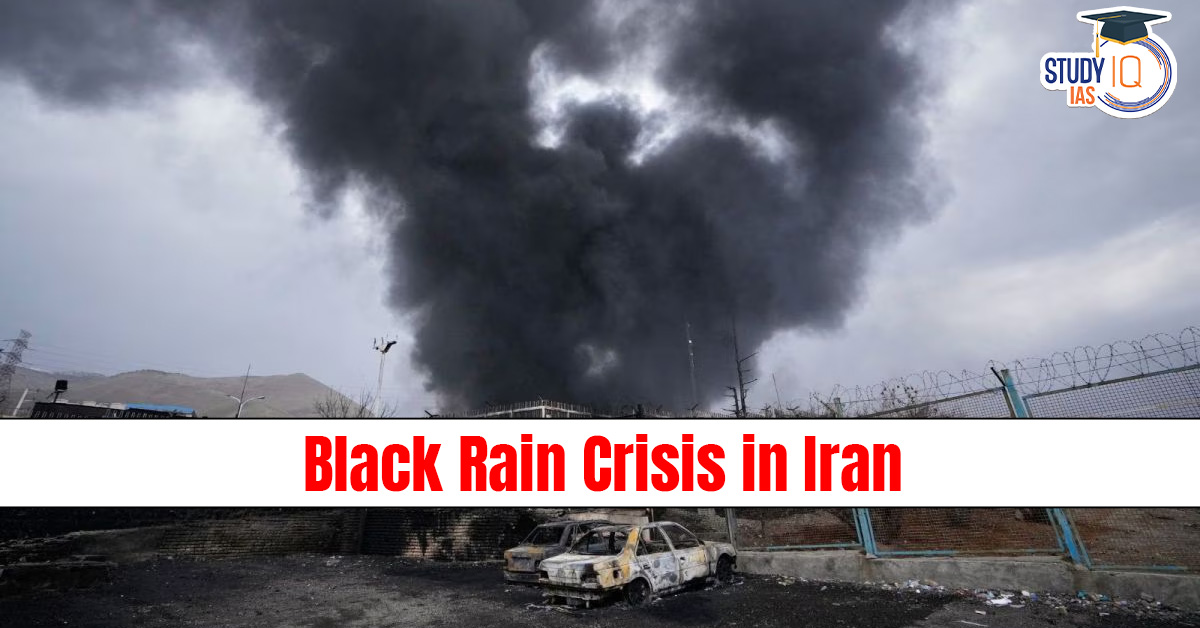
Following massive fires at major fuel depots and oil refineries triggered by recent conflicts, several regions in Iran have witnessed “Black Rain”.
About Black Rain
- Black rain is an extreme form of acid rain or polluted precipitation. It occurs when large-scale combustion (like oil refinery fires) releases massive quantities of particulate matter (PM), specifically soot (Black Carbon) and unburned hydrocarbons, into the atmosphere.
- Mechanism: These particles act as “cloud condensation nuclei.” When water vapor condenses around these soot particles and falls as rain, the precipitation turns black or dark grey.
- Chemical Composition: It often contains high concentrations of sulfur dioxide and nitrogen oxides , which react with water to form sulfuric and nitric acids, making the rain highly acidic.
- Causes of Black Rain
- Oil & Refinery Fires: Intense burning of petroleum releases vast amounts of unburned hydrocarbons and soot that mix with rain. Example:2026 Tehran Fires and the 1991 Kuwait Oil Fires.
- Nuclear Explosions: Mushroom clouds suck up debris and ash, which condense with moisture to create radioactive, tar-like rain. Example:Hiroshima and Nagasaki (1945), where survivors were coated in toxic “Kuroi Ame.”
- Volcanic Eruptions: Huge volumes of fine tephra (ash) and sulfur are ejected into the atmosphere and “washed out” by heavy storms. Example:Mount Pinatubo (1991), where Typhoon Yunya turned volcanic ash into a rain of black mud.
- Massive Wildfires: Pyrocumulonimbus clouds formed by intense heat carry charred organic matter that falls back as dark, ash-laden water. Example:Australia’s “Black Summer” (2019–2020), which contaminated local water catchments with soot.
- Severe Industrial Smog: High concentrations of coal-based soot and SO2 in stagnant air can trigger dark, acidic precipitation during the first rainfall. Example: Historical “London Fog” incidents and industrial-era “Black Rains” in 19th-century Scotland.
- Impact of Black Rain
- Respiratory Crisis: The soot is rich in 5, which can penetrate deep into the lungs and enter the bloodstream, causing acute respiratory distress, asthma, and cardiovascular issues.
- Water & Soil Contamination: As the black rain hits the ground, it leaches heavy metals into the soil and contaminates “Qanats” (traditional Iranian underground water channels) and surface reservoirs.
- Agricultural Damage: The acidity of the rain damages crop cuticles and alters soil pH, threatening food security in affected provinces.
- Corrosion: The acidic nature of the rain causes rapid weathering of historical monuments and urban infrastructure.
|
Read More Notes |
|
| Environment Notes | Art and Culture Notes |
| Science and Tech | History Notes |
| Geography Notes | Indian Polity Notes |
| General Knowledge | International Relation |
|
Explore StudyIQ Courses |
|
 IEA Agrees to Release 400 Million Barrel...
 Anna Mani: Pioneer of Indian Meteorology...
 Lakkundi Treasure: Rare Gold Coins Disco...











 WhatsApp





