
Table of Contents
Context
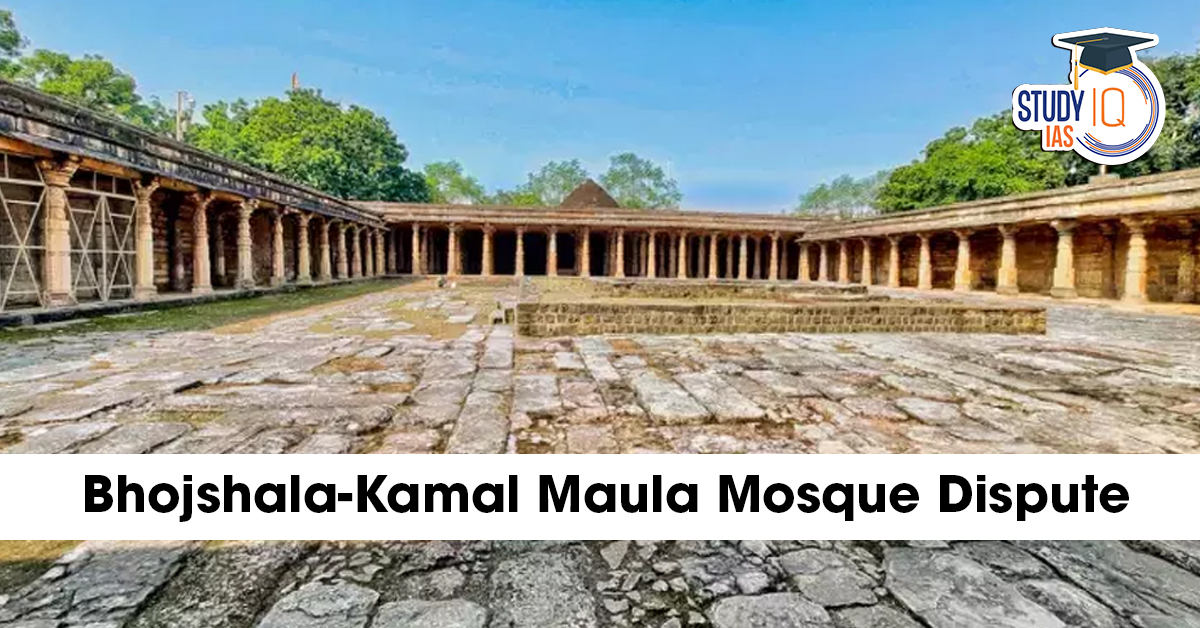
The Madhya Pradesh High Court has announced a site visit to the Bhojshala complex in Dhar following the 2024 ASI survey report, which concluded that the existing mosque was constructed using the remains of a pre-existing temple structure.
About Bhojshala
- Founder: The Bhojshala was originally constructed by Raja Bhoj (reigned c. 1010–1055 AD), the most famous ruler of the Paramara Dynasty.
- Purpose: It was established as a prestigious Sanskrit college (shala) and a center for learning.
- Dedication: The site is dedicated to Goddess Vagdevi (Saraswati). The iconic statue of Vagdevi, originally housed here, is currently in the British Museum, London.
- Architecture: Originally built in the Maru-Gurjara or Nagara style of temple architecture, characterized by intricate carvings on basalt stone.
About Kamal Maula Mosque
- Historical accounts suggest the structure was converted into a mosque during the Malwa Sultanate period (roughly 14th–15th centuries) under rulers like Alauddin Khalji and later Dilawar Khan Ghori.
- It is named after Sheikh Kamal Maula, a Sufi saint who lived in Dhar for several decades.
|
Paramara Dynasty |
| ● Capital: Initially Ujjain, later shifted to Dhar.
● Raja Bhoj: He was a polymath and authored works like Saraswati-Kanthabharana (on grammar) and Samarangana-Sutradhara (on architecture). ● Territory: Centered around the Malwa region of present-day Madhya Pradesh and parts of Rajasthan/Gujarat. |
|
Read More Notes |
|
| Environment Notes | Art and Culture Notes |
| Science and Tech | History Notes |
| Geography Notes | Indian Polity Notes |
| General Knowledge | International Relation |
|
Explore StudyIQ Courses |
|
 Bharat Audyogik Vikas Yojana (BHAVYA Sch...
 NavIC Satellite Clock Failures: Causes, ...
 Rare Earth Elements (REE) Sites in India...










 WhatsApp





