Context
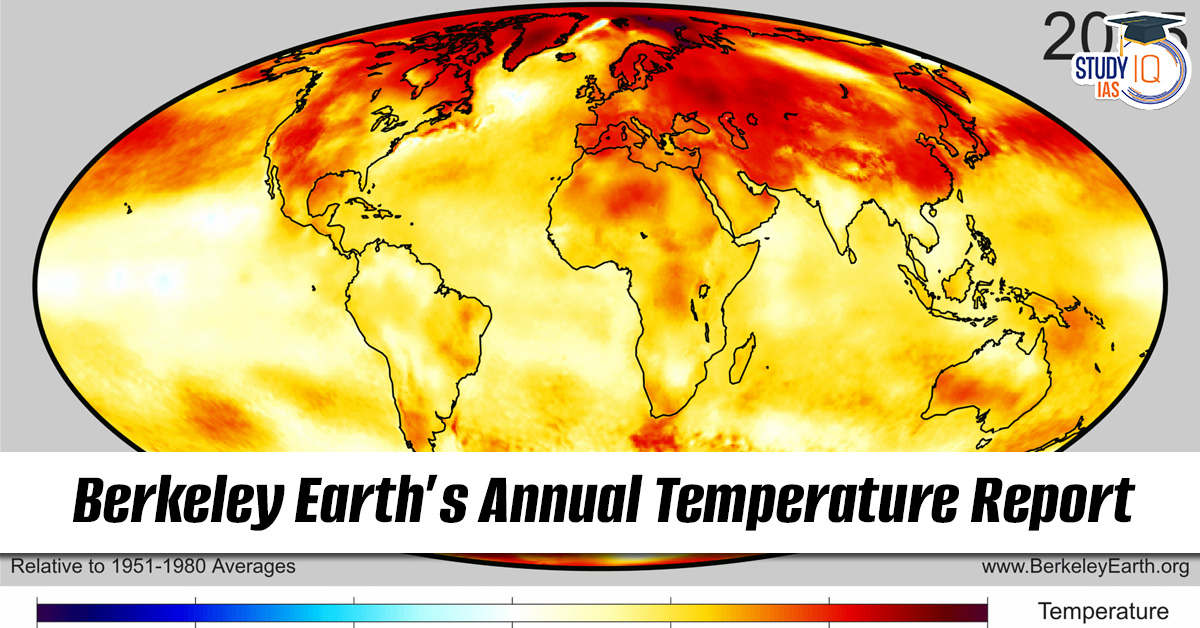
The 2025 Annual Temperature Report released by Berkeley Earth presents a stark assessment of the global climate system.
Key Highlights from the Berkeley Earth Report 2025
- Warmest La Niña year on record: Despite La Niña conditions in the Pacific, global average temperatures in 2025 exceeded all previous La Niña years, highlighting the dominance of anthropogenic warming.
- 770 million people were exposed to extreme heat: even during what is conventionally considered a “cooling phase” of the climate cycle.
- Natural variability overwhelmed by human influence: The report underscores that greenhouse gas accumulation has now raised baseline temperatures so high that ENSO-related cooling can no longer offset warming trends.
- Extreme heat as a global norm: Heatwaves were observed across multiple continents, indicating that extreme heat is becoming a persistent global condition, not confined to El Niño years.
- Disproportionate impacts on the Global South: Regions with high population density, limited adaptive capacity, and dependence on outdoor labour bore the brunt of heat stress, reinforcing climate inequality concerns.
- Rising risks to food, health, and labour productivity: Sustained high temperatures increased risks of crop stress, water scarcity, heat-related illnesses, and economic losses, particularly in tropical and subtropical regions.
- Implications for climate modelling: The report suggests that assumptions about La Niña years being relatively cooler may no longer hold, requiring updates to climate risk assessments and adaptation planning.
- Clear mitigation warning: Berkeley Earth cautions that reliance on natural climate oscillations for temporary relief is no longer viable; only deep and sustained emission reductions can prevent further escalation of heat extremes.
| La Niña |
-
- It refers to the periodic cooling of ocean surface temperatures in the central and east-central equatorial Pacific, coupled with changes in the tropical atmospheric circulation, such as winds, pressure and rainfall.
- In La Niña, trade winds strengthen, pushing more warm water toward the western Pacific, making the eastern Pacific cooler than usual.
- Together, La-Nina and El Niño are the cold and warm phases of the ENSO or El Niño Southern Oscillation.
- Impact of La Niña:
-
- Rainfall associated with the summer monsoon in Southeast and South Asia tends to be greater than normal, especially in northwest India and Bangladesh.
- Strong La Niña events are associated with catastrophic floods in northern Australia.
- Rainier-than-normal conditions are over southeastern Africa and northern Brazil.
- Decreased cloud production and rainfall in central and eastern Pacific.
- Drier-than-normal conditions along the west coast of tropical South America, the Gulf Coast of the United States, and the pampas region of southern South America.
- Upwelling brings cold, nutrient-rich waters to the surface, having positive effects on the fishing industry in western South America.
|
El Niño v/s La Niña
|
| Basis |
El Niño |
La Niña |
| Sea surface temperature |
Periodic warming of sea-surface temperatures across the east-central equatorial Pacific. |
Periodic cooling of sea-surface temperatures across the east-central equatorial Pacific. |
| Formation |
Trade winds weaken. Warm water is pushed back east, toward the west coast of the Americas, resulting in a weaker Walker cell. |
Trade winds strengthen, pushing more warm water toward Asia, resulting in a stronger Walker cell. |
| Period of occurrence |
Typically, they occur every 3–5 years and last 9–12 months. |
Typically, they occur every 3–5 years and last 1–3 years. |
| Impacts |
- Droughts in eastern Australia
- Flooding in western South America
- Weak upwelling over the west coast of South America.
|
- Excessive rainfall in the eastern Australia
- Drought conditions, in South America
- Strong upwelling over the west coast of South America.
|
| Impact on Indian Monsoon |
The winds don’t carry the moisture towards Indian landmass during El Niño, causing deficiency in rainfall. |
High temperatures over the Indian Ocean, off the Somalian coast, and a comparatively better monsoon rains in India. |
|
Sharing is caring!

 Navigating Uncharted Waters: What Next f...
 Astronaut Reentry Explained: How Spacecr...
 Missile Interceptors Explained: Role in ...











 WhatsApp





