
Table of Contents
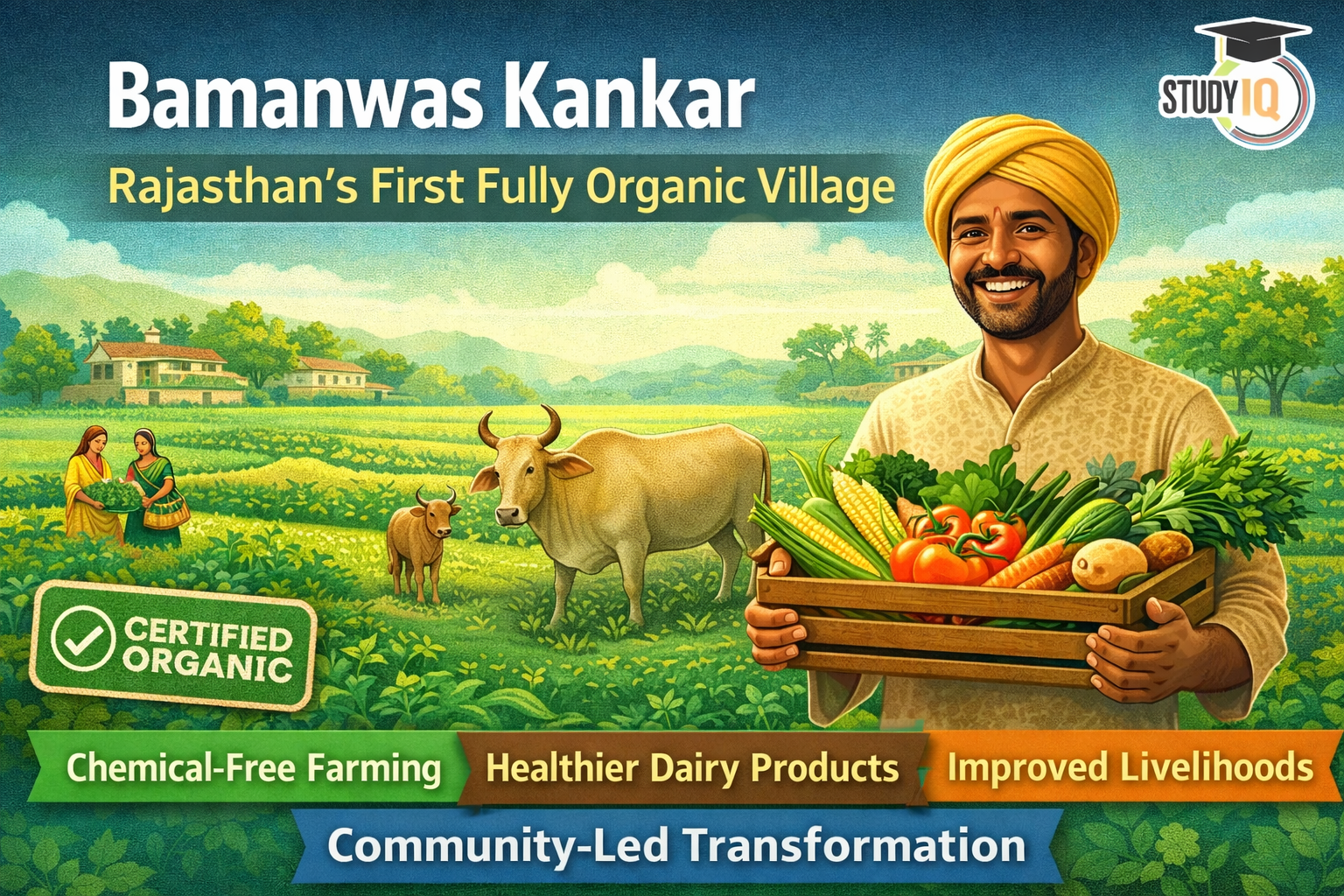
Rajasthan has created history in sustainable agriculture with Bamanwas Kankar village of Kotputli-Behror district becoming the first fully organic certified village in the State. To commemorate this achievement, the Bamanwas Kankar Panchayat organised a ceremonial pledge on 2nd January 2026, marking the village’s collective commitment to organic and chemical-free farming.
This milestone reflects a powerful example of community-led environmental transformation and positions Bamanwas Kankar as a model for sustainable rural development in India.
About Bamanwas Kankar’s Transition to Organic Village Status
The transformation of Bamanwas Kankar was not imposed from outside but driven by grassroots participation and collective decision-making. The entire village adopted a unified approach toward sustainable agriculture.
Key features of its transition:
-
All agricultural activities are completely free from chemical pesticides and synthetic fertilisers.
-
Farmers have shifted to:
-
Natural farming
-
Organic manure
-
Bio-inputs and traditional methods
-
-
Animal husbandry practices follow:
-
Ecological standards
-
Health-conscious approaches
-
Livestock welfare norms
-
-
The initiative was supported by the NGO:
Cofarmin Federation of Organic Societies and Producer Companies (COFED).
Role of COFED:
-
Farmer mobilisation and awareness
-
Data documentation
-
Support in organic certification
-
Technical guidance and coordination
This collective effort ensured that the entire village ecosystem—soil, crops, water, animals, and people—aligned with organic principles.
Benefits of Adopting Organic Farming
1. Soil Health Restoration
-
Reverses soil degradation
-
Improves soil fertility and structure
-
Enhances organic carbon content
2. Reduced Input Costs
-
Eliminates dependence on:
-
Chemical fertilisers
-
Pesticides
-
-
Cuts rising agricultural expenses
3. Groundwater Conservation
-
Sustainable water use
-
Reduced contamination of groundwater
-
Encourages long-term water security
4. Health and Safety Benefits
-
Minimises health risks for:
-
Farmers
-
Consumers
-
-
Avoids exposure to toxic chemicals
5. Enhanced Biodiversity
-
Increase in:
-
Beneficial insects
-
Soil microorganisms
-
On-farm biodiversity
-
6. Better Market Opportunities
-
Access to premium organic markets
-
Higher prices for organic produce
-
Improved farm incomes
Benefits for Animal Husbandry
Organic practices extended beyond crops to livestock management.
Key Gains:
-
Improved animal health
-
Reduced disease incidence
-
Chemical-free dairy products
-
Safer milk and animal products
-
Increased consumer trust
-
Higher market value of produce
-
Better price realisation
-
Stronger livelihood security for farmers
Significance of Bamanwas Kankar’s Achievement
-
India’s Sustainable Agriculture Model
-
Demonstrates that organic farming can be adopted at a village-wide scale.
-
-
Community-Led Governance
-
Shows the power of collective action and Panchayat leadership in environmental sustainability.
-
-
Replicable Rural Model
-
Can be replicated across:
-
Other villages in Rajasthan
-
Drought-prone and semi-arid regions
-
Organic farming clusters
-
-
-
Supports National Goals
-
Aligns with:
-
Sustainable Development Goals (SDGs)
-
Climate-resilient agriculture
-
Natural farming missions
-
-
-
Case Study for Policy & UPSC
-
Excellent example for:
-
GS Paper III (Agriculture & Environment)
-
Rural development models
-
Sustainable livelihood practices
-
-
Bamanwas Kankar as a Symbol of “Green Transformation”
Bamanwas Kankar proves that:
“Sustainability is not policy-driven alone; it is people-driven.”
It stands as:
-
A living laboratory of organic agriculture
-
A symbol of environment-friendly rural governance
-
A beacon for future organic villages in India
Conclusion
The transformation of Bamanwas Kankar into Rajasthan’s first fully organic village is a landmark in India’s sustainable agriculture journey. Through community participation, ecological responsibility, and institutional support from COFED, the village has shown that organic farming is not just environmentally beneficial but also economically viable and socially empowering.
It offers a replicable, scalable, and inspiring model for rural India’s transition towards a greener and healthier future.
 Navigating Uncharted Waters: What Next f...
 Astronaut Reentry Explained: How Spacecr...
 Missile Interceptors Explained: Role in ...











 WhatsApp





