
Table of Contents
Context
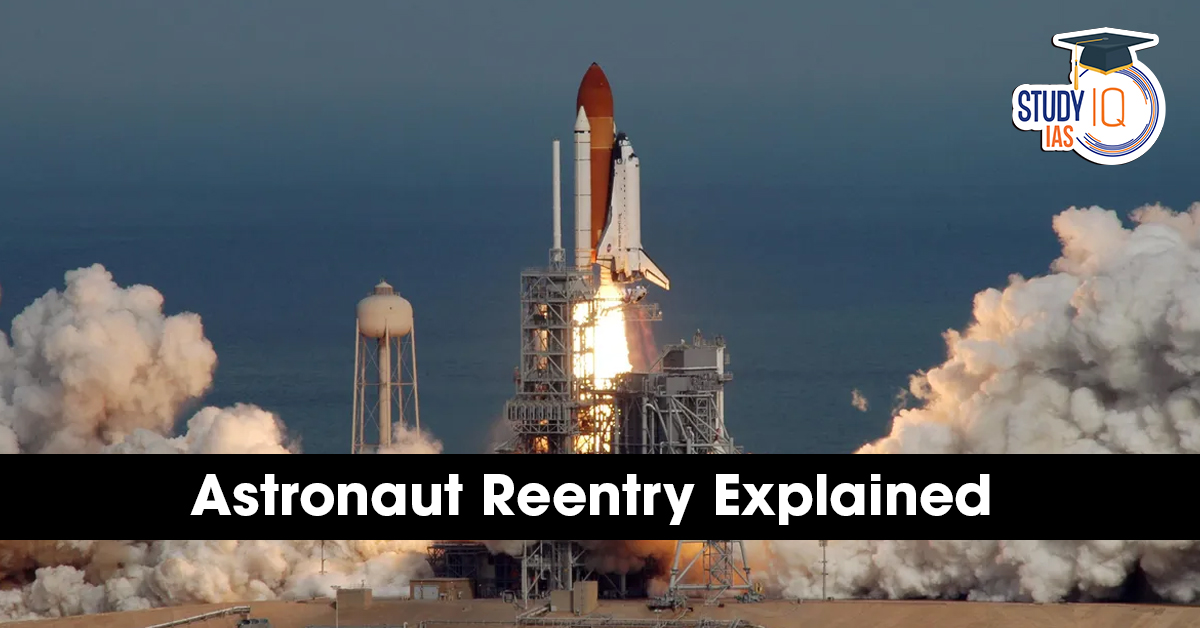
- Re-entry is the most technically demanding phase as a spacecraft orbiting Earth travels at nearly 28,000 km/h. To return safely, this enormous kinetic energy must be reduced in a controlled manner without structural failure, overheating, or loss of control. Each stage of re-entry is carefully engineered to manage physics, heat, and human safety.
|
Issues in Atmospheric Re-entry |
| Re-entry is scientifically and technologically complex because a spacecraft must safely shed enormous orbital energy within minutes. The major issues involved are:
● Extreme Thermal Heating: A spacecraft in Low Earth Orbit travels at ~7.8 km/s. During re-entry, this kinetic energy converts into intense heat due to air compression at hypersonic speeds. Temperatures can exceed 1,500–3,000°C. Without a robust thermal protection system (TPS), the capsule would melt or structurally fail. ● Narrow Re-entry Corridor: The spacecraft must enter the atmosphere within a precise angular window. ○ Too shallow (overshoot): The capsule may skip off the atmosphere and return to space. ○ Too steep (undershoot): Excessive heat and deceleration forces can destroy the vehicle or endanger crew. ● High Deceleration (G-forces): As atmospheric drag slows the spacecraft, astronauts experience intense deceleration forces (3–8 G). If not properly managed through trajectory design and seat orientation, these forces can cause physiological stress or injury. ● Communication Blackout: Extreme heating ionises surrounding air, forming a plasma sheath around the capsule. This plasma blocks radio signals, causing temporary communication blackout between crew and ground control. ● Guidance and Steering Limitations: A purely ballistic descent offers limited steering capability and high G-loads. Modern capsules operate as semi-ballistic bodies to generate lift and control descent, but this requires precise centre-of-gravity management and thruster control. ● Safe Landing Requirements: Even after atmospheric braking, the capsule’s speed remains too high for direct landing. A reliable parachute system must deploy correctly; failure at this stage can be catastrophic. |
How the Gaganyaan Crew Module Will Re-enter
India’s Gaganyaan mission uses a capsule-based architecture designed for controlled, semi-ballistic re-entry.
- De-orbit Burn by Service Module: The Service Module (SM) performs the retrograde burn to reduce orbital velocity and initiate descent.
- Module Separation: After de-orbiting, the Service Module separates and burns up during re-entry. Only the Crew Module (CM) survives atmospheric descent.
- Controlled Re-entry within Corridor: The Crew Module enters the atmosphere within the safe re-entry corridor, carefully avoiding overshoot and undershoot boundaries.
- Semi-Ballistic Flight Mode: The CM operates as a semi-ballistic body by offsetting its centre of gravity, generating lift. This allows controlled banking and trajectory correction to reach the designated landing zone.
- Thermal Protection System: An ablative heat shield protects the Crew Module from extreme heating by absorbing and carrying away thermal energy.
- In ablative systems, the outer material gradually burns and erodes during re-entry. This process absorbs heat and carries it away.
- Plasma Blackout Phase: During peak heating, a plasma sheath forms, causing temporary communication blackout until the capsule slows down.
- Three-Stage Parachute Deployment: Drogue Parachutes are Small parachutes are deployed first to stabilise and slow the capsule. Main parachutes reduce descent speed significantly. The capsule performs a controlled splashdown in the Bay of Bengal.
|
Read More Notes |
|
| Environment Notes | Art and Culture Notes |
| Science and Tech | History Notes |
| Geography Notes | Indian Polity Notes |
| General Knowledge | International Relation |
|
Explore StudyIQ Courses |
|
 Navigating Uncharted Waters: What Next f...
 Missile Interceptors Explained: Role in ...
 World Wildlife Day 2026: Theme, Signific...











 WhatsApp





