
Table of Contents
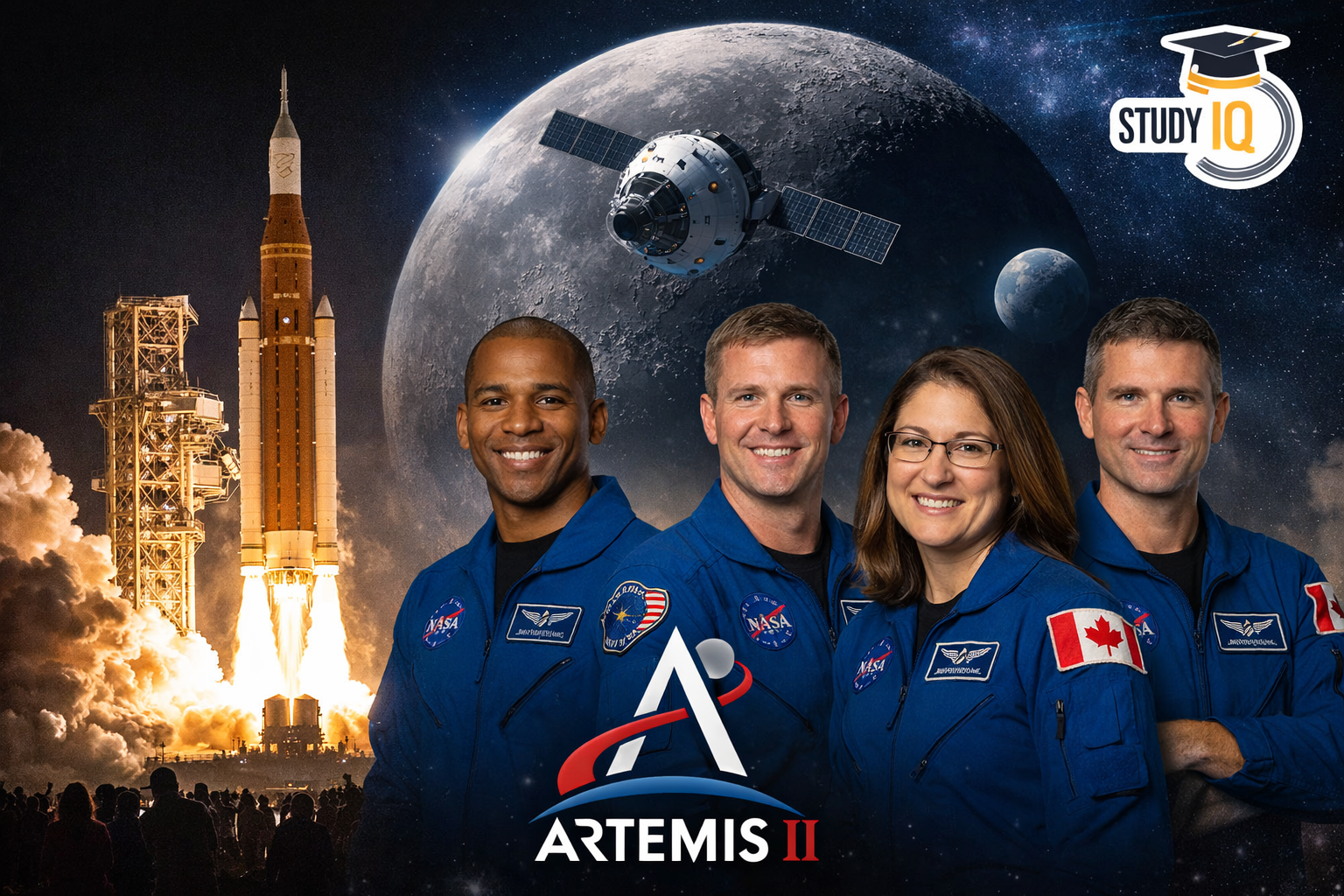
In a historic moment for global space exploration, NASA has successfully launched the Artemis II mission, sending four astronauts on a 10-day journey around the Moon. The launch took place from the Kennedy Space Center, marking humanity’s first crewed mission to deep space since 1972, the final phase of the Apollo program.
The mission represents a major milestone in the Artemis program, which aims to establish a sustainable human presence on the Moon and lay the groundwork for future missions to Mars.
Artemis II Launch 2026: Liftoff Marks Return to Deep Space
The powerful Space Launch System (SLS) rocket roared to life, generating nearly 8.8 million pounds of thrust from its twin solid rocket boosters and four RS-25 engines. As the rocket lifted off, umbilical connections detached, signaling the transition to fully autonomous flight.
Within minutes, the mission achieved key milestones:
- Booster separation, reducing weight and increasing efficiency
- Core stage cutoff and separation, marking the end of initial propulsion
- Transition to upper-stage operations carrying the crew toward orbit
The Orion spacecraft, carrying the astronauts, was successfully deployed into orbit, setting the stage for its journey toward the Moon.

Artemis II: Crew Embarks on Historic Journey
The Artemis II mission features a diverse crew of four astronauts:
- Reid Wiseman – Commander
- Victor Glover – Pilot
- Christina Koch – Mission Specialist
- Jeremy Hansen – Mission Specialist
This mission is notable for sending the first woman, first person of colour, and first non-American astronaut on a journey around the Moon, reflecting a broader shift toward inclusivity in space exploration.

Artemis II Mission Profile: 10-Day Lunar Flyby
Artemis II is designed as a crewed test flight, focusing on validating systems critical for future lunar landings rather than landing itself.
Key Phases of the Mission
- Launch and Earth orbit checks
- Outbound journey toward the Moon
- Lunar flyby, passing thousands of miles above the surface
- Return trajectory and re-entry into Earth’s atmosphere
The spacecraft will travel approximately 695,000 miles during the mission, reaching one of the farthest distances ever achieved by humans in space.
Artemis II: Free-Return Trajectory Ensures Safety
A defining feature of Artemis II is its free-return trajectory, a path that uses the Moon’s gravitational pull to loop the spacecraft back toward Earth.
This trajectory:
- Minimizes reliance on propulsion systems
- Provides a built-in safety mechanism
- Has historical precedent in missions like Apollo 13
The approach ensures that even in the event of system failure, the crew can safely return to Earth.
Key Systems and In-Orbit Developments
Following launch, the Orion spacecraft successfully deployed its solar array wings, spanning about 63 feet. These arrays provide continuous power for:
- Life-support systems
- Communication networks
- Navigation and onboard instruments
Mission updates confirm that the crew has already completed critical proximity operations tests, manually flying the spacecraft near its upper stage to validate navigation and handling capabilities.
Additionally, minor technical challenges, including a temporary communication link disruption and a toilet system issue, were quickly addressed by mission control, demonstrating the robustness of onboard systems and ground support.
Scientific and Strategic Significance
Artemis II is not merely symbolic; it is a critical step in advancing human spaceflight capabilities.
Key Objectives:
- Test life-support systems for deep-space missions
- Validate navigation and communication beyond Earth orbit
- Assess crew performance and safety protocols
The mission also carries secondary payloads, including CubeSats, which will conduct scientific experiments in deep space, expanding the mission’s research scope.
A Step Toward Future Exploration
The success of Artemis II paves the way for upcoming missions, particularly Artemis III, which aims to land humans on the Moon, including the first woman.
More broadly, the Artemis program signals a renewed global focus on space exploration, with implications for:
- Technological innovation
- International collaboration
- Long-term plans for Mars missions
 Utkal Divas 2026: Date, History, Signifi...
 Cicada COVID Variant (BA.3.2): Symptoms,...
 FATF Report on India’s Action on Virtu...













 WhatsApp





