
Table of Contents
Context
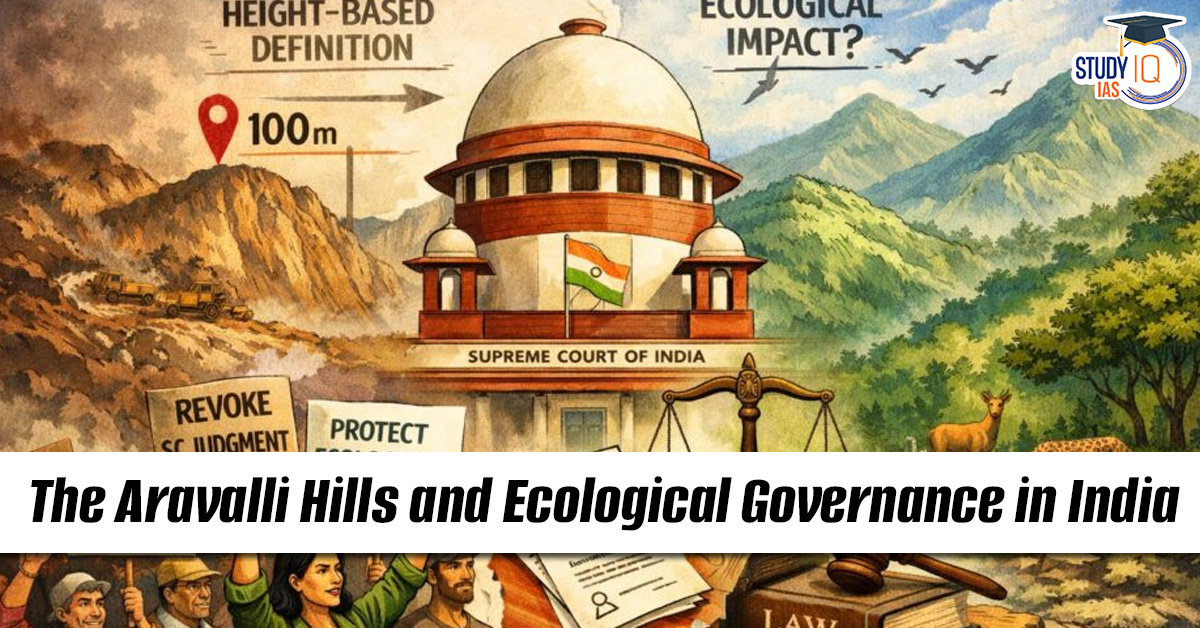
A fundamental issue in India’s environmental governance has come to light due to the current dispute surrounding the legal redefinition of the Aravalli Hills: can the law effectively safeguard ecological systems if it places a higher priority on strict legal neatness than ecological function? The Supreme Court approved a new unified definition of the Aravalli Hills in November 2025. This definition recognizes only formations that rise at least 100 meters above the local topography and groups them into spatially contiguous ranges. More than 90% of the Aravalli landscape, which is primarily made up of low ridges and hillocks, may lose legal protection despite its crucial ecological importance, despite the decision’s stated goal of regulatory clarity. Excluding these features from legal recognition risks rendering them “invisible” to environmental regulation despite their continued ecological activity.
Functional Ecology Versus Legal Formalism
Ecological research indicates that topographical features can impact hydrology, soil stability, and ecosystem connectivity without requiring arbitrary height limitations. Instead of functioning as a group of distinct peaks, the Aravallis are an integrated system. Therefore, rather than focusing only on elevation, legal definitions must take ecological function into account. If law is to safeguard what really matters for climate resilience, functional requirements like recharge capacity, slope integrity, vegetation continuity, and corridor connectivity are crucial. Without this change, significant areas of a functioning ecosystem could not be covered by legal protections, hastening environmental deterioration.
Climate Adaptation, Disaster Risk and Landscape Integration
Planning for disaster risk and climate adaptation are severely impacted by the legal definitions’ omission of functional landscapes. Accurate depictions of surface processes, including runoff, infiltration, and slope stability, are becoming more and more important in climate models and risk assessments. Low-elevation ridges frequently vanish from planning databases, groundwater recharge maps, and urban resilience measures when they are not included in legal frameworks. The Indo-Gangetic plains and the Delhi-NCR, which are predicted to see more severe heatwaves, dust storms, and unpredictable rains under climate change scenarios, are especially worried about this. The Aravallis have historically mitigated these hazards, and as climatic stress increases, their significance will only increase.
Water Security and Rural Livelihoods
An important aspect of the Aravalli conflict is water security. By absorbing monsoon rainwater and replenishing aquifers, the hills function as a broken rock sponge. According to Central Groundwater Board estimates, over-extraction, vegetation loss, and disruption of recharge zones have caused groundwater levels in some areas of Haryana and Rajasthan to drop by more than 60% in just 20 years. Of the 28 blocks in southern Haryana, 26 are considered over-exploited. Recharge rates in the Aravalli landscape are estimated to be two million litres per hectare annually under intact conditions. In areas where extraction exceeds replenishment by more than 300%, weakening legal protection for these recharge zones runs the risk of hastening groundwater depletion and jeopardizing industrial supply, domestic water access, and agriculture.
Urban Resilience and Air Quality in Delhi-NCR
For urban environmental resilience, the Aravallis are equally important. Over 46 million people live in Delhi-NCR, which frequently has dangerous air quality, with PM2.5 levels reaching extremely high levels in the winter. The Aravallis serve as a natural barrier to dust transmission from the Thar Desert and neighbouring plains, even if combustion sources account for the majority of pollution. According to studies, eliminating or breaking lower ridges can raise dust loads by four to six times, making pollution episodes worse. Rocky and green barriers play a crucial role in regulating surface temperatures as urban heat islands become more intense. Therefore, the Aravallis must be considered natural infrastructure in urban design and incorporated into master plans, frameworks for disaster management, and policies for climate adaptation.
Role of the Judiciary in Environmental Protection
Throughout history, the judiciary has been instrumental in environmental regulation, frequently utilizing the sustainable development doctrine and the precautionary principle. Judicial sensitivity to ecological complexity is demonstrated in this case by the Supreme Court’s determination to reexamine its own order suo motu and form an expert committee. The dispute does, however, also draw attention to the limitations of judicially created definitions in the absence of consistent scientific input. Legal protection must translate into ecological protection in practice, even while the government has made it clear that no new mining permits would be issued in core and ecologically vulnerable areas and that safeguards will apply to a large portion of the legally designated range.
Comparative International Perspectives
Functional landscape conservation is becoming more and more important in environmental governance worldwide. Rather than topographic prominence, ecological value is used to designate Natura 2000 locations in the European Union. Hydrological function is given precedence over elevation in US watershed-based management strategies. Similarly, regardless of altitude, Australia‘s landscape-scale conservation frameworks incorporate groundwater recharge zones, biodiversity corridors, and climate resilience. These examples show that rather than relying solely on physical measurements, legislative frameworks that take ecological processes into account are necessary for effective environmental protection.
Conclusion
A more comprehensive lesson for India’s environmental destiny can be learned from the Aravalli Hills issue. Policy models that isolate ecological function from legal neatness are untenable as climate threats increase. According to projections, if current trends continue, up to 22% of the Aravalli area may disappear by 2059, leaving about 2,630 square kilometres vulnerable to mining and related pressures even as climate stress increases. It is necessary to move toward function-based legal definitions, integrated climate planning, and ongoing judicial scrutiny in order to protect the Aravallis and comparable ecosystems. Then and only then can the law be a true weapon of ecological resilience instead of an unintentional erasing tool.
 Supreme Court Law Clerk Recruitment 2026...
 Constitutional Morality as the Anchor of...
 Insider Trading in the Age of Social Med...










 WhatsApp





