
Table of Contents
Alternate Wetting and Drying (AWD) is an innovative and scientifically proven irrigation practice in rice cultivation that significantly reduces water use and methane emissions without compromising crop yield. As water scarcity, climate change, and rising cultivation costs challenge Indian agriculture, AWD is emerging as a low-cost, high-impact climate-smart solution for sustainable paddy farming.
India, the world’s largest producer and exporter of rice, stands to gain enormously from adopting AWD at scale—economically, environmentally, and strategically.
What is Alternate Wetting and Drying (AWD)?
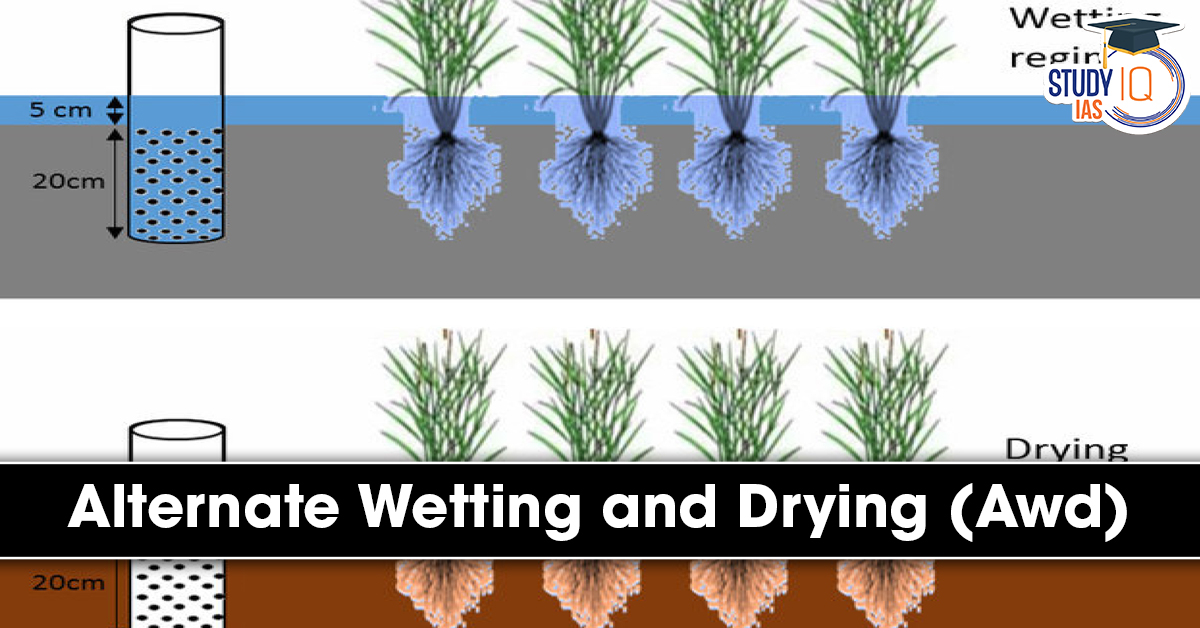
Alternate Wetting and Drying (AWD) is an irrigation technique in which rice fields are not kept continuously flooded. Instead, fields are allowed to dry intermittently before re-irrigation, based on soil moisture levels.
Unlike traditional flooded paddy cultivation, AWD introduces aerobic conditions periodically into the soil, disrupting methane-producing microbes while maintaining adequate moisture for rice growth.
AWD is endorsed by international institutions such as the International Rice Research Institute (IRRI) and is increasingly promoted under climate-smart agriculture programmes.
Traditional Paddy Cultivation vs AWD
| Parameter | Traditional Flooding | AWD |
|---|---|---|
| Water management | Continuous flooding (4–5 cm) | Intermittent drying and flooding |
| Soil condition | Anaerobic | Alternating aerobic–anaerobic |
| Methane emissions | High | 30–50% lower |
| Water use | Very high | 25–40% lower |
| Yield impact | Stable | No yield loss |
How Alternate Wetting and Drying Works
The AWD method follows a controlled irrigation cycle:
-
Initial flooding for the first 15–20 days after transplanting
-
Water is then allowed to recede naturally
-
Irrigation is applied only when the water table drops to 10–15 cm below soil surface
-
This cycle continues until the flowering stage
-
Fields are kept moist during grain filling to avoid stress
A perforated field water tube is often installed to visually monitor underground water levels.
Why AWD Reduces Methane Emissions
Flooded rice fields create oxygen-free soil conditions, ideal for methanogenic microbes that produce methane (CH₄). Methane is a potent greenhouse gas with 28 times the global warming potential of CO₂.
AWD introduces oxygen into the soil during drying phases, which:
-
Suppresses methanogenic activity
-
Promotes methane-oxidising bacteria
-
Reduces overall greenhouse gas emissions
Studies show AWD can reduce methane emissions by 30–50% per crop cycle.
Water Conservation Benefits of AWD
Water scarcity is becoming a critical challenge in rice-growing regions. AWD addresses this directly by:
-
Reducing irrigation frequency
-
Minimising percolation and seepage losses
-
Improving irrigation efficiency
On average, AWD saves 1.5–2 million litres of water per acre per season, making it highly suitable for water-stressed states.
Impact of AWD on Rice Yield
One of the biggest concerns among farmers is yield loss. Extensive field trials across India and Southeast Asia confirm that:
-
Grain yield remains unchanged
-
In some cases, root development and nutrient uptake improve
-
Lodging and pest incidence may reduce due to stronger root systems
Thus, AWD is yield-neutral but resource-efficient.
Economic Benefits for Farmers
Reduced Input Costs
-
Lower irrigation expenses
-
Reduced electricity or diesel consumption
-
Better nutrient efficiency
Carbon Credit Opportunities
Methane reductions achieved through AWD can be monetised via carbon markets.
-
Average methane reduction: ~2–3 tonnes CO₂ equivalent per hectare
-
Carbon credit price: $15–25 per tonne
-
Potential additional income: ₹3,000–4,000 per hectare per crop
This creates a new non-crop income stream for farmers.
AWD and Climate-Smart Agriculture
AWD fits squarely within the framework of Climate-Smart Agriculture (CSA):
-
Mitigation: Reduces greenhouse gas emissions
-
Adaptation: Conserves water and improves resilience
-
Productivity: Maintains yields
It directly supports India’s commitments under the Paris Agreement and Nationally Determined Contributions (NDCs).
Challenges in AWD Adoption
Despite its benefits, AWD faces some implementation barriers:
-
Lack of farmer awareness
-
Risk perception in rain-fed areas
-
Weed pressure if drying is mismanaged
-
Need for proper monitoring tools
These challenges can be addressed through extension services, digital monitoring, and farmer training.
Government and Institutional Support
AWD is increasingly promoted under:
-
National Mission for Sustainable Agriculture (NMSA)
-
Climate-smart village programmes
-
State-level water conservation initiatives
-
Public–private carbon farming projects
Supportive policies can accelerate adoption across major rice-growing belts.
Future Scope of AWD in India
With rising water stress and expanding carbon markets, AWD has the potential to:
-
Transform rice cultivation practices
-
Integrate farmers into climate finance systems
-
Reduce India’s agricultural emissions significantly
If adopted across even 25% of India’s rice area, AWD could save billions of cubic metres of water annually and cut millions of tonnes of CO₂-equivalent emissions.
Conclusion
Alternate Wetting and Drying is not merely an irrigation technique—it is a strategic agricultural intervention that aligns farmer welfare with climate action. By saving water, cutting methane emissions, and enabling carbon income, AWD offers a rare triple-win for farmers, the environment, and the economy.
In the era of climate uncertainty, AWD proves that smart farming, not expensive farming, is the future.
 Viksit Bharat Shiksha Adhishthan Bill 20...
 Cyclone Maila Intensifies Over Solomon S...
 List of Military Exercises of India 2026...













 WhatsApp





