
Table of Contents
Context
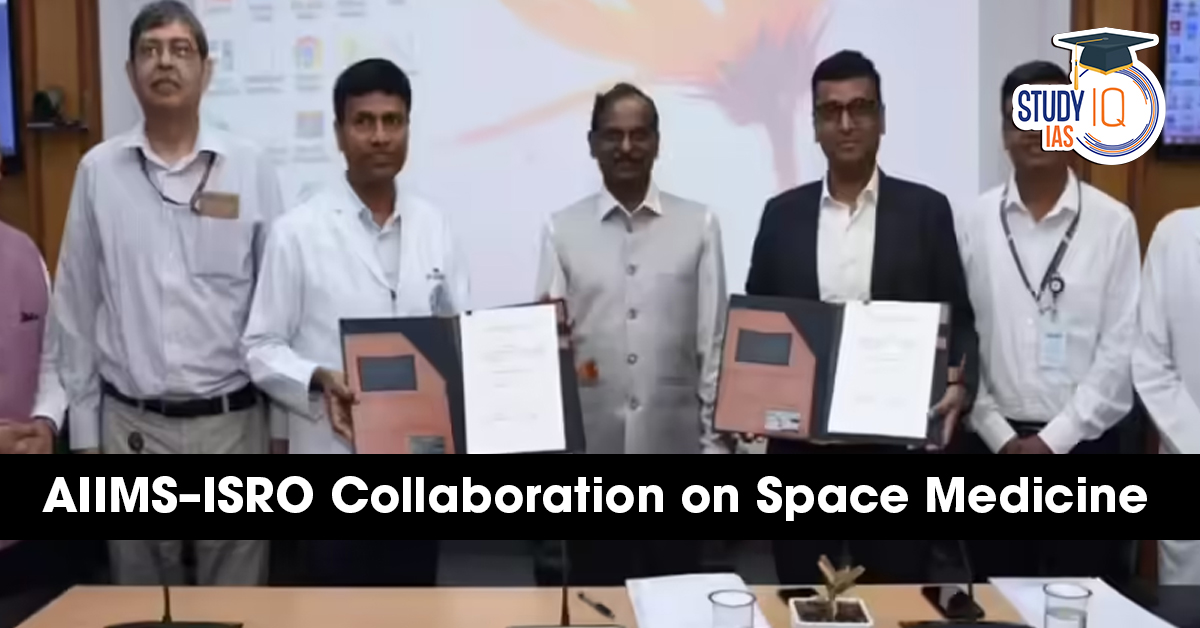
- India has taken a major step toward strengthening its space medicine capabilities with the signing of a Memorandum of Understanding (MoU) between All India Institute of Medical Sciences, New Delhi and the Indian Space Research Organisation.
Key Areas of AIIMS–ISRO Collaboration
- Cardiovascular and Autonomic Regulation: Spaceflight affects heart rate, blood pressure, and circulation due to the absence of gravity. Research will help develop medical protocols for astronauts during missions.
- Musculoskeletal Health: Microgravity leads to bone density loss and muscle weakening. Collaborative studies will focus on preventive therapies, exercise protocols, and medical monitoring.
- Microbiome and Immunology: Space conditions may alter the human microbiome and immune response. Understanding these changes is essential for maintaining astronaut health during long-duration missions.
- Genomics and Biomarkers: Scientists will study genetic markers and molecular changes that occur in astronauts’ bodies during space missions to improve medical monitoring.
- Behavioural and Psychological Health: Isolation, confinement, and stress in space missions can affect mental health. Research will examine psychological resilience and behavioural health strategies.
Significance of the Collaboration
- Strengthening India’s Human Spaceflight Programme: The collaboration will support the Gaganyaan mission and future crewed space missions by improving astronaut medical preparedness.
- Development of Indigenous Space Medicine Expertise: India currently relies on limited domestic expertise in this specialised field. The partnership will help build homegrown capabilities in aerospace medicine and biomedical research.
- Advances in Medical Science: Research in space medicine often leads to medical innovations on Earth, including improved treatments for cardiovascular diseases, bone disorders, and immune system conditions.
- Interdisciplinary Scientific Collaboration: The MoU creates a platform for collaboration between space scientists, doctors, biomedical researchers, and engineers, strengthening India’s research ecosystem.
- Contribution to Long-Duration Space Missions: Future missions such as space stations, lunar missions, or deep-space exploration will require extensive knowledge of human adaptation to space environments.
|
Read More Notes |
|
| Environment Notes | Art and Culture Notes |
| Science and Tech | History Notes |
| Geography Notes | Indian Polity Notes |
| General Knowledge | International Relation |
|
Explore StudyIQ Courses |
|
 Algorithmic Sovereignty Should Be Indiaâ...
 $100 Oil: Why Supply Security Matters Mo...
 Bridging the Digital Divide: Meaning, Ch...










 WhatsApp





