
Table of Contents
Context
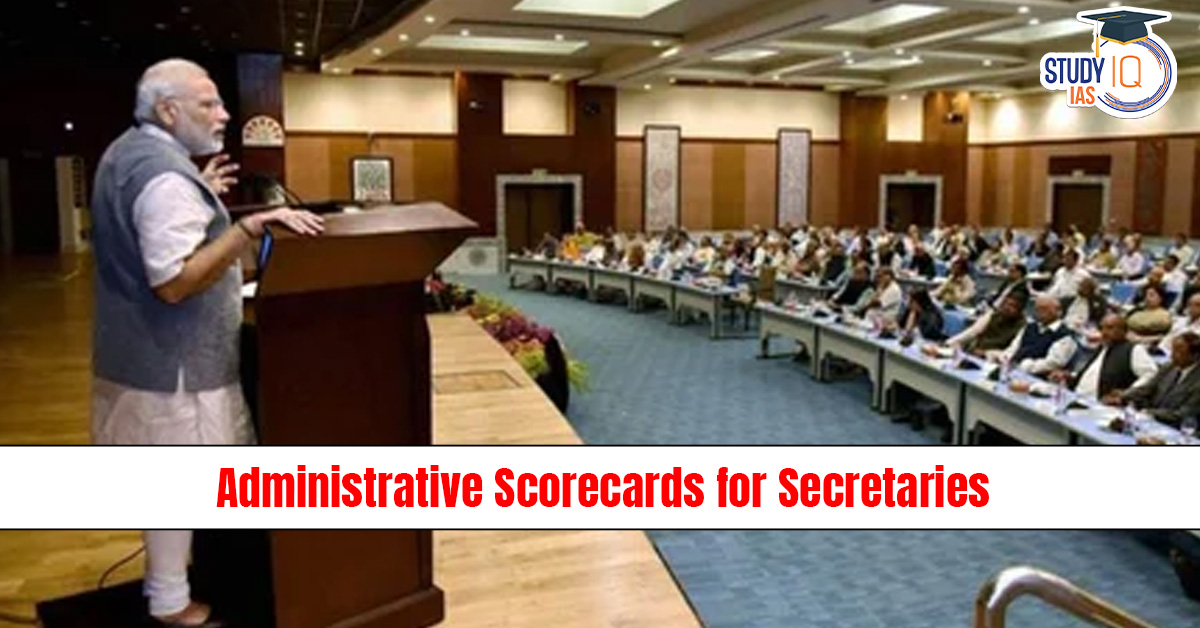
For the first time, the Cabinet Secretariat has introduced “administrative scorecards” for Secretaries to the Government of India. As reported by The Indian Express, these scorecards quantify individual and departmental performance through a structured, marks-based assessment. The initiative reflects a broader push towards objective evaluation, accountability, and outcome-oriented governance within the senior civil services.
What Are Administrative Scorecards?
|
Administrative Scorecards |
| ● Administrative scorecards are performance assessment tools issued by the Cabinet Secretariat to Union Secretaries.
● They evaluate both individual performance and departmental functioning using an objective and comparable framework. ● The assessment aims to measure efficiency in absolute terms and relative to peer departments. ● The first set of scorecards covered performance for September, October, and November 2025 and was circulated in early January 2026 by the Cabinet Secretary. |
Key Parameters of Assessment
- The scorecards are based on approximately a dozen performance indicators, with a total score of 100 marks.
- File disposal carries the highest weightage of 20 marks.
- Output and activities, as well as expenditure on schemes and capital expenditure, are allotted 15 marks each.
- Other parameters include:
- Public grievance redressal
- Quality and timeliness of Cabinet notes
- Completion of projects monitored by the Project Monitoring Group (PMG)
- Timely clearance of bills by the Pay and Accounts Office (PAO) and Chief Controller of Accounts (CCA)
Negative and Discretionary Marking
- The scorecards include up to 12 negative marks.
- Penalties may be imposed for:
- Excessive expenditure on foreign visits or events
- Abnormal pendency of files at the Secretary level and above
- Delayed payments to Micro, Small and Medium Enterprises (MSMEs)
- Additionally, 5 discretionary marks may be awarded by the Cabinet Secretary for exceptional performance or significant contributions.
Administrative Scorecards for reforms
The introduction of scorecards fits within a longer trajectory of civil service reforms in India. Beginning with constitutional provisions and the First Administrative Reforms Commission (1966), reforms have evolved through the Second ARC (2009), the Right to Information Act, and recent digitisation-led initiatives aimed at improving transparency, accountability, and capacity.
Mission Karmayogi: Capacity Building at Scale
- Mission Karmayogi, formally the National Programme for Civil Services Capacity Building, is a flagship reform initiative.
- It seeks to modernise post-recruitment training across all levels of the civil services.
- The programme aims to create citizen-centric, future-ready, and outcome-oriented civil servants.
- The Capacity Building Commission (CBC) was established in 2021 to guide policy and standards.
- Karmayogi Bharat, a Special Purpose Vehicle set up in 2022, oversees implementation.
- The iGOT Karmayogi digital platform provides continuous, competency-based learning through online courses accessible anytime and anywhere.
Lateral Entry into the Civil Services
- Lateral entry involves recruiting professionals from outside the traditional civil service structure into government roles.
- Such appointments are typically made at the levels of Joint Secretary, Director, and Deputy Secretary.
- The objective is to infuse specialised domain expertise into policymaking and administration.
- These positions play a critical role in shaping and implementing public policy.
PRAGATI: Monitoring and Timely Implementation
- PRAGATI (Pro-Active Governance and Timely Implementation) was launched in 2015.
- It is a digital platform for real-time monitoring of projects, schemes, and grievance redressal.
- The platform integrates video conferencing, data analytics, and field-level inputs to enable direct oversight.
- Major infrastructure projects, including the Chenab Bridge and the Bogibeel Bridge, were expedited under PRAGATI review mechanisms.
Conclusion
The introduction of administrative scorecards marks a shift towards measurable accountability at the highest levels of the bureaucracy. When viewed alongside initiatives such as Mission Karmayogi, lateral entry, and PRAGATI, it signals a broader reform agenda aimed at enhancing performance, professionalism, and responsiveness in India’s civil services.
|
Read More Notes |
|
| Environment Notes | Art and Culture Notes |
| Science and Tech | History Notes |
| Geography Notes | Indian Polity Notes |
| General Knowledge | International Relation |
|
Explore StudyIQ Courses |
|
 Disaster Management in India, Classifica...
 Good Friday 2026: Date, History, Meaning...
 Removal of the Chief Election Commission...










 WhatsApp





