Table of Contents
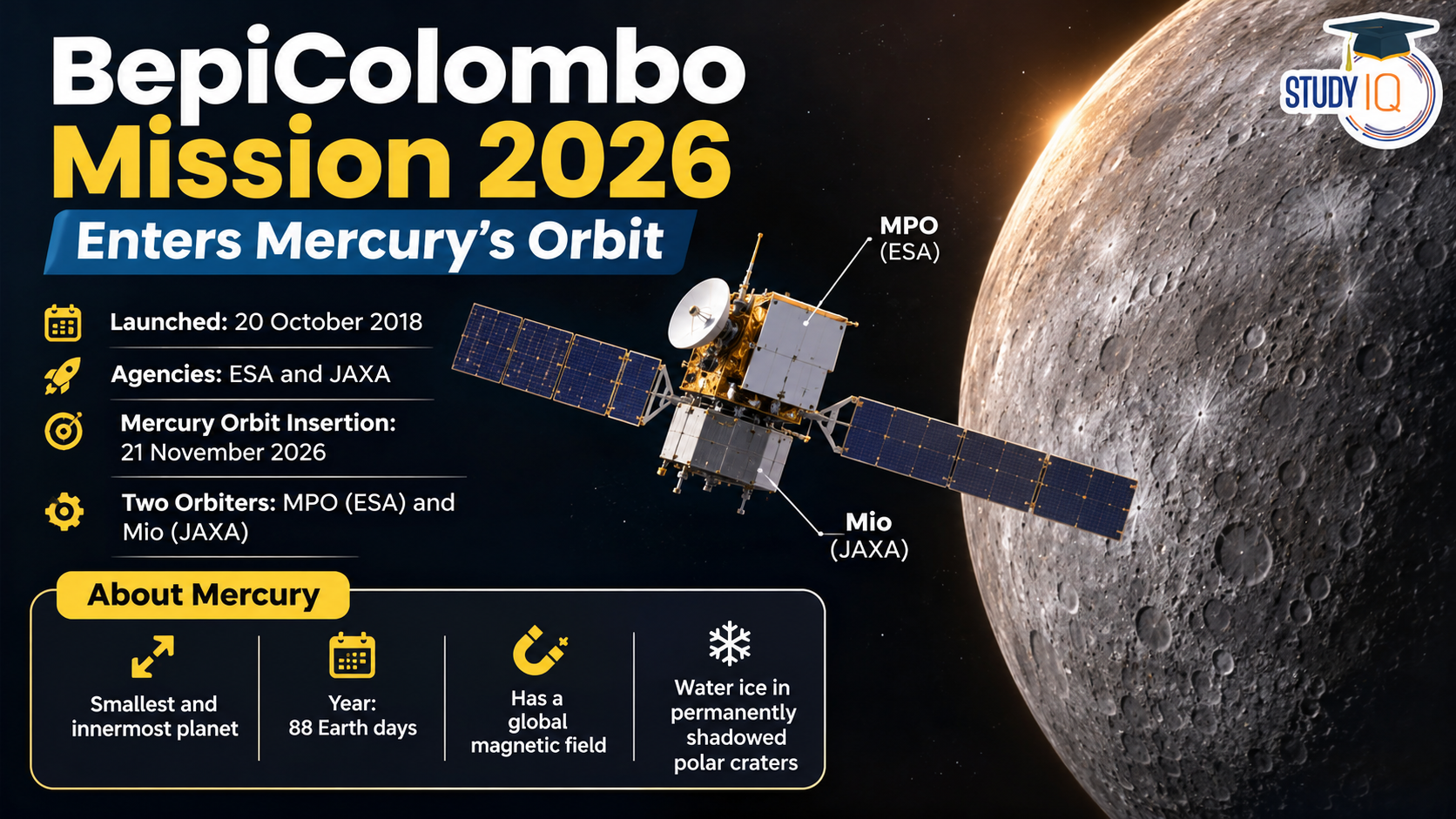
The BepiColombo mission, a joint initiative of the European Space Agency (ESA) and Japan Aerospace Exploration Agency (JAXA), successfully entered Mercury’s orbit on 21 November 2026 after an eight-year journey. The mission aims to study Mercury’s internal structure, surface composition, magnetic field and interaction with the solar wind.
Why in the News?
The European-Japanese BepiColombo spacecraft successfully achieved Mercury Orbit Insertion (MOI) on 21 November 2026. However, the European Space Agency reported a software-related thruster malfunction during the orbital insertion manoeuvre.
The thruster burn ended earlier than planned, achieving approximately 77% of the intended velocity change. Despite this technical issue, the spacecraft entered a stable orbit around Mercury and the mission remains on track.
About the BepiColombo Mission
BepiColombo is an international planetary exploration mission jointly developed by ESA and JAXA. It is designed to conduct a comprehensive investigation of Mercury, the smallest and innermost planet of the Solar System.
Key Facts:
- Launch Date: 20 October 2018.
- Launch Vehicle: Ariane 5 rocket.
- Launch Site: Kourou, French Guiana.
- Partner Agencies: European Space Agency (ESA) and Japan Aerospace Exploration Agency (JAXA).
- Target Planet: Mercury.
- Mercury Orbit Insertion: 21 November 2026.
The spacecraft travelled through the inner Solar System using planetary gravity assists and solar-electric propulsion to reach Mercury.
Three Main Components of BepiColombo
The BepiColombo spacecraft comprises two scientific orbiters and one transfer module.
1. Mercury Planetary Orbiter (MPO)
- Developed by the European Space Agency (ESA).
- Will investigate Mercury’s surface, internal structure, composition and magnetic field.
- Designed to operate in a relatively low-altitude polar orbit.
2. Mercury Magnetospheric Orbiter (Mio)
- Developed by the Japan Aerospace Exploration Agency (JAXA).
- Will study Mercury’s magnetic field, magnetosphere and interaction with the solar wind.
- Designed to operate in a highly elliptical polar orbit.
3. Mercury Transfer Module (MTM)
- Provides propulsion during the interplanetary journey.
- Uses solar-electric propulsion.
- Separated from the spacecraft stack on 3 September 2026.
The two scientific orbiters are scheduled to separate on 9–10 December 2026.
Thruster Glitch During Orbit Insertion
During the Mercury Orbit Insertion manoeuvre, a software issue involving attitude guidance and thruster control caused the spacecraft’s thrusters to stop firing earlier than expected.
The planned burn was approximately 37 minutes, but the manoeuvre achieved only 77% of the intended velocity change.
Consequently, BepiColombo entered an approximately 75-hour orbit instead of the originally planned 58-hour orbit.
ESA confirmed that the spacecraft is safe and that the remaining orbital manoeuvres have been adjusted without affecting the planned separation of its scientific orbiters.
Important Firsts and Historical Significance
- BepiColombo is the third spacecraft mission to visit Mercury.
- It is the second mission to achieve orbit around Mercury.
- It is the first mission designed to operate two scientific orbiters around Mercury simultaneously.
- It achieved orbit capture around another planet using the weak stability capture technique, a first for a planetary mission beyond Earth orbit.
Previous Missions to Mercury
| Mission | Space Agency | Achievement |
|---|---|---|
| Mariner 10 (1974–75) | NASA | First spacecraft to visit Mercury |
| MESSENGER (2011–2015) | NASA | First spacecraft to orbit Mercury |
| BepiColombo (2026) | ESA–JAXA | First mission with two Mercury orbiters |
Important Facts About Mercury
Mercury is the smallest and innermost planet of the Solar System.
- Position: First planet from the Sun.
- Size: Smallest planet in the Solar System.
- Natural Satellites: Mercury has no moons.
- Orbital Period: Approximately 88 Earth days.
- Rotation Period: Approximately 59 Earth days.
- Solar Day: Approximately 176 Earth days.
- Magnetic Field: Possesses a global magnetic field associated with its large metallic core.
- Water Ice: Water ice exists in permanently shadowed craters near its poles.
- Atmosphere: Has an extremely thin exosphere rather than a substantial atmosphere.
Significance of the BepiColombo Mission
BepiColombo will provide valuable information about the formation and evolution of terrestrial planets. Its two orbiters will conduct complementary observations to investigate Mercury’s geological history, internal structure, magnetic environment and polar water ice.
The mission will also improve scientific understanding of planetary magnetism and the interaction between the solar wind and planetary environments.
UPSC Prelims: Key Takeaways
- BepiColombo is a joint mission of ESA and JAXA.
- It was launched in October 2018 using an Ariane 5 rocket.
- MPO was developed by ESA, while Mio was developed by JAXA.
- Mercury is the smallest and innermost planet.
- Mercury has no natural satellites.
- Mercury completes one revolution around the Sun in approximately 88 Earth days.
- MESSENGER was the first spacecraft to orbit Mercury.
- Mercury has a global magnetic field.
- Water ice is present in permanently shadowed polar craters.

 Bisleri Case 2026: Bromate Contamination...
 National Milk Day 2026: History, Signifi...
 Constitution Day 2026: Why November 26 I...














 WhatsApp