Table of Contents
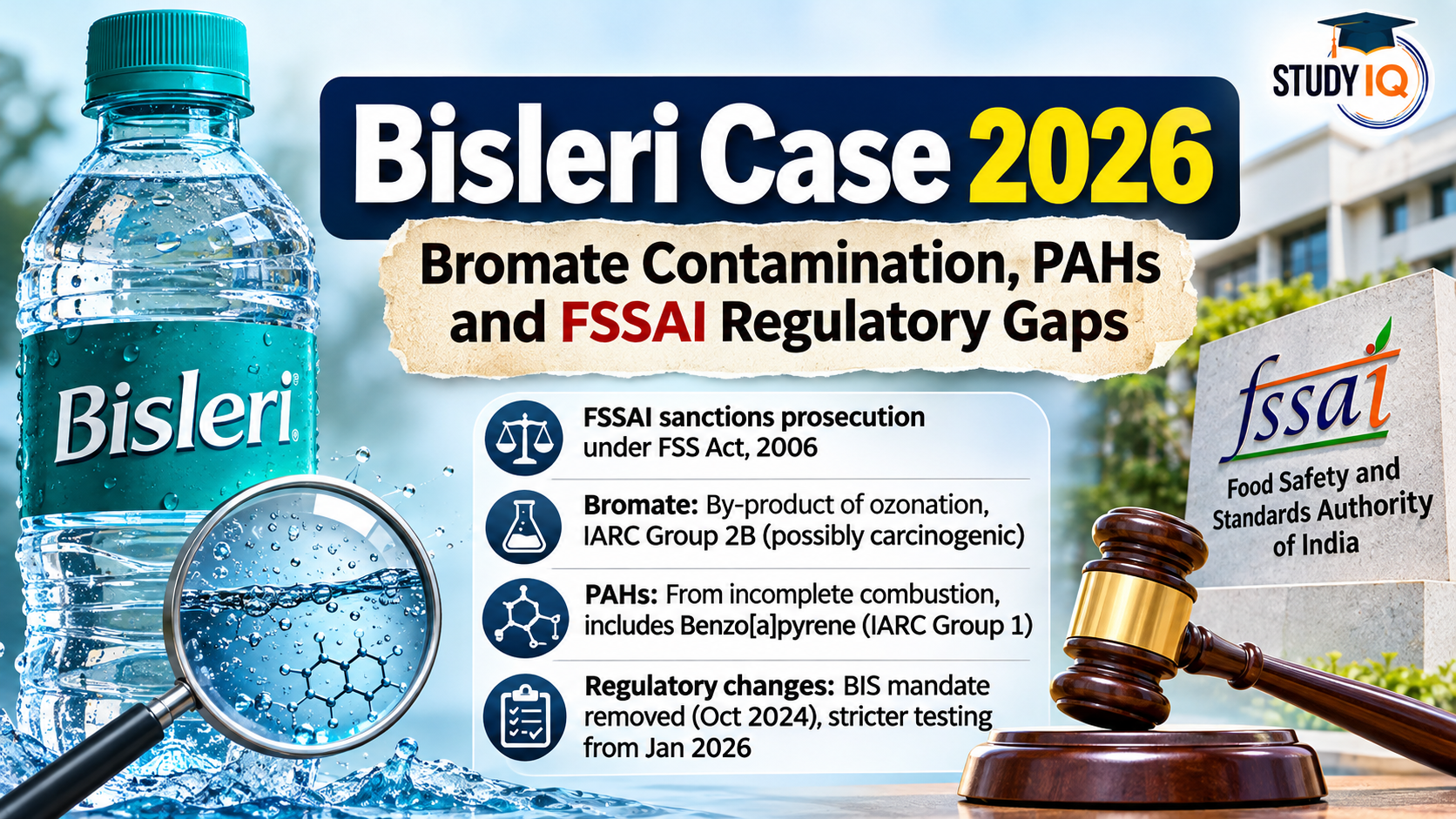
The Food Safety and Standards Authority of India (FSSAI) has sanctioned prosecution against Bisleri International Pvt. Ltd. under the Food Safety and Standards (FSS) Act, 2006, after a packaged drinking water sample failed the prescribed bromate limit. A Referral Food Laboratory also detected polynuclear aromatic hydrocarbons (PAHs) in the sample.
The case has raised concerns about drinking water safety, chemical contamination, food quality monitoring and regulatory gaps in India’s packaged drinking water industry.
However, a sanction to prosecute does not mean that the company has been convicted. The matter must be decided through the legal process.
What Are the Key Contaminants in the Bisleri Case?
Two important chemical contaminants are relevant to the case:
1. Bromate
-
Bromate is an inorganic chemical by-product that can form during water treatment.
-
It is produced when ozone, used for disinfection, reacts with naturally occurring bromide in source water.
-
The International Agency for Research on Cancer (IARC) classifies bromate as a Group 2B carcinogen, meaning it is possibly carcinogenic to humans.
-
The World Health Organization (WHO) has prescribed a provisional guideline value of 10 micrograms per litre (µg/L) for bromate in drinking water.
2. Polynuclear Aromatic Hydrocarbons (PAHs)
-
PAHs are organic chemical compounds produced primarily through the incomplete combustion of coal, oil, wood and other organic materials.
-
They can enter water through industrial emissions, contaminated soil and certain older coal-tar-based pipe or tank linings.
-
Some PAHs are associated with serious health risks, including cancer.
Benzo[a]pyrene is an important PAH classified by IARC as a Group 1 carcinogen (carcinogenic to humans). WHO’s guideline value for benzo[a]pyrene in drinking water is 0.7 µg/L.
Note: The detection of PAHs does not automatically establish that benzo[a]pyrene was detected in the Bisleri sample.
Regulatory Framework for Packaged Drinking Water in India
Packaged drinking water is regulated under the Food Safety and Standards Act, 2006.
1. Food Safety and Standards Act, 2006
Under Section 3(1)(j) of the Act, packaged drinking water is classified as food. Therefore, manufacturers must comply with applicable food safety and quality standards.
2. Packaged Drinking Water vs Natural Mineral Water
India recognises two distinct categories:
| Basis | Packaged Drinking Water | Natural Mineral Water |
|---|---|---|
| Source | Water from any suitable source | Protected underground source |
| Treatment | Purification and treatment permitted | Limited permitted treatment |
| Mineral content | May be adjusted | Characteristic stable mineral composition |
3. Changes in BIS Certification Requirements (October 2024)
In October 2024, FSSAI removed the mandatory Bureau of Indian Standards (BIS) certification requirement for packaged drinking water and mineral water.
Subsequently, both categories were classified as high-risk food categories.
The enhanced regulatory framework includes:
-
Pre-licence inspection of manufacturing facilities.
-
Annual inspections.
-
Third-party food safety audits.
4. Testing Requirements from January 2026
From 1 January 2026, manufacturers are required to follow enhanced testing requirements, including:
-
Testing of source water.
-
Monthly microbiological testing.
-
Compliance with applicable food safety and quality standards.
These measures aim to strengthen quality assurance and consumer protection.
What Are the Major Regulatory Gaps?
The Bisleri case highlights several important challenges in India’s packaged drinking water sector:
-
Chemical contamination: Microbiological safety alone is insufficient; chemical contaminants must also be monitored.
-
Water treatment risks: Improperly controlled ozonation can lead to bromate formation.
-
Infrastructure concerns: Contaminated storage tanks and pipelines can introduce harmful substances into drinking water.
-
Monitoring and enforcement: Regular inspections and independent laboratory testing are essential to ensure compliance.
-
Consumer awareness: Consumers need reliable information about water quality, certification and safety standards.
Way Forward
India needs a comprehensive approach to strengthen packaged drinking water safety.
-
Strengthen independent laboratory testing and surveillance.
-
Ensure strict monitoring of bromate and other chemical contaminants.
-
Improve source-water quality and treatment processes.
-
Strengthen accountability of manufacturers and bottling facilities.
-
Improve transparency in food safety inspections and enforcement.
-
Increase consumer awareness regarding packaged drinking water standards.
Conclusion
The Bisleri case highlights the importance of strong food safety regulation, scientific testing and accountability in India’s packaged drinking water industry. With increasing dependence on bottled water, effective implementation of FSSAI standards and regular monitoring of chemical contaminants are essential to protect public health.
Frequently Asked Questions (FAQs)
1. Why has FSSAI sanctioned prosecution against Bisleri?
FSSAI sanctioned prosecution after a packaged drinking water sample failed the bromate limit and a Referral Food Laboratory detected PAHs.
2. What is bromate in drinking water?
Bromate is an inorganic chemical by-product that can form when ozone reacts with naturally occurring bromide during water treatment.
3. What is the WHO guideline for bromate in drinking water?
The WHO provisional guideline value is 10 µg/L.
4. What are PAHs?
PAHs are organic compounds formed primarily through incomplete combustion of substances such as coal, oil and wood.
5. What changed in BIS certification requirements in October 2024?
FSSAI removed the mandatory BIS certification requirement for packaged drinking water and natural mineral water, while introducing enhanced regulatory oversight through high-risk classification.
6. Is Bisleri convicted in this case?
No. A sanction to prosecute is not a conviction. The allegations must be established through the legal process.

 National Milk Day 2026: History, Signifi...
 Constitution Day 2026: Why November 26 I...
 India-Nepal Relations 2026: New Strategi...











 WhatsApp