Table of Contents
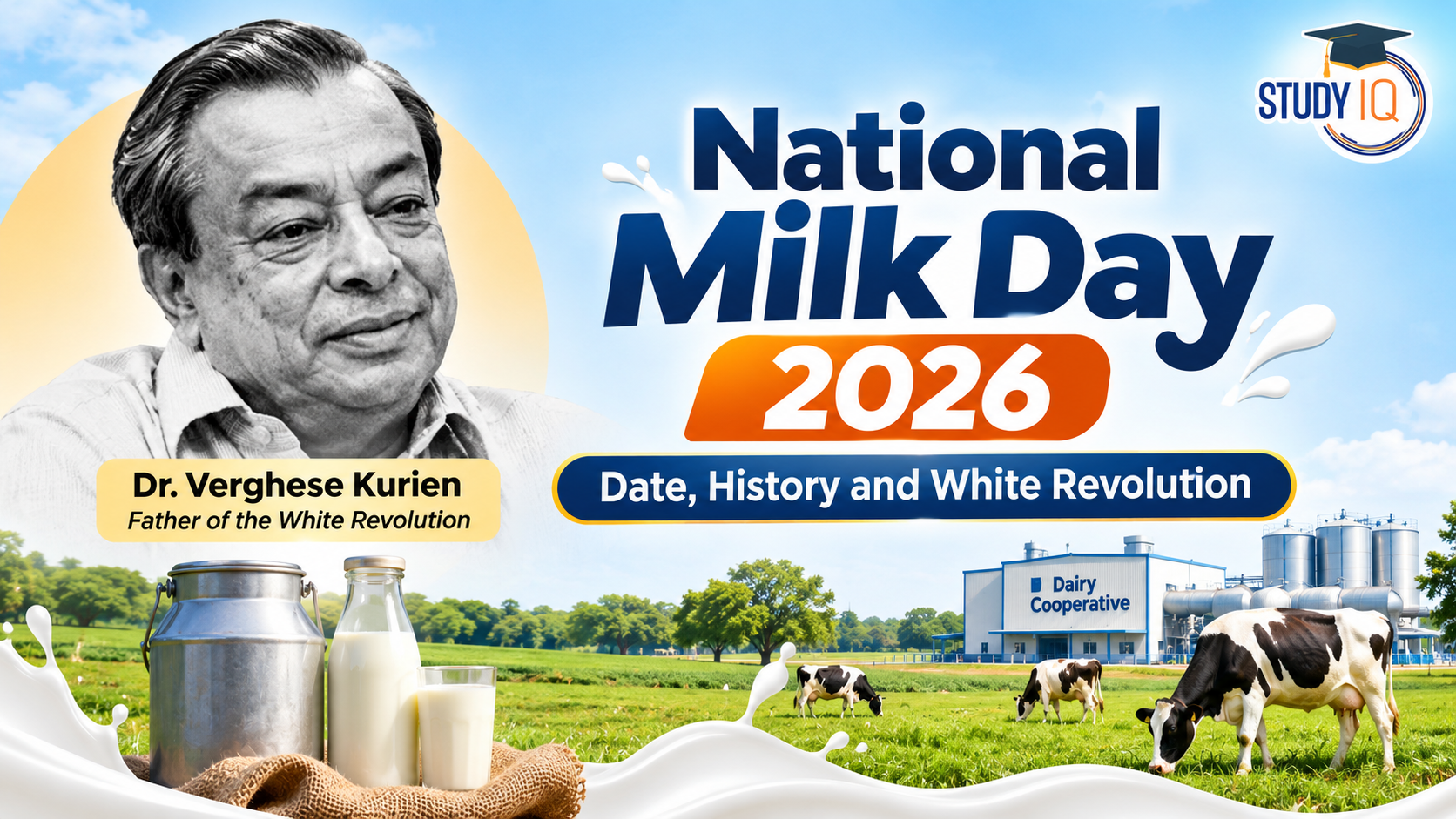
National Milk Day 2026 is observed on 26 November to commemorate the birth anniversary of Dr. Verghese Kurien, popularly known as the Father of the White Revolution in India. The day recognises his contribution to India’s dairy cooperative movement and the transformation of the country into the world’s largest milk producer.
India’s dairy sector plays a significant role in nutritional security, rural employment, women’s empowerment and agricultural development. According to the Basic Animal Husbandry Statistics 2025, India’s milk production reached 247.87 million tonnes in 2024–25, registering an annual growth of 3.58%.
National Milk Day 2026: Important Highlights
| Particulars | Details |
|---|---|
| Date | 26 November 2026 |
| First observed | 2014 |
| Country | India |
| Commemorates | Birth anniversary of Dr. Verghese Kurien |
| Date of birth | 26 November 1921 |
| Popular title | Father of the White Revolution |
| Associated movement | White Revolution |
| Major programme | Operation Flood |
| Implementing institution | National Dairy Development Board (NDDB) |
National Milk Day was first observed in 2014 following an initiative by the Indian Dairy Association and other dairy-sector institutions. It highlights the contribution of dairy farmers and cooperative institutions to India’s economic and social development.
National Milk Day is different from World Milk Day, which is celebrated on 1 June every year. World Milk Day was established by the Food and Agriculture Organization (FAO) in 2001.
Who Was Dr. Verghese Kurien?
Dr. Verghese Kurien (1921–2012) was an Indian social entrepreneur and dairy engineer who transformed India’s dairy industry through the cooperative movement.
Born on 26 November 1921 in Kozhikode, Kerala, he played a crucial role in developing the Anand model of dairy cooperatives and making milk production a major source of rural economic development.
His major contributions include:
- Amul: Played a central role in developing Amul into a successful farmer-owned dairy cooperative enterprise.
- Anand Pattern: Promoted a cooperative model that connected milk producers directly with organised markets.
- NDDB: Served as the first chairman of the National Dairy Development Board, established in 1965.
- Operation Flood: Led the implementation of the programme that transformed India’s dairy production and distribution system.
Major Awards Received by Dr. Verghese Kurien
| Award | Year |
|---|---|
| Ramon Magsaysay Award | 1963 |
| World Food Prize | 1989 |
| Padma Shri | 1965 |
| Padma Bhushan | 1966 |
| Padma Vibhushan | 1999 |
What Is the White Revolution in India?
The White Revolution refers to the transformation of India’s dairy sector through increased milk production, improved productivity, dairy cooperatives and organised milk procurement and distribution networks.
It was primarily driven by Operation Flood, launched in 1970 by the National Dairy Development Board under the leadership of Dr. Verghese Kurien.
The programme aimed to establish a nationwide dairy network that connected rural milk producers with urban consumers.
Objectives of the White Revolution
- Increase milk production and improve dairy productivity.
- Establish dairy cooperatives at the village level.
- Eliminate unnecessary intermediaries in milk distribution.
- Ensure remunerative prices for dairy farmers.
- Strengthen milk processing, storage and transportation infrastructure.
- Improve nutritional security and rural livelihoods.
Operation Flood: Three Phases
Operation Flood was implemented in three major phases between 1970 and 1996.
| Phase | Period | Major Features |
|---|---|---|
| Phase I | 1970–1980 | Connected 18 milk sheds with four major metropolitan markets: Delhi, Mumbai, Kolkata and Chennai. |
| Phase II | 1981–1985 | Expanded the network to 136 milk sheds and 290 urban markets. |
| Phase III | 1985–1996 | Strengthened dairy cooperatives and expanded milk procurement, processing and marketing infrastructure. |
Operation Flood helped India move from a milk-deficient country towards self-sufficiency and eventually become the world’s largest milk producer.
India’s Dairy Sector: Latest Statistics 2024–25
According to the Department of Animal Husbandry and Dairying’s Basic Animal Husbandry Statistics 2025, India continues to hold the first position globally in milk production.
| Indicator | Statistics |
|---|---|
| Total milk production (2024–25) | 247.87 million tonnes |
| Annual growth rate | 3.58% |
| Per capita milk availability | 485 grams/day |
| Milk production (2014–15) | 146.31 million tonnes |
| Share in global milk production | Approximately 25% |
| Global ranking | 1st |
India’s milk production increased by 69.41% between 2014–15 and 2024–25. Per capita milk availability also increased from 319 grams per person per day to 485 grams during the same period.
These figures reflect improvements in dairy infrastructure, livestock productivity and cooperative participation.
Top Five Milk-Producing States in India
According to the Basic Animal Husbandry Statistics 2025, the leading milk-producing states in India during 2024–25 were:
| Rank | State | Share of Total Production |
|---|---|---|
| 1 | Uttar Pradesh | 15.66% |
| 2 | Rajasthan | 14.82% |
| 3 | Madhya Pradesh | 9.12% |
| 4 | Gujarat | 7.78% |
| 5 | Maharashtra | 6.71% |
These five states collectively contributed 54.09% of India’s total milk production. Uttar Pradesh remained the largest milk-producing state, followed by Rajasthan.
Contribution of the Dairy Sector to India’s Economy
The dairy sector is an important component of India’s agricultural and rural economy. It contributes to employment generation, income diversification and nutritional security.
1. Rural Employment: Dairying provides livelihoods to approximately 8.5 crore rural households.
2. Women’s Empowerment: Women account for nearly 70% of India’s dairy farming workforce, making dairy cooperatives an important instrument of women’s economic participation.
3. Economic Contribution: The livestock sector contributed 5.49% of India’s total Gross Value Added (GVA) and 30.87% of agriculture and allied sector GVA in 2023–24, at current prices.
4. Nutritional Security: Milk provides essential nutrients, including protein, calcium, magnesium and potassium, supporting balanced nutrition.
Government Schemes for Dairy Development in India
The Government of India has introduced several initiatives to improve livestock productivity, strengthen dairy infrastructure and increase farmers’ incomes.
| Scheme | Launch Year | Major Objective |
|---|---|---|
| Rashtriya Gokul Mission | 2014 | Conservation and development of indigenous bovine breeds. |
| National Programme for Dairy Development (NPDD) | 2014 | Strengthening milk collection, chilling, testing and processing infrastructure. |
| Animal Husbandry Infrastructure Development Fund (AHIDF) | 2020 | Promoting investment in dairy processing and value addition. |
| National Livestock Mission (NLM) | 2014 | Promoting livestock entrepreneurship and improving feed and fodder availability. |
| Livestock Health and Disease Control Programme (LHDCP) | — | Improving animal health through vaccination and disease control. |
| Supporting Dairy Cooperatives and Farmer Producer Organisations (SDCFPO) | — | Providing financial assistance to dairy cooperatives and producer organisations. |
White Revolution 2.0: Objectives and Targets
White Revolution 2.0 is a cooperative-led initiative launched in 2024 to strengthen India’s dairy cooperative network and expand milk procurement.
The initiative focuses on increasing organised milk procurement, improving market access and creating additional income opportunities for dairy farmers.
Major Objectives
- Establish 75,000 new dairy cooperative societies.
- Strengthen 46,422 existing dairy cooperative societies.
- Expand dairy cooperative coverage in villages and Panchayats that lack such facilities.
- Increase milk procurement by dairy cooperatives by 50% over five years.
- Promote women’s participation in the dairy sector.
The initiative aims to strengthen the rural dairy economy through better infrastructure, institutional support and cooperative participation.
National Milk Day 2026: Significance and Challenges
National Milk Day provides an opportunity to recognise India’s achievements in dairy production while highlighting the challenges facing the sector.
Despite being the world’s largest milk producer, India faces several issues:
- Low productivity among certain indigenous and non-descript cattle breeds.
- Shortage of quality feed and fodder.
- Increasing animal disease risks.
- Inadequate cold-chain and milk processing infrastructure in some regions.
- Climate change and heat stress affecting livestock productivity.
- Price fluctuations and limited market access for small dairy farmers.
Strengthening veterinary services, scientific breeding, dairy cooperatives, digital infrastructure and climate-resilient livestock practices will be essential for sustainable dairy development.
Conclusion
National Milk Day 2026 celebrates India’s remarkable journey from milk deficiency to becoming the world’s largest milk-producing country. The contribution of Dr. Verghese Kurien and the success of Operation Flood demonstrate the importance of cooperative institutions in rural development.
Going forward, initiatives such as White Revolution 2.0 can help strengthen dairy infrastructure, empower women farmers, improve productivity and promote sustainable rural livelihoods. India’s dairy sector will remain an important pillar of nutritional security and the vision of Viksit Bharat @2047.

Frequently Asked Questions (FAQs)
Q1. When is National Milk Day celebrated in India?
National Milk Day is celebrated every year on 26 November to commemorate the birth anniversary of Dr. Verghese Kurien.
Q2. Who is known as the Father of the White Revolution in India?
Dr. Verghese Kurien is known as the Father of the White Revolution for his contribution to India’s dairy cooperative movement.
Q3. When was National Milk Day first observed?
National Milk Day was first observed in India in 2014.
Q4. When was Operation Flood launched?
Operation Flood was launched in 1970 by the National Dairy Development Board (NDDB).
Q5. Which state is the largest milk producer in India?
Uttar Pradesh was the largest milk-producing state in 2024–25, contributing 15.66% of India’s total milk production.
Q6. What is India’s total milk production in 2024–25?
India produced 247.87 million tonnes of milk in 2024–25.
Q7. What is White Revolution 2.0?
White Revolution 2.0 is a cooperative-led initiative launched in 2024 to expand dairy cooperative coverage and increase milk procurement across India.
Q8. When is World Milk Day celebrated?
World Milk Day is celebrated on 1 June every year and was established by the Food and Agriculture Organization in 2001.
 Constitution Day 2026: Why November 26 I...
 India-Nepal Relations 2026: New Strategi...
 National Landslide Susceptibility Mappin...










 WhatsApp