Table of Contents
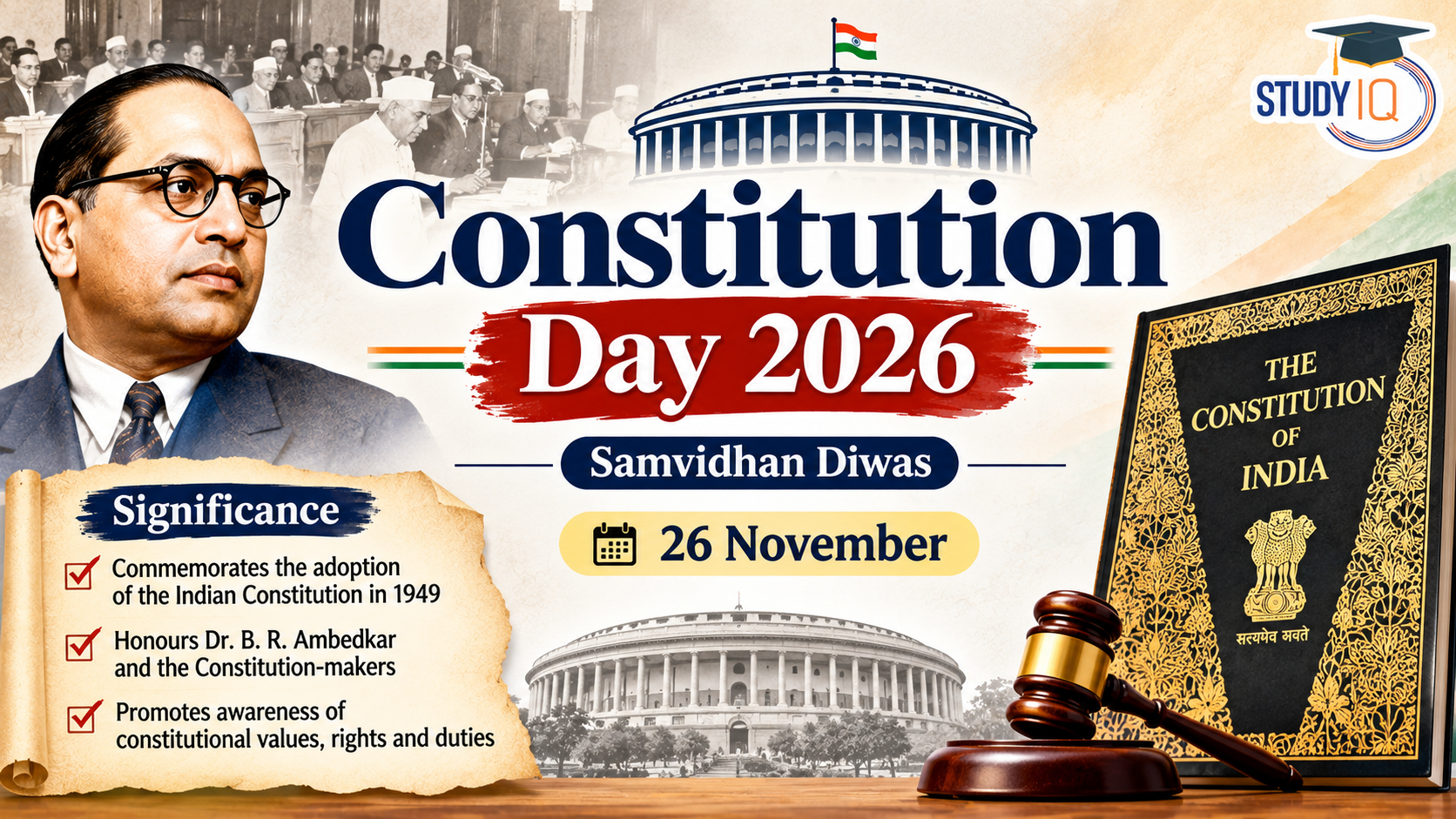
Constitution Day, also known as Samvidhan Diwas, is celebrated every year on November 26 in India to commemorate the adoption of the Indian Constitution by the Constituent Assembly on November 26, 1949.
The day highlights the importance of constitutional values, democratic principles, fundamental rights and citizens’ duties. Although the Constitution was adopted in 1949, it came into force on January 26, 1950, marking the beginning of India as a sovereign democratic republic.
Constitution Day serves as a reminder of the vision of India’s Constitution-makers and their commitment to establishing a democratic, inclusive and just society.
Why Is November 26 Celebrated as Constitution Day?
On November 26, 1949, the Constituent Assembly formally adopted the Constitution of India after nearly three years of deliberations.
The Constitution was signed by members of the Constituent Assembly on January 24, 1950, and came into effect on January 26, 1950.
November 26 was officially declared Constitution Day in 2015 by the Government of India to honour the contribution of Dr. B.R. Ambedkar and commemorate the adoption of the Constitution.
Before 2015, November 26 was primarily observed as National Law Day. The tradition of observing National Law Day was initiated in 1979 by former Supreme Court Bar Association president Laxmi Mall Singhvi.
In October 2015, Prime Minister Narendra Modi announced the observance of Constitution Day while laying the foundation stone of the Dr. B.R. Ambedkar Memorial in Mumbai.
Role of Dr. B.R. Ambedkar in Drafting the Constitution
Dr. Bhimrao Ramji Ambedkar is widely recognised as the chief architect of the Indian Constitution because of his leadership of the Drafting Committee.
The Constituent Assembly established the Drafting Committee on August 29, 1947, with Dr. B.R. Ambedkar as its chairman.
The committee examined constitutional provisions, incorporated amendments and prepared the final draft.
Some important facts about the Constitution-making process include:
- The Constituent Assembly took 2 years, 11 months and 18 days to complete the Constitution.
- The original Constitution contained 395 Articles, 22 Parts and 8 Schedules.
- More than 2,000 amendments were proposed during the Assembly’s deliberations.
- The Constitution was handwritten in English and Hindi.
- The original document was decorated with artwork by artists from Santiniketan under the guidance of Nandalal Bose.
The Constitution reflected the aspirations of a newly independent nation and established a framework for democratic governance.
Significance of the Preamble
The Preamble represents the philosophy and fundamental objectives of the Indian Constitution.
It begins with the words “We, the People of India”, establishing that the ultimate source of constitutional authority is the people.
The Preamble declares India to be a:
- Sovereign
- Socialist
- Secular
- Democratic
- Republic
It also guarantees the ideals of Justice, Liberty, Equality and Fraternity.
The words ‘Socialist’ and ‘Secular’ were added to the Preamble through the 42nd Constitutional Amendment Act, 1976.
In November 2024, the Supreme Court upheld the inclusion of these two words in the Preamble.
Fundamental Rights and Duties Under the Constitution
The Indian Constitution establishes a comprehensive framework to protect individual freedoms and promote responsible citizenship.
Fundamental Rights: Part III of the Constitution (Articles 12–35) guarantees essential rights, including:
- Right to Equality (Articles 14–18).
- Right to Freedom (Articles 19–22).
- Right against Exploitation (Articles 23–24).
- Right to Freedom of Religion (Articles 25–28).
- Cultural and Educational Rights (Articles 29–30).
- Right to Constitutional Remedies (Article 32).
Fundamental Duties: Part IVA, under Article 51A, lists the fundamental duties of citizens. These duties were introduced through the 42nd Constitutional Amendment Act, 1976.
They encourage citizens to respect the Constitution, protect national unity, preserve the environment and promote scientific temper.
How Is Constitution Day Celebrated in India?
The Government of India organises several activities to promote constitutional awareness among citizens.
Major activities include:
- Reading the Preamble in educational institutions and government offices.
- Organising debates, quizzes and essay-writing competitions.
- Conducting awareness programmes on Fundamental Rights and Duties.
- Organising discussions on constitutional values and democratic governance.
- Encouraging citizens to participate in constitutional literacy initiatives.
These activities aim to strengthen constitutional awareness, civic responsibility and democratic participation.

Conclusion
Constitution Day is more than an annual commemoration. It reminds citizens that democracy, equality, liberty and justice are the foundations of the Indian political system.
The Constitution provides the institutional framework for governance while protecting individual rights and maintaining the balance between the state and its citizens.
Observing November 26 as Samvidhan Diwas reinforces the importance of constitutional morality, democratic participation and the vision of the makers of the Indian Constitution.
 National Milk Day 2026: History, Signifi...
 India-Nepal Relations 2026: New Strategi...
 National Landslide Susceptibility Mappin...













 WhatsApp