Table of Contents
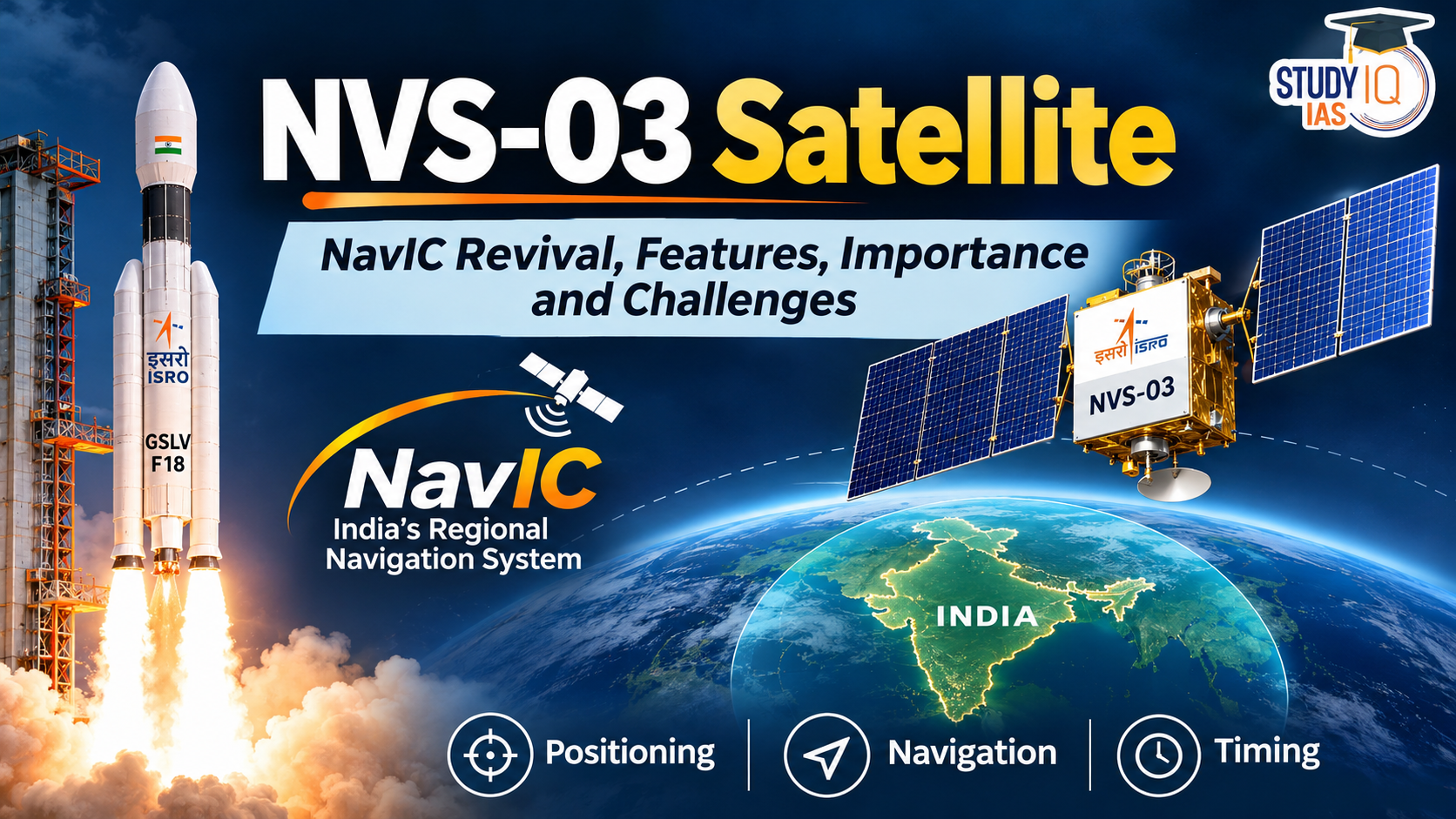
India’s space navigation capabilities have received a significant boost with the launch of NVS-03, ISRO’s third second-generation navigation satellite. The mission is important for strengthening India’s indigenous Navigation with Indian Constellation (NavIC), which has faced repeated technical challenges, particularly atomic clock failures and difficulties in launching replacement satellites.
The NVS-03 mission highlights India’s efforts to achieve technological self-reliance and reduce dependence on foreign navigation systems. It is particularly relevant for UPSC GS Paper III under Science and Technology and Space Technology.
Read Also: UPSC Daily Current Affairs 2026
What Is NVS-03 Satellite?
NVS-03 is part of ISRO’s second-generation Navigation Satellite Series (NVS), developed to improve the reliability and continuity of India’s regional navigation system.
The satellite was launched aboard the GSLV-F18 rocket from Satish Dhawan Space Centre, Sriharikota, on 30 October 2026. It was successfully injected into Geosynchronous Transfer Orbit (GTO).
The satellite carries an indigenous rubidium atomic clock, supports the L1 frequency band and has a designed mission life of approximately 12 years.
Its primary objective is to strengthen NavIC’s positioning, navigation and timing (PNT) services.
What Is NavIC?
NavIC, previously known as the Indian Regional Navigation Satellite System (IRNSS), is India’s independent regional satellite navigation system developed by ISRO.
It was initiated following the Kargil War of 1999, when India’s dependence on foreign navigation systems highlighted strategic vulnerabilities.
NavIC was originally designed around a seven-satellite constellation, providing coverage over India and approximately 1,500 km beyond its borders.
It provides two services:
-
Standard Positioning Service (SPS): Available to civilian users.
-
Restricted Service (RS): Encrypted service available to authorised users.
Unlike the American GPS, which provides global coverage, NavIC focuses on India and its surrounding region.
Why Did NavIC Face Operational Challenges?
NavIC experienced repeated technical problems due to failures of atomic clocks installed aboard navigation satellites.
Atomic clocks provide extremely accurate timing signals required to calculate geographical positions. Even minor timing errors can significantly affect positioning accuracy.
Other challenges included:
-
Failure of IRNSS-1H in 2017 due to the non-separation of its heat shield.
-
Failure of NVS-02 to reach its intended operational orbit in 2025 due to a propulsion-system issue.
-
Repeated failures of imported atomic clocks.
-
Reduction in the number of operational satellites below the minimum required for standalone positioning services.
These problems highlighted the importance of reliable satellite manufacturing and indigenous technological capabilities.
Key Features of NVS-03 Satellite
1. Indigenous Atomic Clock: NVS-03 carries an indigenously developed rubidium atomic clock, reducing dependence on imported precision timing technology.
2. Additional L1 Frequency Band: Alongside the existing L5 and S frequency bands, the L1 band improves interoperability with GPS and other global navigation systems.
3. Longer Mission Life: The second-generation NVS satellites are designed for approximately 12 years of operational life compared with 10 years for first-generation satellites.
4. Improved Reliability: Advanced satellite architecture and improvements in timing technology aim to strengthen the continuity of NavIC services.
Importance of NVS-03 for India
Strategic Autonomy: An independent navigation system reduces India’s dependence on foreign-controlled infrastructure, particularly during geopolitical tensions and military operations.
Transportation: NavIC supports railway tracking, vehicle navigation, maritime applications and logistics management.
Disaster Management: Accurate positioning information can improve rescue operations, emergency response and disaster relief coordination.
Agriculture: Satellite navigation can support precision farming, land mapping and efficient agricultural resource management.
Telecommunications and Banking: Accurate timing signals are essential for synchronising communication networks, financial transactions and electricity grids.
Atmanirbhar Bharat: Indigenous atomic clock technology strengthens domestic capabilities in precision engineering, electronics and advanced space technology.
Challenges Ahead
Despite the progress, several challenges remain.
-
Manufacturing reliability: India needs a dependable domestic supply chain for atomic clocks and other critical satellite components.
-
Consumer adoption: Wider integration of NavIC into smartphones, automobiles and navigation devices is necessary.
-
Institutional capacity: Better coordination between ISRO, government agencies, research institutions and private industries is required.
-
Satellite replacement: NVS-04 and NVS-05 are important for strengthening the constellation and ensuring service continuity.
-
Quality assurance: Rigorous testing and redundancy mechanisms are essential to minimise future mission failures.
Conclusion
The NVS-03 mission represents an important step towards strengthening India’s indigenous navigation infrastructure. Its technological improvements, particularly the indigenous atomic clock and additional L1 frequency band, can support India’s ambition to achieve strategic autonomy in space-based navigation.
However, technological sovereignty requires more than successful satellite launches. Reliable manufacturing, continuous satellite replacement, wider civilian adoption and institutional strengthening are equally important.

 MP ADPO Prelims Exam Analysis 2026: SET ...
 Punjab Drug Crisis: Causes, Drug Traffic...
 Khelo India Sports Goods Manufacturing S...













 WhatsApp