Table of Contents
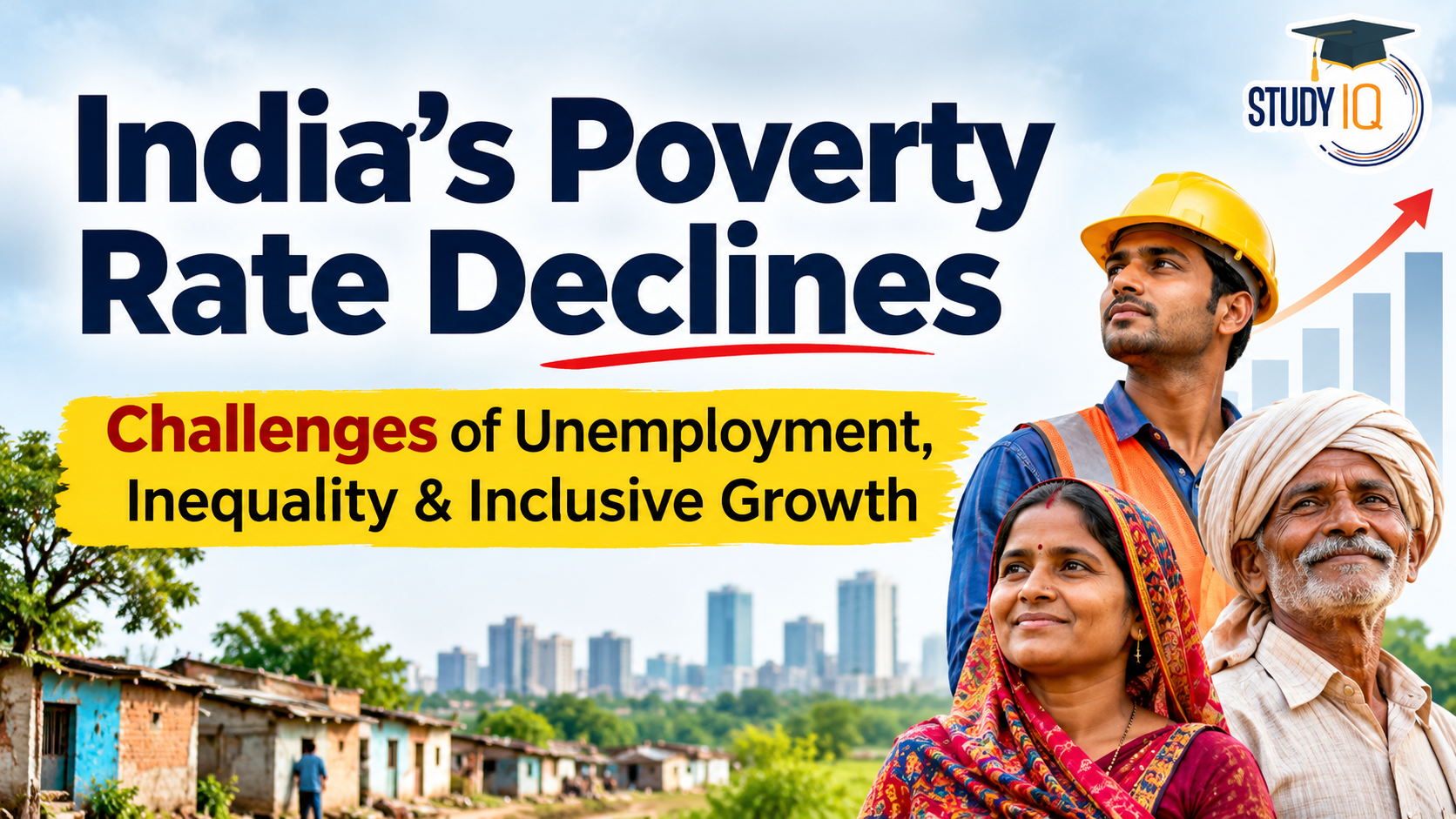
India has made significant progress in poverty reduction over the past decade. According to the World Bank’s October 2026 Poverty and Equity Brief, extreme poverty declined from 27.1% in 2011–12 to 2.6% in 2023–24, using the $3-per-day poverty line (2021 PPP).
Similarly, poverty measured against the $4.20-per-day threshold declined from 57.7% to 16.1%.
However, declining poverty does not automatically translate into better employment opportunities, higher wages or economic security. Youth unemployment, regional disparities and income inequality remain significant challenges.
India’s next development challenge is therefore shifting from poverty alleviation to sustainable livelihood creation and inclusive growth.
Read Also: UPSC Daily Current Affairs 2026
Major Achievements in Poverty Reduction
Several factors have contributed to India’s progress:
-
Expansion of social protection and Direct Benefit Transfer (DBT).
-
Improved access to food security through the Public Distribution System.
-
Growth in household consumption.
-
Expansion of financial inclusion through Jan Dhan accounts.
-
Improvements in housing, sanitation, electricity and drinking water.
These developments demonstrate the contribution of economic growth and welfare interventions to poverty reduction.
However, crossing an international poverty threshold does not necessarily guarantee financial stability or protection against economic shocks.
Regional Disparities: The BIMARU Debate
Despite national progress, poverty remains geographically concentrated.
According to the World Bank, approximately 57% of India’s poor population lives in a contiguous belt extending from Uttar Pradesh to West Bengal.
The traditional BIMARU states include Bihar, Madhya Pradesh, Rajasthan and Uttar Pradesh. Persistent poverty in eastern and central India highlights structural challenges such as:
-
Limited industrial development.
-
Inadequate infrastructure.
-
Poor human capital indicators.
-
Limited productive employment.
-
Uneven urbanisation.
Way forward: Region-specific investment in infrastructure, manufacturing, education and healthcare is essential.
Unemployment and Stagnant Wages
Economic growth does not automatically ensure inclusive development.
India continues to face challenges related to youth unemployment, informal employment and inadequate wage growth.
The World Bank’s October 2026 brief highlights youth unemployment at 15.9% in the period discussed.
Additionally, wage disparities remain significant. According to the Indian Express analysis, factory worker wages in Jharkhand declined by 5.2% in 2024–25, compared with a national increase of 5.3%.
This indicates the need to focus on employment quality rather than merely employment numbers.
Youth Unemployment and NEET Population
NEET refers to young people who are Not in Employment, Education or Training.
District-level findings highlighted in the article indicate substantial youth disengagement in Bihar, West Bengal and Uttar Pradesh.
This creates risks of underutilising India’s demographic dividend, increasing economic dependency and perpetuating intergenerational poverty.
Policy priority: Strengthen vocational education, apprenticeships, digital literacy and industry-oriented skill development.
Way Forward: From Poverty Alleviation to Inclusive Growth
India requires a comprehensive development strategy:
-
Employment-intensive growth: Promote textiles, food processing, tourism and manufacturing.
-
MSME development: Improve credit availability, technology and market access.
-
Regional development: Strengthen infrastructure and industrial investment in poorer states.
-
Skill development: Align education and vocational training with industry requirements.
-
Women’s participation: Improve childcare, workplace safety and employment opportunities.
-
Social security: Expand protection for informal workers and ensure decent wages.
-
Human capital: Invest in healthcare, nutrition and quality education.
Government initiatives such as MGNREGA, PM-KISAN, PM Mudra Yojana, Skill India and the National Rural Livelihoods Mission can support these objectives.
Conclusion
India’s declining poverty rate represents an important development achievement. However, unemployment, regional inequalities and stagnant wages reveal that poverty reduction alone cannot guarantee inclusive growth.
As India moves towards Viksit Bharat @2047, the focus must shift towards productive employment, decent wages, human capital development and sustainable livelihoods.
The real measure of development is not merely how many people escape poverty, but whether they gain access to dignified work, stable incomes and equal economic opportunities.

 NVS-03 Satellite: NavIC Revival, Feature...
 Punjab Drug Crisis: Causes, Drug Traffic...
 UPSC EPFO Interview Schedule 2026 Out, E...













 WhatsApp