Table of Contents
Funding Ecosystem: Context
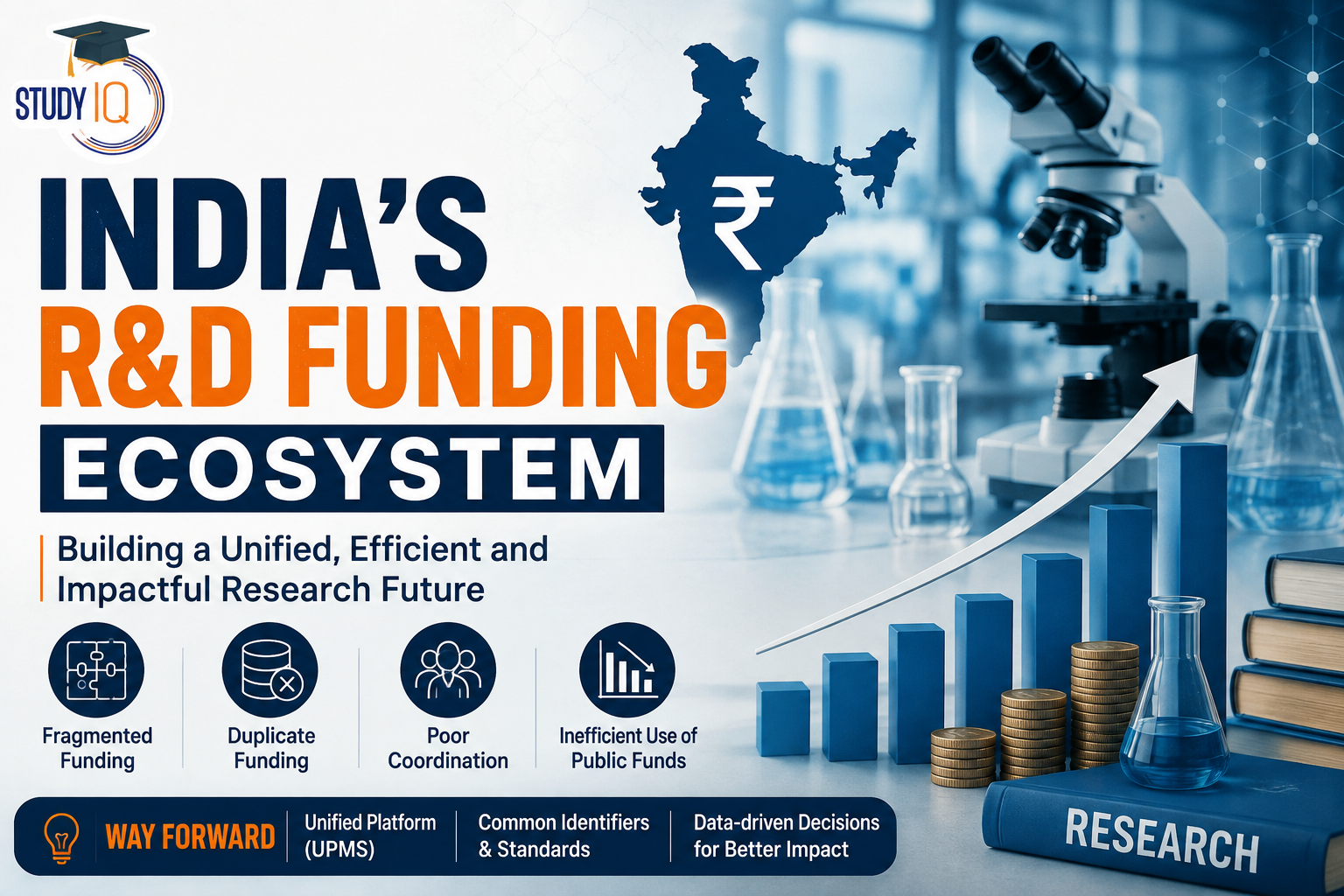
A 2026 NITI Aayog report on Ease of Doing R&D in India found that nearly 80% of funding under the Anusandhan National Research Foundation (ANRF) is concentrated in the IITs, while multiple agencies may be funding similar research areas.
Read Also: UPSC Daily Current Affairs 2026
What explains the concentration of public R&D funding among a limited number of institutions in India?
- Unequal Research Capacity: Institutions with better laboratories, research teams and research-support systems are better placed to compete for competitive grants.
- g., NITI Aayog notes that more than 80% of ANRF R&D funding goes to the IIT system, while the participation of State institutions remains far below the intended level.
- Funding Feedback Loop: Institutions that receive more funding can further improve their infrastructure and research capabilities, increasing their ability to secure future grants.
- Limited Diversity in Review: Concentrated representation in funding committees can favour familiar institutions and research networks, reinforcing the existing concentration of R&D funding.
- g., NITI Aayog noted limited representation of institutions outside the IIT system in ANRF expert committees, which may contribute to a narrower distribution of research funding.
- Unequal Research Capacity: State universities often have weaker labs, research facilities and research-support systems, making it harder for them to compete with well-established institutions for national R&D grants.
- Focus on Research Excellence: Leading institutions may receive a larger share of funding because advanced research requires specialised infrastructure, skilled researchers and a strong research ecosystem.
- g., NITI Aayog states that uniformity in R&D funding is neither expected nor desirable, recognising that institutions with stronger research capabilities may require greater funding for high-end research.
Why does fragmented R&D funding reduce coordination among research funding agencies in India?
- Siloed Funding Data: Separate databases prevent agencies from getting a complete picture of projects already funded by other agencies.
- Incompatible Data Systems: Different agencies use different formats and names for researchers, institutions and projects, making it difficult to match records across databases.
- Poor Information Sharing: When funding information is not routinely shared, agencies find it harder to coordinate their research priorities and funding calls.
- Weak Project Monitoring: Without linked records, agencies cannot easily track whether a researcher or institution is already undertaking related projects or what results earlier funding has produced.
- Higher Administrative Burden: Researchers often provide similar information separately to different agencies, while agencies independently verify and process the same data.
- Weak Learning Across Projects: When grants are not linked with researchers, institutions and research outputs, agencies cannot easily learn from earlier projects while designing new funding programmes.
What are the implications of fragmented R&D funding data for the effective use of public research funds in India?
- Duplicate Funding: Fragmented data makes it difficult for agencies to know whether similar research is already being funded, leading to possible overlap in public spending.
- g., NITI Aayog identified overlapping support by DST and CSIR in Hydrogen Energy and Carbon Capture, Utilisation and Storage, showing how separate funding systems can support similar research.
- Poor Funding Allocation: Fragmented data prevents policymakers from seeing the overall distribution of public R&D funding, making it difficult to identify institutions or research areas that are over-funded, under-funded or receiving little attention.
- Weak Research Planning: Fragmented funding information makes it difficult to align government spending with national research priorities and identify gaps in important research areas.
- Poor Measurement of Research Outcomes: When grant records cannot be reliably linked with researchers, projects and their outputs, it becomes difficult to assess whether public funding is producing meaningful results.
- Higher Research Transaction Costs: Multiple and incompatible funding systems increase the administrative work required from researchers and funding agencies, reducing the efficiency of the research process.
Way Forward
- Build a Single National Platform: Bring Central and State R&D funding agencies onto one common platform to provide a complete picture of research funding.
- g., The proposed Unified Project Management System (UPMS) can serve as a single entry point for planning, funding, monitoring and evaluation of public R&D projects.
- Adopt Common Digital Identifiers: Give every funder, institution, researcher and grant a unique identifier so that records across different agencies can be linked accurately.
- g.,Funder IDs, ROR for institutions, ORCID for researchers and Grant DOIs can connect funding records across agencies and reduce duplication caused by inconsistent names.
- Standardise Research Data: Require agencies to record funding information in a common and machine-readable format covering the funder, researcher, institution, amount, duration and research field.
- g., Standard metadata can ensure that records such as “IISc, Bangalore” and “Indian Institute of Science, Bengaluru” are recognised as the same institution.
- Ensure Interoperability with Global Systems: India should connect its national system with existing global research infrastructure rather than creating an isolated database.
- g., A UPMS-based system compatible with Crossref, ROR and ORCID would allow Indian research funding to be compared and tracked within global research databases.
- Use a Hybrid National Model: India can retain national ownership of the funding platform while adopting internationally compatible technical standards.
- g., The UK Gateway to Research and EU systems such as CORDIS and OpenAIRE demonstrate how government-owned portals can work with globally compatible research identifiers.
- Link Grants to Research Outcomes: Every grant should be connected with the publications, patents, datasets and other outputs produced from it.
- g., A Grant DOI can connect a funded project with its subsequent papers, patents and data, making it easier to assess the impact of public R&D spending.
- Use Data for Funding Decisions: A unified database should not merely store information; it should help identify duplication, funding concentration and neglected research areas.
- g., Comparing grants across agencies can reveal whether multiple agencies are funding near-identical research proposals or the same research theme, allowing better allocation of public funds.

UPSC IAS Live GS P2I Foundation 2027 Pratigya August Evening Batch 2 (Basic)
 Appointment of Deputy Election Commissio...
 UAPA Act 1967: Key Provisions, Supreme C...














 WhatsApp