
Table of Contents
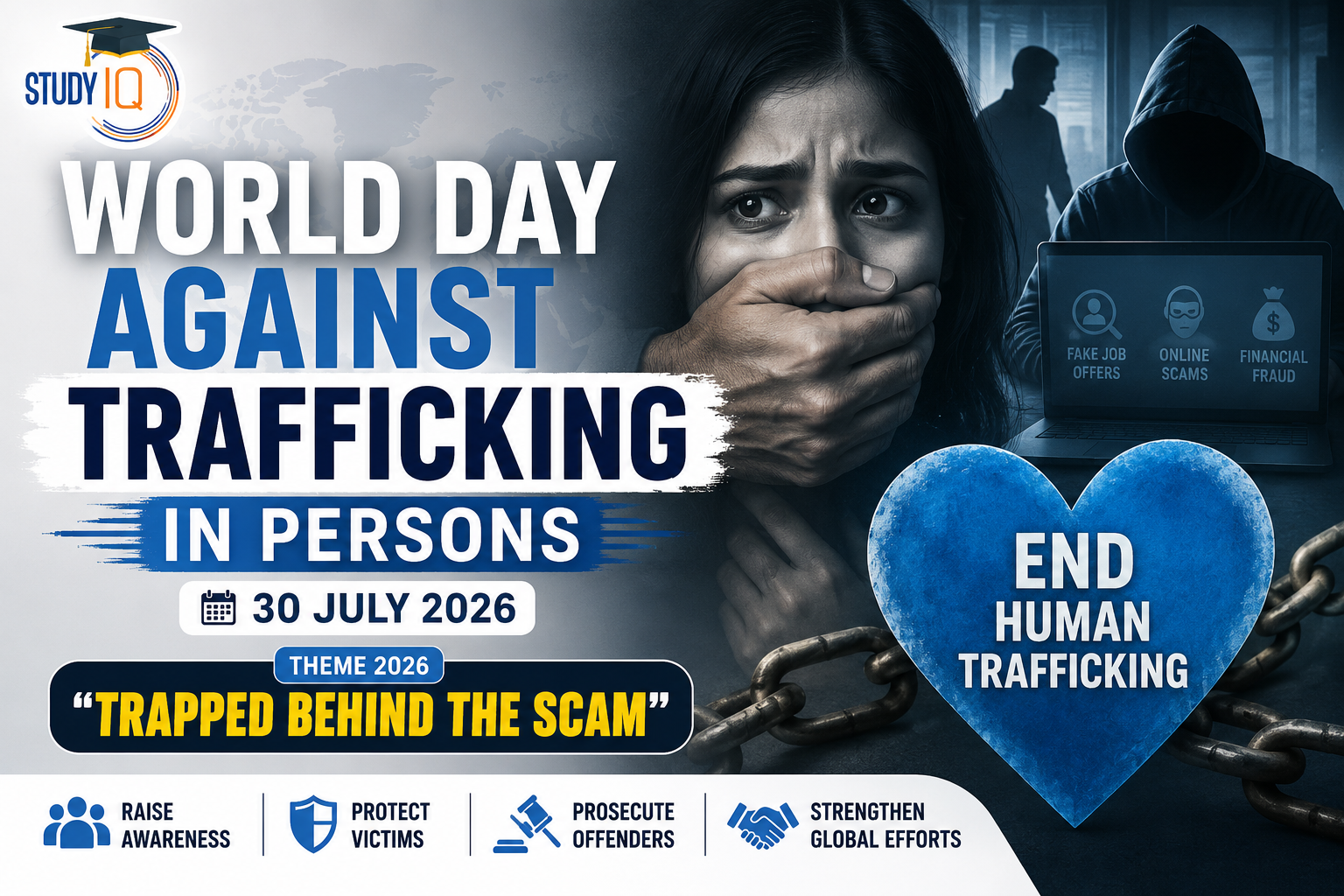
World Day Against Trafficking in Persons 2026 is observed every year on 30 July to raise awareness about the global crime of human trafficking, protect victims’ rights, and strengthen international efforts to prevent trafficking. Established by the United Nations General Assembly (UNGA) in 2013, the day calls for governments, law enforcement agencies, civil society, and citizens to work together against one of the world’s fastest-growing organized crimes.
The 2026 theme, “Trapped Behind the Scam,” highlights the alarming rise of trafficking victims being lured through fake overseas job offers and forced into cyber-enabled financial fraud operations by transnational criminal networks.
Read Also: UPSC Daily Current Affairs 2026
World Day Against Trafficking in Persons 2026 Overview
| Particular | Details |
|---|---|
| Observed On | 30 July 2026 |
| Theme | Trapped Behind the Scam |
| Declared By | United Nations General Assembly (UNGA) |
| First Observed | 2014 |
| UN Resolution | A/RES/68/192 |
| Objective | Raise awareness, protect victims, prevent trafficking, and strengthen global cooperation |
| Lead Organization | United Nations Office on Drugs and Crime (UNODC) |
World Day Against Trafficking in Persons 2026 Theme
The 2026 theme, “Trapped Behind the Scam,” focuses on a rapidly emerging form of human trafficking where victims are deceived by fake international employment opportunities and later forced to conduct online financial scams.
Many organized crime syndicates now combine human trafficking, cybercrime, money laundering, corruption, and digital fraud into sophisticated criminal operations.
Victims are coerced into carrying out activities such as:
- Romance scams
- Cryptocurrency investment fraud
- Online financial scams
- Digital payment fraud
- Phishing attacks
- Fake investment schemes
- Social media deception
The theme emphasizes that behind many online scams are individuals who are themselves victims of trafficking and forced criminality.
What is Human Trafficking?
Human trafficking is a grave violation of human rights involving the recruitment, transportation, transfer, harbouring, or receipt of persons through:
- Force
- Threats
- Fraud
- Deception
- Abuse of power
- Exploitation of vulnerability
The objective is exploitation, which may include:
- Sexual exploitation
- Forced labour
- Domestic servitude
- Modern slavery
- Forced criminal activities
- Child exploitation
- Organ trafficking
The internationally accepted definition comes from the UN Protocol to Prevent, Suppress and Punish Trafficking in Persons (Palermo Protocol).
How Victims Become Trapped in Online Scam Networks
According to the United Nations Office on Drugs and Crime (UNODC), traffickers increasingly exploit vulnerable individuals using fraudulent recruitment campaigns.
1. Fake Job Offers
Victims receive attractive overseas employment offers in sectors such as:
- Customer support
- Information technology
- Marketing
- Data entry
- Digital services
2. Cross-Border Trafficking
Once victims arrive in another country:
- Passports are confiscated
- Communication is restricted
- Movement is tightly controlled
- Victims are confined inside guarded compounds
3. Forced Cyber Fraud
Victims are compelled to conduct:
- Romance scams
- Cryptocurrency investment fraud
- Online investment scams
- Financial phishing
- Digital payment fraud
4. Abuse and Exploitation
Victims often experience:
- Physical violence
- Psychological torture
- Debt bondage
- Constant surveillance
- Threats against family members
- Unrealistic work targets
These conditions leave victims with little opportunity to escape.
Global Financial Impact
According to UNODC, cyber-enabled scam centres operating in East and South-East Asia generated an estimated US$18–37 billion in financial losses during 2023.
Many of these scam operations are believed to be linked with organized criminal groups that simultaneously engage in:
- Human trafficking
- Cybercrime
- Money laundering
- Drug trafficking
- Corruption
UNODC’s Efforts to Combat Human Trafficking
The United Nations Office on Drugs and Crime (UNODC) supports countries through a comprehensive anti-trafficking strategy.
Strengthening Investigations
UNODC assists governments by:
- Training investigators
- Improving victim identification
- Supporting anti-trafficking task forces
- Enhancing prosecution capabilities
Strengthening Legal Frameworks
It helps countries modernize laws addressing:
- Human trafficking
- Cybercrime
- Organized crime
- Money laundering
- Corruption
Promoting International Cooperation
Since trafficking networks operate across borders, UNODC promotes:
- Intelligence sharing
- Joint investigations
- Mutual legal assistance
- International law enforcement cooperation
United Nations Convention Against Cybercrime
A major international development was the adoption of the United Nations Convention Against Cybercrime by the UN General Assembly in December 2024.
The Convention aims to:
- Strengthen international cooperation against cybercrime
- Improve collection of digital evidence
- Facilitate cross-border criminal investigations
- Combat online fraud and organized cybercrime
- Support action against trafficking-linked scam operations
The convention represents an important legal framework for addressing technology-enabled trafficking crimes.
Blue Heart Campaign Against Human Trafficking
The Blue Heart Campaign is the global awareness initiative led by the United Nations Office on Drugs and Crime (UNODC).
What Does the Blue Heart Symbolize?
The Blue Heart represents:
- Solidarity with victims
- Hope for survivors
- Global commitment to ending trafficking
- Awareness about modern slavery
- The cold-heartedness of traffickers who exploit people for profit
The campaign encourages governments, organizations, businesses, and citizens to unite against human trafficking.
How Can Individuals Help?
Everyone can contribute to combating human trafficking by:
- Sharing awareness campaigns using #EndHumanTrafficking
- Supporting the Blue Heart Campaign
- Donating to the United Nations Voluntary Trust Fund for Victims of Human Trafficking
- Educating communities about trafficking risks
- Verifying overseas job offers
- Reporting suspicious recruitment agencies or trafficking activities
- Promoting safe migration practices
History of World Day Against Trafficking in Persons
Recognizing the growing global threat of trafficking, the United Nations General Assembly adopted Resolution A/RES/68/192 in December 2013, declaring 30 July as the World Day Against Trafficking in Persons.
The day has been observed annually since 2014 to:
- Raise public awareness
- Protect victims’ rights
- Promote implementation of international anti-trafficking laws
- Encourage cooperation among governments and law enforcement agencies
Importance of World Day Against Trafficking in Persons
The observance is increasingly significant because:
- Millions of people remain vulnerable to trafficking worldwide.
- Criminal networks are increasingly using digital platforms to recruit victims.
- Online scam compounds have emerged as a new form of forced criminality.
- International cooperation is essential to dismantle transnational trafficking networks.
- Greater public awareness can prevent recruitment through fraudulent employment offers and protect vulnerable communities.
Key Facts for UPSC, SSC & Competitive Exams
- Date Observed: 30 July
- Theme 2026: Trapped Behind the Scam
- Declared By: United Nations General Assembly
- UN Resolution: A/RES/68/192
- Lead UN Agency: United Nations Office on Drugs and Crime (UNODC)
- Global Symbol: Blue Heart
- International Legal Instrument: Palermo Protocol (UN Protocol to Prevent, Suppress and Punish Trafficking in Persons)
- Major Concern in 2026: Forced cyber-enabled financial scams through fake overseas job offers
- New International Framework: United Nations Convention Against Cybercrime (adopted in December 2024)
 Species in News: Asian Wild Pig- Habitat...
 BRICS AI Open-Source Community: China’...
 India’s Artificial Sun: New 82.6 GHz G...













 WhatsApp





