Table of Contents
The United Nations Commission on International Trade Law (UNCITRAL) recently marked its 60th anniversary, with India’s External Affairs Minister addressing the inaugural session. As the principal legal body of the United Nations for international trade law, UNCITRAL plays a crucial role in creating harmonised legal frameworks that facilitate international commerce and investment.
For UPSC aspirants, UNCITRAL is an important international organisation frequently featured in current affairs and International Relations.
What is UNCITRAL?
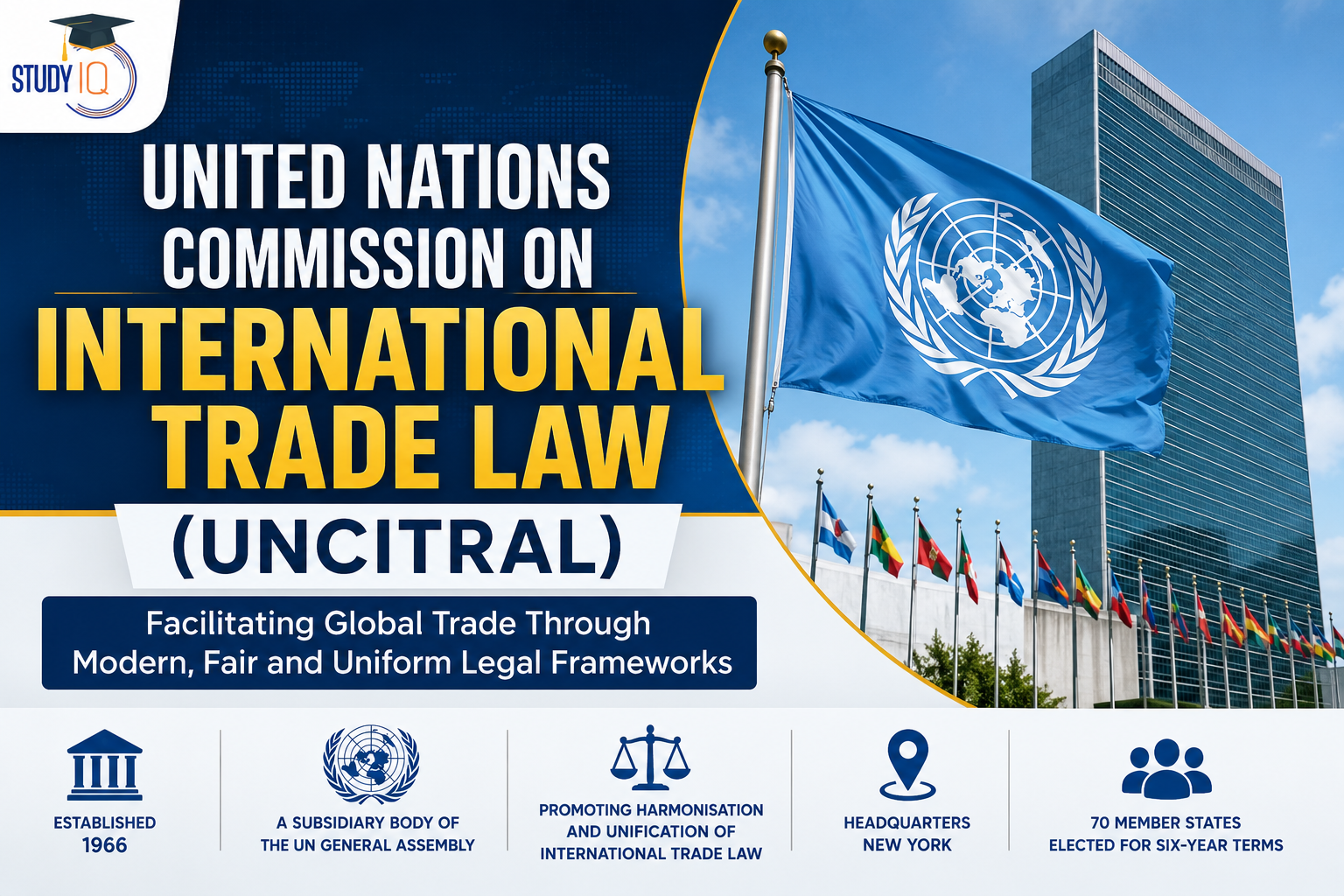
The United Nations Commission on International Trade Law (UNCITRAL) is a subsidiary body of the United Nations General Assembly, established in 1966. It serves as the UN’s primary legal body responsible for promoting the harmonisation and modernisation of international trade law.
Its work aims to reduce legal barriers to international trade by developing internationally accepted legal standards that provide certainty and predictability in commercial transactions.
Key Facts about UNCITRAL
| Particular | Details |
|---|---|
| Full Name | United Nations Commission on International Trade Law |
| Established | 1966 |
| Parent Body | United Nations General Assembly |
| Nature | Principal legal body of the UN for international trade law |
| Headquarters | New York |
| Annual Sessions | Held alternately in Vienna and New York |
| Members | 70 Member States |
| Membership Term | Six years |
| Renewal | Half the members elected every three years |
| India | Founding Member |
Objectives of UNCITRAL
UNCITRAL seeks to create a predictable and efficient legal environment for international trade. Its major objectives include:
- Harmonising international trade laws across countries.
- Modernising outdated commercial legal frameworks.
- Reducing legal obstacles in cross-border trade.
- Encouraging investment through legal certainty.
- Supporting economic development by facilitating international commerce.
- Promoting uniform commercial rules accepted globally.
Functions of UNCITRAL
UNCITRAL performs several important functions to improve international commercial law.
1. Drafting International Legal Instruments
It prepares:
- Model Laws
- Conventions
- Legislative Guides
- Practice Guides
These instruments help countries adopt uniform commercial laws.
2. Harmonising Trade Laws
It works towards reducing legal differences among countries that create barriers to international business.
3. Promoting Uniform Commercial Rules
UNCITRAL develops internationally accepted legal standards covering:
- International sale of goods
- Arbitration
- Electronic commerce
- Insolvency law
- Secured transactions
- Public procurement
- Mediation
4. Technical Assistance
It assists countries in:
- Drafting legislation
- Reforming commercial laws
- Building institutional capacity
5. Capacity Building
UNCITRAL conducts seminars, training programmes and awareness initiatives to strengthen legal systems worldwide.
Membership of UNCITRAL
UNCITRAL consists of 70 Member States elected by the United Nations General Assembly.
Membership Features
- Six-year tenure
- Half of the members are replaced every three years.
- Ensures equitable geographical representation.
Regional Representation
Members are elected from five regional groups:
- African States
- Asian States
- Eastern European States
- Latin American and Caribbean States
- Western European and Other States
India has been associated with UNCITRAL since its establishment as a founding member.
Headquarters and Sessions
UNCITRAL is headquartered in New York.
Its annual sessions are held alternately in New York and Vienna, allowing participation from member states and international legal experts.
Major Areas Covered by UNCITRAL
UNCITRAL develops legal frameworks relating to:
- International commercial arbitration
- International sale of goods
- Electronic commerce
- Digital trade
- Cross-border insolvency
- Mediation
- Public procurement
- Transport law
- Investment dispute settlement
- Micro, Small and Medium Enterprises (MSMEs)
Importance of UNCITRAL
UNCITRAL has significantly contributed to making international trade more efficient and legally secure.
Its importance includes:
- Facilitates global trade.
- Promotes legal certainty in cross-border transactions.
- Encourages foreign investment.
- Reduces commercial disputes.
- Supports developing countries in legal reforms.
- Enhances international economic cooperation.
India’s Role in UNCITRAL
India has been actively associated with UNCITRAL since its inception.
India’s Contributions
- Founding member of UNCITRAL.
- Participates in drafting international trade laws.
- Supports rules-based international commerce.
- Advocates balanced legal frameworks that protect both developed and developing economies.
- Uses UNCITRAL standards in strengthening its commercial and arbitration laws.
India has also undertaken reforms in commercial dispute resolution and arbitration that align with UNCITRAL principles.
Why UNCITRAL Matters for UPSC
UNCITRAL is important for:
UPSC Prelims
Questions may be asked on:
- Year of establishment
- Parent organisation
- Headquarters
- Membership
- Functions
- India’s role
UPSC Mains
Relevant topics include:
- International institutions
- Global governance
- International trade
- Economic diplomacy
- Rule-based multilateral trading system
- Ease of doing business
Read Also: UPSC Daily Current Affairs 2026
 Species in News: Asian Wild Pig- Habitat...
 BRICS AI Open-Source Community: China’...
 India’s Artificial Sun: New 82.6 GHz G...














 WhatsApp