Table of Contents
Context
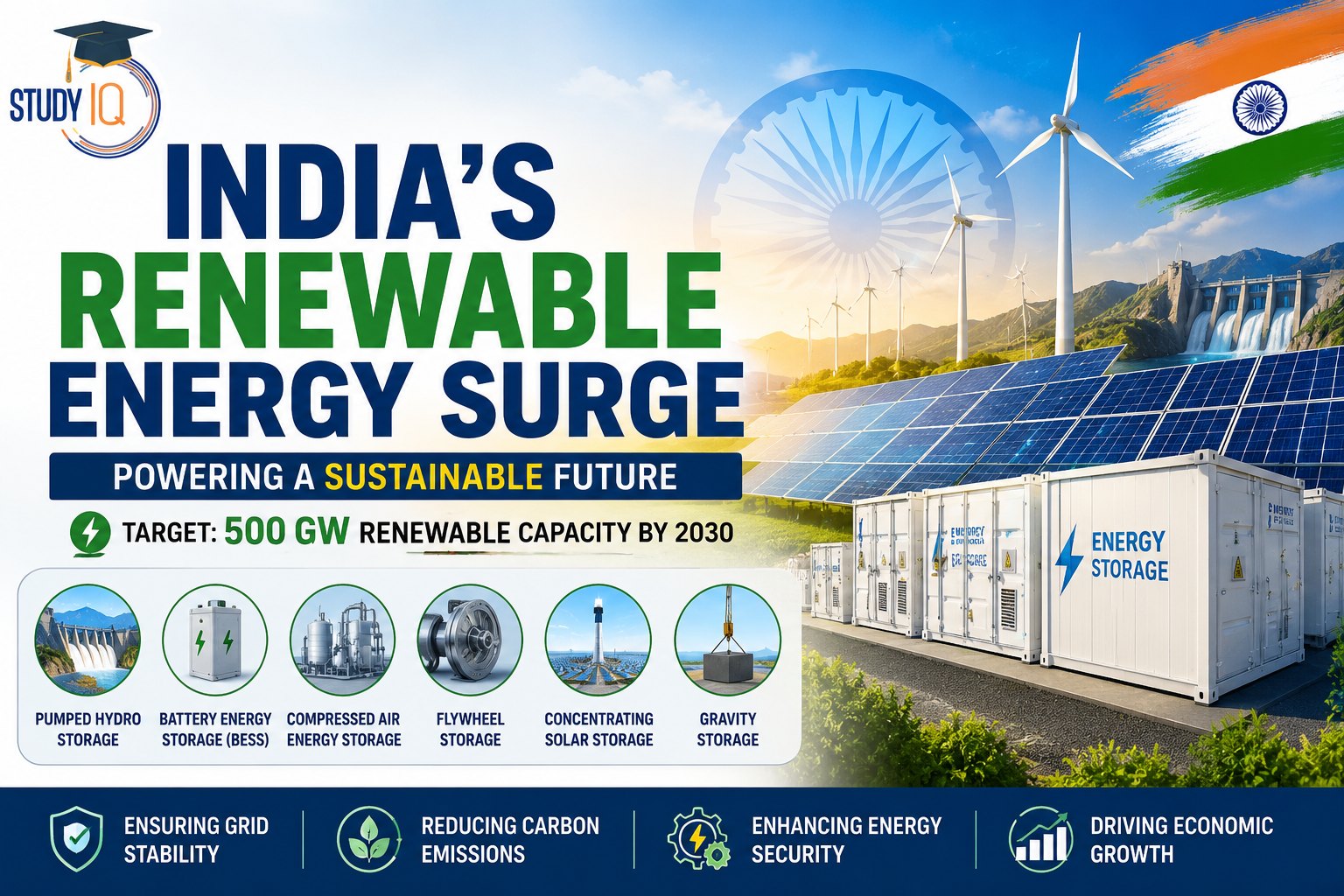
As India targets 500 GW of renewable energy capacity by 2030, energy storage has become crucial for ensuring reliable and stable power supply.
About Energy Storage
- Meaning of Energy Storage: Energy storage refers to technologies and systems that store surplus electricity during periods of excess generation and release it when power demand exceeds supply.
- Enabling Reliable Renewable Energy: Energy storage separates the timing of electricity generation from consumption, allowing renewable energy sources to function more reliably like dispatchable power.
- Importance of Storage Systems: Without energy storage, excess renewable power is wasted through curtailment, grid stability is affected during low-generation periods, and dependence on coal-based baseload power continues.
Types of Energy Storage Technologies
| Technology | How It Works & India Status |
| Pumped Hydro Storage (PHS) | Pumps water from lower to upper reservoir using surplus electricity; releases water through turbines on demand. India’s dominant storage technology: 94 GW installed; needs to grow to ~124 GW by 2036. |
| Battery Energy Storage System (BESS) | Li-ion batteries store surplus power; discharge on demand. Fast response (milliseconds). India has only ~0.27 GW installed vs 41 GW needed by 2030 — the most critical gap. |
| Compressed Air Energy Storage (CAES) | Stores excess electricity as compressed air in underground caverns; released through turbines. Nascent stage in India. |
| Flywheels | Stores energy as rotational kinetic energy; provides rapid, short-duration grid stability. Used for frequency regulation. |
| Concentrating Solar (CSES) | Molten salt stores solar heat energy; turbines run on stored heat after sunset. Pilot stage in India; Rajasthan is ideal. |
| Gravity Storage | Uses heavy masses lifted by surplus electricity; lowered to generate power. Early commercial stage globally. |
India’s Storage Gap
- Limited Battery Storage Capacity: Despite having nearly 220 GW of installed renewable energy capacity in 2025, India’s Battery Energy Storage System (BESS) capacity remains extremely low at only around 0.27 GW.
- Rising Future Storage Requirement: The Central Electricity Authority estimates that India will require 41 GW/160 GWh of BESS and 124 GW of pumped hydro storage by 2036 for reliable renewable integration.
- Dependence on Chinese Imports: India imports nearly 75-80% of its lithium-ion battery cells from China, creating strategic and economic vulnerabilities in the energy transition.
- Emerging Duck Curve Challenge: Grid operators increasingly face the “duck curve” problem, where excess solar generation during afternoons is followed by sharp electricity demand after sunset.
Associated challenges
- High Cost of BESS: Battery Energy Storage Systems remain expensive, with installation costs of nearly Rs 3-4 crore per MWh and heavy dependence on imported lithium-ion cells.
- Chinese Dominance in Supply Chains: China controls nearly 70% of global lithium-ion battery manufacturing and key mineral processing, while India has limited domestic refining and processing capacity.
- Constraints in Pumped Hydro Projects: Most suitable pumped hydro sites are located in ecologically sensitive regions such as the Himalayas and Western Ghats, leading to environmental and social concerns along with long gestation periods.
- Weak Financial Health of DISCOMs: State DISCOMs continue to face cumulative losses exceeding Rs 6 lakh crore, limiting their ability to invest in storage and grid modernisation.
- Policy and Regulatory Gaps: India lacks a mandatory storage procurement framework, resulting in fragmented BESS deployment and weak long-term investment signals.
Way Forward
- National Battery Storage Policy: India should mandate storage integration with large renewable energy projects and establish a predictable long-term procurement pipeline.
- Expanding ACC Manufacturing: The Production Linked Incentive Scheme for Advanced Chemistry Cells should be accelerated to achieve domestic battery manufacturing capacity of 50 GWh annually by 2030.
- Diversifying Critical Mineral Sources: India must strengthen partnerships with lithium-rich countries such as Australia, Chile, Argentina, and the Democratic Republic of the Congo while expanding the role of Khanij Bidesh India Limited.
- Fast-Tracking Pumped Hydro Projects: A dedicated approval mechanism should accelerate environmental clearances and promote community-linked pumped storage projects in hilly states.
- Reforming DISCOMs: Schemes such as the Revamped Distribution Sector Scheme should be fully implemented to improve DISCOM finances and attract private investment in storage infrastructure.
- Promoting Green Hydrogen Storage: India should expand green hydrogen production using surplus renewable energy to complement battery storage for long-duration energy needs.
|
Read More Notes |
|
| Environment Notes | Art and Culture Notes |
| Science and Tech | History Notes |
| Geography Notes | Indian Polity Notes |
| General Knowledge | International Relation |
|
Explore StudyIQ Courses |
|
 India–Poland Relations 2026: Strategic...
 Supreme Court on Children's Right to Int...
 Daily Current Affairs PDF 2026: Download...











 WhatsApp