Table of Contents
Context
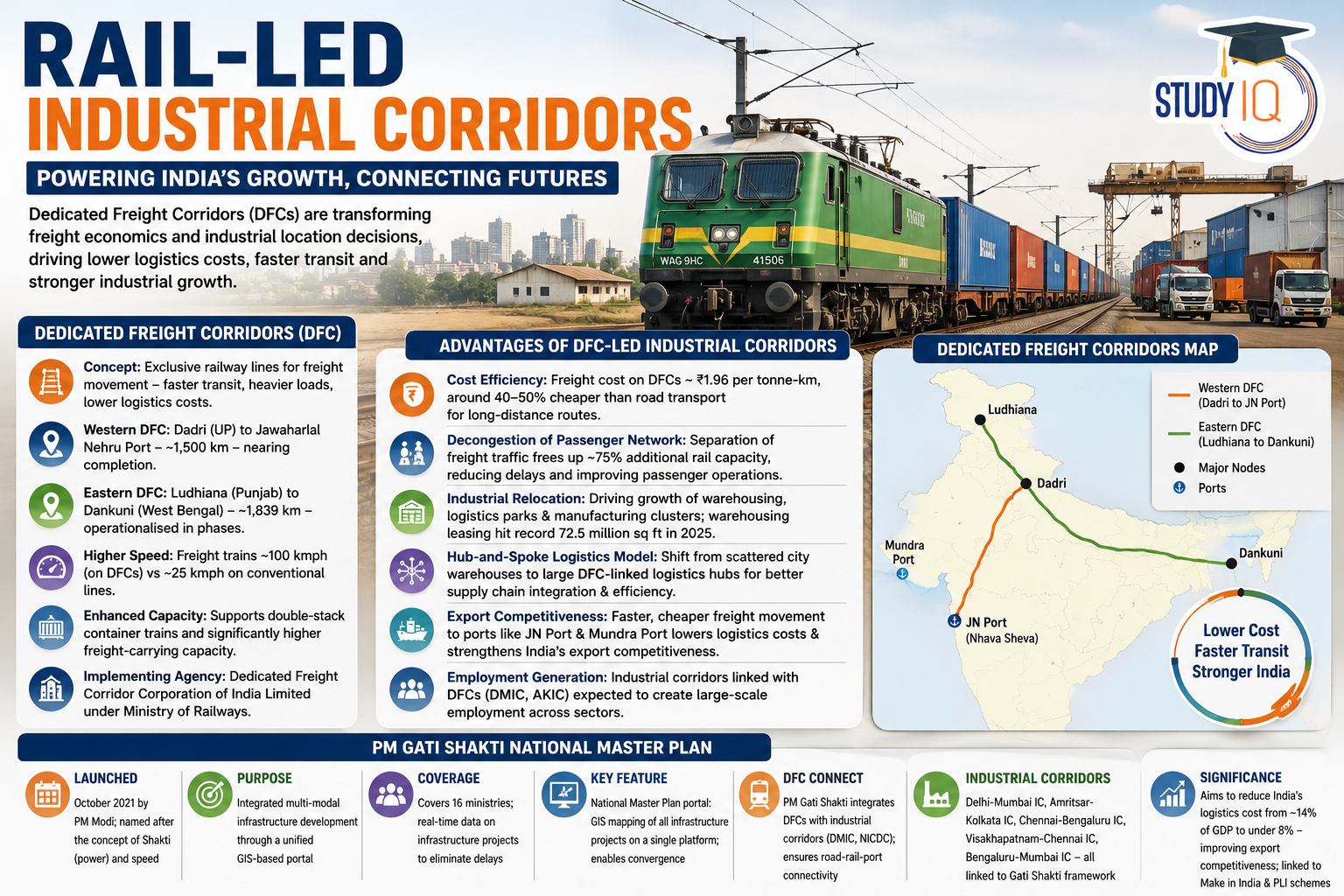
India’s Dedicated Freight Corridors (DFCs) are fundamentally transforming freight economics and industrial location decisions. With the Western DFC nearing completion, warehousing leasing hit a record 72.5 million sq ft in 2025 (+29% year-on-year), driven by firms relocating supply chains along freight corridors.
Read Also: UPSC Daily Current Affairs 2026
About Dedicated Freight Corridors (DFC)
- Concept: DFCs are exclusive railway lines designed solely for freight movement, enabling faster transit, heavier loads, and lower logistics costs.
- Western Dedicated Freight Corridor: It connects Dadri in Uttar Pradesh to Jawaharlal Nehru Port over nearly 1,500 km and is close to operational completion.
- Eastern Dedicated Freight Corridor: The Eastern DFC links Ludhiana in Punjab to Dankuni in West Bengal across nearly 1,839 km and is being operationalised in phases.
- Higher Freight Speed: Freight trains on DFCs can operate at speeds of nearly 100 kmph compared to about 25 kmph on conventional shared railway lines.
- Enhanced Carrying Capacity: DFCs support double-stack container trains and significantly higher freight-carrying capacity than traditional rail corridors.
- Implementing Agency: The corridors are being developed by the Dedicated Freight Corridor Corporation of India Limited under the Ministry of Railways.
Advantages of DFC-led Industrial Corridors
- Cost Efficiency: Dedicated Freight Corridors (DFCs) reduce freight transportation costs to nearly Rs 1.96 per tonne-km, making them around 40–50% cheaper than road transport for long-distance routes.
- Decongestion of Passenger Network: The separation of freight traffic from passenger lines frees up nearly 75% additional rail capacity which enables smoother passenger operations and reduces delays.
- Industrial Relocation: DFC corridors are driving the growth of warehousing, logistics parks, and manufacturing clusters, with warehousing leasing reaching a record 72.5 million sq ft in 2025.
- Hub-and-Spoke Logistics Model: Industries are shifting from scattered city warehouses to large DFC-linked logistics hubs to improve supply chain integration and operational efficiency.
- Export Competitiveness: Faster and cheaper freight movement to ports such as Jawaharlal Nehru Port and Mundra Port helps lower India’s logistics costs and strengthens export competitiveness.
- Employment Generation: Industrial corridors linked with DFCs, including the Delhi-Mumbai Industrial Corridor and the Amritsar-Kolkata Industrial Corridor, are expected to create large-scale employment opportunities across sectors.
| PM Gati Shakti National Master Plan | |
| Launched | October 2021 by PM Modi; named after the concept of Shakti (power) and speed |
| Purpose | Integrated multi-modal infrastructure development — roads, railways, airways, waterways, ports, logistics, digital infrastructure — through a unified GIS-based portal |
| Coverage | Covers 16 ministries; provides real-time data on infrastructure projects to eliminate delays caused by siloed planning |
| Key Feature | National Master Plan portal: GIS mapping of all infrastructure projects on a single platform; enables convergence of state and central projects |
| DFC Connect | PM Gati Shakti directly integrates DFCs with industrial corridors (DMIC, NICDC); ensures road-rail-port connectivity |
| Industrial Corridors | Delhi-Mumbai IC, Amritsar-Kolkata IC, Chennai-Bengaluru IC, Visakhapatnam-Chennai IC, Bengaluru-Mumbai IC — all linked to the Gati Shakti framework |
| Significance | Aims to reduce India’s logistics cost from ~14% of GDP to under 8% — improving export competitiveness; directly linked to Make in India and PLI schemes |
|
Read More Notes |
|
| Environment Notes | Art and Culture Notes |
| Science and Tech | History Notes |
| Geography Notes | Indian Polity Notes |
| General Knowledge | International Relation |
|
Explore StudyIQ Courses |
|
 India–Poland Relations 2026: Strategic...
 Supreme Court on Children's Right to Int...
 Daily Current Affairs PDF 2026: Download...














 WhatsApp