Table of Contents
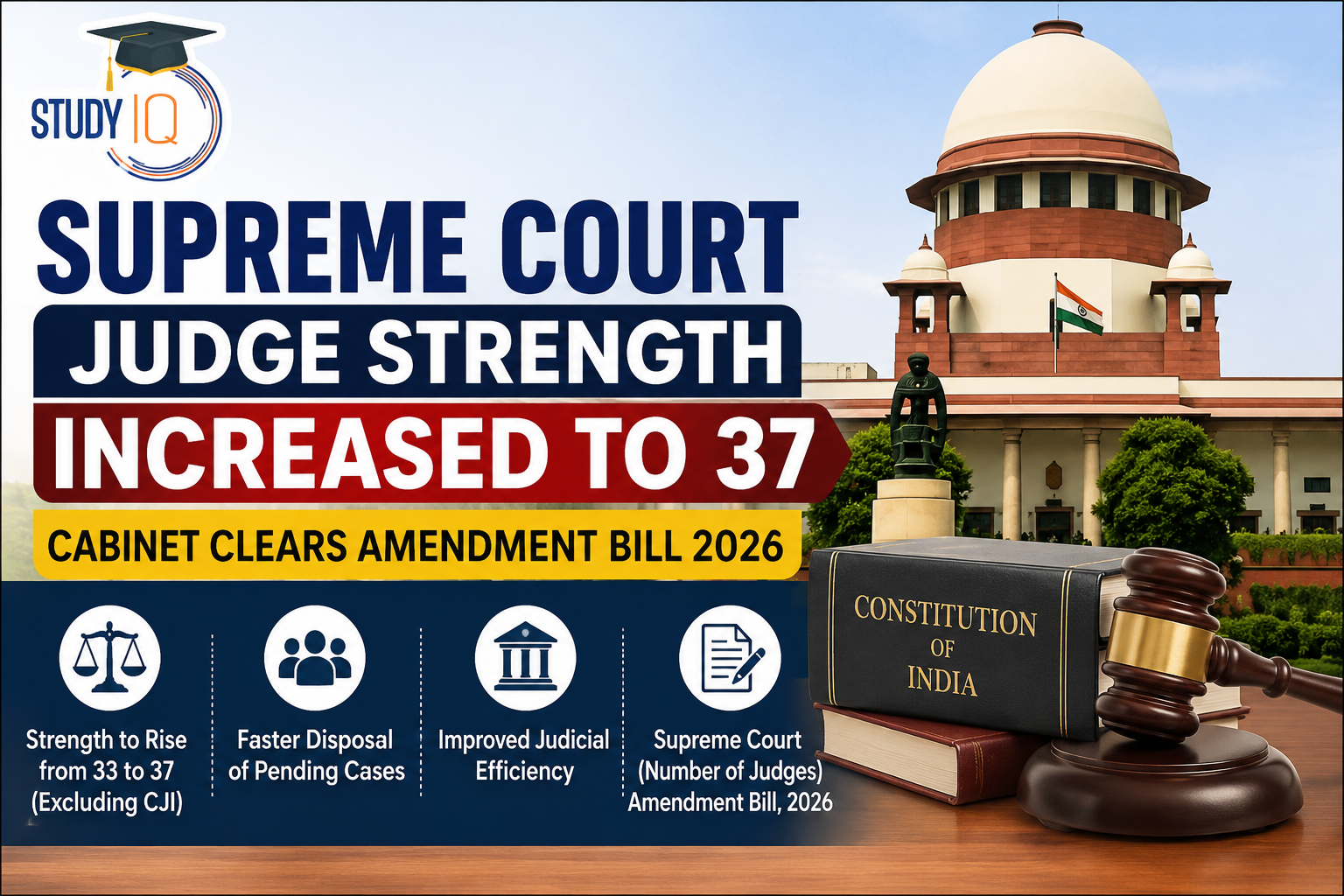
The Union Cabinet, chaired by Prime Minister Narendra Modi, has approved a major judicial reform proposal to increase the strength of the Supreme Court of India from 33 judges to 37 judges, excluding the Chief Justice of India (CJI). With the CJI included, the total sanctioned strength of the apex court will rise from 34 to 38 judges.
The proposal will be introduced in Parliament through the Supreme Court (Number of Judges) Amendment Bill, 2026. The move is aimed at improving judicial efficiency, reducing case pendency, and ensuring speedy justice delivery across the country.
Supreme Court Judge Strength Increased to 37
At present, the Supreme Court has a sanctioned strength of:
- 33 judges, excluding the CJI
- 34 judges, including the CJI
After the amendment:
- 37 judges, excluding the CJI
- 38 judges, including the CJI
This will be one of the biggest expansions in the strength of the apex court in recent years.
Key Highlights of the Supreme Court (Number of Judges) Amendment Bill 2026
| Feature | Details |
|---|---|
| Bill Name | Supreme Court (Number of Judges) Amendment Bill, 2026 |
| Current Strength | 33 Judges + CJI |
| Proposed Strength | 37 Judges + CJI |
| Total Increase | 4 Additional Judges |
| Objective | Faster disposal of pending cases |
| Constitutional Basis | Article 124(1) |
| Funding Source | Consolidated Fund of India |
Why the Increase in Supreme Court Judges is Important
India’s judiciary has been facing a continuous rise in pending cases over the years. The Supreme Court handles:
- Constitutional matters
- Centre-State disputes
- Fundamental Rights cases
- Election disputes
- Criminal and civil appeals
- Public Interest Litigations (PILs)
Due to increasing litigation and complex governance issues, the workload on judges has expanded significantly.
Benefits of Increasing Judge Strength
1. Faster Disposal of Cases
Additional judges will help reduce the backlog of pending cases and speed up hearings.
2. Better Judicial Efficiency
More judges mean more benches can function simultaneously.
3. Reduced Burden on Existing Judges
The current judges face enormous workload pressure. Extra appointments can improve work distribution.
4. Speedy Constitutional Hearings
Constitution benches often take time due to limited judge availability. Higher strength can improve constitutional adjudication.
5. Improved Access to Justice
Citizens may receive quicker judgments and reduced delays.
Pendency of Cases in the Supreme Court
The Supreme Court has witnessed a steady increase in pending cases over the years due to:
- Population growth
- Increase in awareness of legal rights
- Expansion of governance and regulations
- Rise in PILs and constitutional litigation
The government believes that expanding judicial capacity is necessary to ensure timely justice.
Constitutional Provision Related to the Supreme Court’s Strength
Under Article 124(1) of the Constitution of India:
Article 124(1): There shall be a Supreme Court of India consisting of a Chief Justice of India and such number of Judges as Parliament may by law prescribe.
This provision empowers Parliament to determine the strength of the Supreme Court through legislation. Accordingly, the number of judges in the apex court can be increased or modified by passing a law in Parliament.
At the time of the commencement of the Constitution in 1950, the Supreme Court consisted of:
One Chief Justice of India (CJI)
Up to seven puisne judges
Over the years, with the rise in population, litigation, constitutional responsibilities, and pendency of cases, Parliament amended the Supreme Court (Number of Judges) Act, 1956 several times to enhance the sanctioned strength of the Court according to judicial requirements.
History of Supreme Court Judge Strength in India
The Supreme Court’s strength has expanded gradually since independence.
| Year | Judge Strength (Excluding CJI) |
|---|---|
| 1950 | 7 |
| 1956 | 10 |
| 1960 | 13 |
| 1977 | 17 |
| 1986 | 25 |
| 2008 | 30 |
| 2019 | 33 |
| 2026 (Proposed) | 37 |
The 2026 amendment represents another major step in judicial reforms.
Supreme Court (Number of Judges) Act, 1956
The Supreme Court (Number of Judges) Act, 1956 determines the sanctioned strength of the apex court.
The new amendment bill seeks to revise the provisions of the 1956 Act to formally increase the number of judges.
Expenditure on Additional Judges
The expenses related to:
- Salaries
- Staff
- Court infrastructure
- Security
- Housing and administrative support
will be charged to the Consolidated Fund of India.
The Consolidated Fund is the primary financial account of the Government of India where:
- Government revenues
- Loans
- Recoveries of loans
are deposited.
Challenges Before the Indian Judiciary
Despite the increase in judge strength, several structural challenges remain:
1. Vacancy Delays
Judicial appointments often face delays.
2. Infrastructure Issues
Many courts lack adequate infrastructure and digital facilities.
3. Rising Litigation
Increasing awareness and governance complexities continue to raise litigation volume.
4. Judicial Reforms Needed
Experts argue that reforms should also focus on:
- Lower judiciary
- Technology adoption
- Case management systems
- Judicial accountability
Government’s Objective Behind the Amendment
The Centre has stated that the proposal aims to:
- Improve justice delivery
- Reduce pendency
- Enhance judicial functioning
- Strengthen constitutional governance
- Increase institutional efficiency
The move is being viewed as an important reform to modernize India’s judicial system.
Important Areas for Preparation
- Article 124
- Judicial reforms
- Supreme Court structure
- Pendency of cases
- Separation of powers
- Constitutional bodies
Frequently Asked Questions (FAQs)
What is the new strength of the Supreme Court?
The sanctioned strength will increase to 38 judges, including the CJI, and 37 judges excluding the CJI.
Which law will be amended?
The Supreme Court (Number of Judges) Act, 1956, will be amended through the 2026 Amendment Bill.
Which Article deals with the Supreme Court composition?
Article 124(1) of the Constitution deals with the composition of the Supreme Court.
Why is judge strength being increased?
The increase aims to reduce case backlog, improve judicial efficiency, and ensure faster justice delivery.
Who approved the proposal?
The Union Cabinet, led by Prime Minister Narendra Modi, approved the proposal.
Conclusion
The Cabinet approval to increase the strength of the Supreme Court from 33 to 37 judges excluding the Chief Justice marks a significant development in India’s judicial reform journey. As the country faces growing litigation and rising constitutional challenges, strengthening the apex court’s capacity is seen as essential for ensuring timely justice and maintaining public confidence in the judiciary.
The Supreme Court (Number of Judges) Amendment Bill, 2026 is expected to play a key role in improving the efficiency, accessibility, and responsiveness of India’s highest court.
Sharing is caring!
 Kathakali Festival 2026: Theme, History ...
 Kohat Attack 2026: What Happened in Khyb...
 World Bamboo Day 2026: Date, Theme, Hist...














 WhatsApp