
Table of Contents
Context
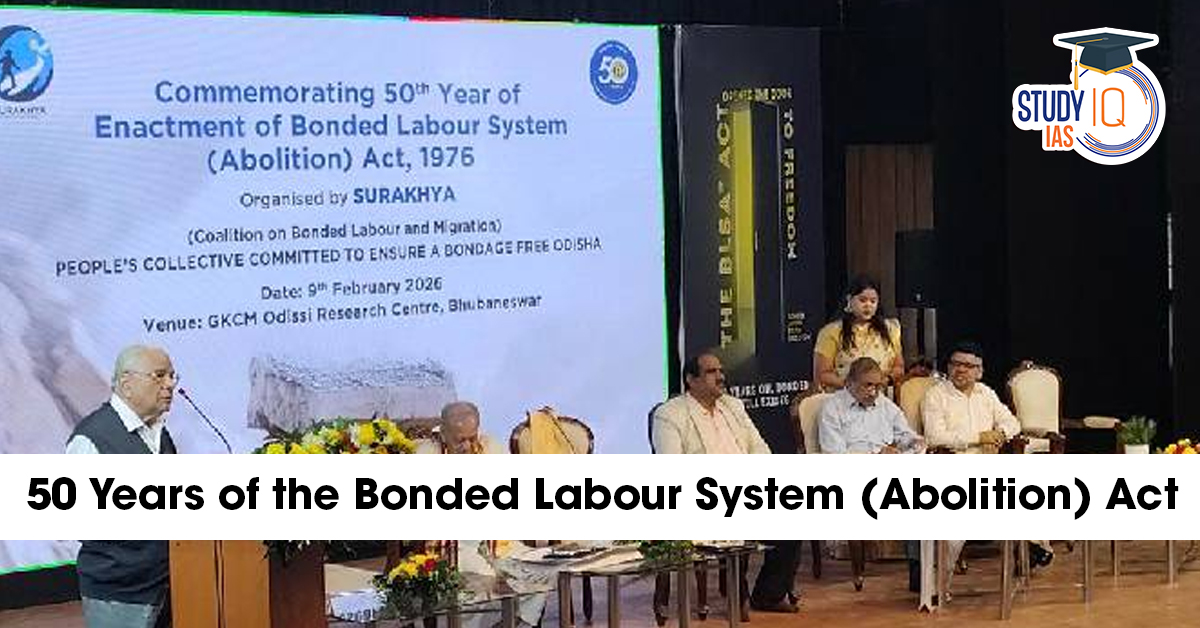
The Bonded Labour System (Abolition) Act, 1976, enacted to eradicate one of the most exploitative forms of labour in India, completed 50 years in 2026. The law abolished bonded labour, extinguished bonded debts, and placed responsibility on the State to identify, release, and rehabilitate bonded labourers. However, five decades later, ground realities indicate that while rescue has improved, rehabilitation remains weak, resulting in cyclical and inter-generational bondage.
Bonded Labour System (Abolition) Act, 1976: Salient Features
- Abolition of the System: The Act legally extinguishes all forms of bonded labour and renders such arrangements void.
- Extinguishment of Debt: All bonded debts stand cancelled, releasing labourers from inherited or coercive financial liabilities.
- Release of Labourers: Authorities are required to ensure the prompt liberation of persons held in bondage.
- Protection from Displacement: Freed labourers cannot be evicted from homesteads or lands they previously occupied due to bonded arrangements
- District-Level Implementation: District Magistrates, assisted by Vigilance Committees, are entrusted with identification, release, and monitoring.
- Rehabilitation Measures: The framework provides for financial assistance, housing support, land allotment, and livelihood rehabilitation.
- Identification and Rescue: Periodic surveys and enforcement drives are mandated to detect and eliminate instances of bondage.
|
Concept of Bonded Labour in India |
| ● Definition: Bonded labour refers to a condition in which an individual is compelled to work to discharge a debt or obligation, typically under coercive or exploitative circumstances.
● Historical Practices: At the time of enactment, traditional systems such as Kamaiya (agrarian debt bondage) and Vettichakiri (customary forced service in Telangana) reflected entrenched socio-economic subordination. ● Nature of Coercion: Bondage may involve restriction of mobility, denial or suppression of wages, compulsion to continue work against one’s will, or obligations transmitted across generations through custom or inheritance. |
Constitutional Safeguards Against Forced Labour
- Article 23: Prohibits human trafficking, begar, and all forms of forced labour; violations attract penal consequences.
- Article 24: Forbids employment of children below 14 years in factories, mines, and hazardous occupations.
- Article 39(e) & (f): Directs the State to protect workers and children from exploitation and to ensure conditions consistent with dignity.
- Article 21: Judicial interpretation by the Supreme Court of India has expanded the right to life to include the right to live with dignity, encompassing protection from exploitative labour.
Statutory and Institutional Framework
- Bonded Labour System (Abolition) Act, 1976: Provides for abolition, debt cancellation, release, and rehabilitation.
- Bharatiya Nyaya Sanhita, Section 143: Criminalises forced labour and trafficking-related conduct.
- Juvenile Justice Act & SC/ST (Prevention of Atrocities) Act: Extend protective safeguards for children and historically marginalised communities.
- Implementation Authority: The Ministry of Labour and Employment administers policy frameworks and rehabilitation schemes.
Structural Causes for Persistence
- Poverty and Indebtedness: Low and irregular incomes push vulnerable households into debt-linked labour arrangements.
- Informalisation of Work: A substantial share of India’s workforce operates without formal contracts or regulatory protection, heightening susceptibility to exploitation (as indicated by the National Sample Survey Office).
- Caste-Based Vulnerability: Disproportionate representation of Dalit and backward communities underscores entrenched social hierarchies (noted by the National Commission on Labour)
- Weak Enforcement: Limited identification and prosecution reflect implementation deficits.
- Low Conviction Rates: Data from the National Crime Records Bureau indicate minimal convictions relative to reported cases.
- Hidden Nature of Bondage: Many cases remain unreported in sectors such as brick kilns, quarries, and agriculture.
- Delayed Rehabilitation: Lags in compensation and livelihood support often result in re-entry into exploitative work.
- Caste and Social Inequality: Structural discrimination perpetuates vulnerability among marginalised communities.
- Sectoral Dependence: Certain industries rely on cheap, tied labour and resist regulatory reform.
Government Initiatives for Eradication
| Government Initiatives for Eradication |
| ● Central Sector Scheme for Rehabilitation of Bonded Labourers: Provides graded financial assistance (₹1–3 lakh), skill development, and legal support for reintegration.
● Anti-Human Trafficking Units: State-level units for investigation, rescue, and coordination. ● Ujjawala Scheme: Focuses on prevention, rescue, rehabilitation, and reintegration of trafficking victims. ● Integrated Child Protection Scheme: Ensures care and rehabilitation of trafficked and exploited children. ● Skill India Mission and PMKVY: Enhance employability of vulnerable populations, including released labourers. |
Way Forward
- Robust Enforcement: Ensure strict compliance with statutory mandates through regular inspections and accountability mechanisms.
- Proactive Identification: Conduct targeted surveys and rescue operations in high-risk sectors and regions.
- Time-Bound Rehabilitation: Deliver immediate financial assistance, skill training, and social security linkages.
- Awareness and Legal Literacy: Empower vulnerable communities to recognise and report exploitation.
- Inclusive Development Strategy: Address root causes through rural employment, universal education, and social protection.
 Graphic Processing Units (GPUs) – Work...
 Gold Imports and the Indian Economy – ...
 Nilgiri Tahr Conservation: Ecology, Habi...











 WhatsApp





