
Table of Contents
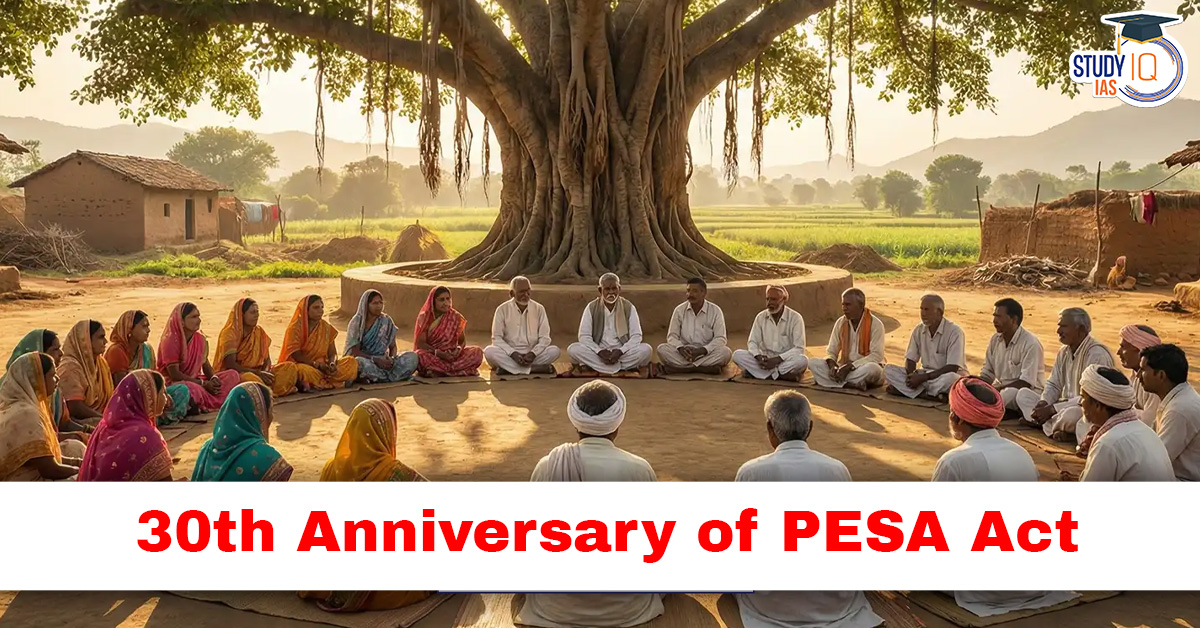
The 30th Anniversary of the Panchayats (Extension to Scheduled Areas) Act, 1996 (PESA) marks three decades of India’s most transformative experiment in tribal self-governance and grassroots democracy. Recently, the Ministry of Panchayati Raj organised PESA Mahotsav: Utsav Lok Sanskriti Ka in Visakhapatnam, highlighting the cultural, constitutional, and democratic spirit of the Act.
Enacted to correct the historical exclusion of tribal regions from decentralised governance, the PESA Act, 1996 remains a cornerstone of constitutional justice for Scheduled Areas under the Fifth Schedule.
Background of the PESA Act
The PESA Act was enacted in 1996 following the recommendations of the Bhuria Committee (1995), which recognised that the uniform model of Panchayati Raj under the 73rd Constitutional Amendment failed to account for the distinct socio-cultural systems of tribal communities.
Why PESA Was Needed
-
Fifth Schedule Areas were excluded from Part IX of the Constitution
-
Tribal customary institutions were undermined by bureaucratic governance
-
Rising land alienation, mining, displacement and forest exploitation
PESA sought to restore community control, customary law and participatory decision-making in Scheduled Areas.
Constitutional Framework of PESA
-
Applicable to: Fifth Schedule Areas
-
Nodal Ministry: Ministry of Panchayati Raj (MoPR)
-
Spatial Reach:
-
10 Fifth Schedule states
-
~77,500 villages
-
~22,000 Panchayats
-
The Act mandates states to enact laws consistent with tribal traditions and governance systems while implementing Panchayati Raj institutions.
Key Objectives of the PESA Act
-
Empower Gram Sabhas as the primary authority
-
Protect tribal land, forests and livelihoods
-
Recognise customary laws and dispute resolution mechanisms
-
Promote bottom-up development planning
-
Prevent forced displacement and exploitation
Salient Features of the PESA Act
1. Gram Sabha Supremacy
The Gram Sabha is the core institution of governance with authority over:
-
Social and cultural practices
-
Community resources
-
Development planning and beneficiary selection
2. Definition of Village
A village is defined as a habitation or group of hamlets sharing traditions, not merely administrative boundaries.
3. Land and Resource Protection
-
Mandatory Gram Sabha consultation and consent before:
-
Land acquisition
-
Resettlement and rehabilitation
-
Mining of minor minerals
-
-
Ownership and management of Minor Forest Produce (MFP)
4. Social Regulation
Gram Sabhas can:
-
Prevent intoxicant abuse
-
Regulate money-lending practices
-
Protect vulnerable households from exploitation
5. Political Representation
-
Reservation proportional to population
-
STs guaranteed minimum 50% seats
-
Chairpersons at all levels must be Scheduled Tribe
6. Financial Accountability
Village Panchayats must obtain a Gram Sabha utilisation certificate before accessing funds.
Significance of the PESA Act at 30 Years
1. Democratic Empowerment
Covers 8.6% of India’s population belonging to Scheduled Tribes, enabling direct participation in governance.
2. Cultural Preservation
Legally recognises tribal customs, traditions and dispute resolution systems.
3. Land Rights Safeguard
Acts as a constitutional shield against arbitrary land alienation and corporate-led displacement.
4. Livelihood Security
Empowers communities through control over forest produce and natural resources.
Government Initiatives for PESA Implementation
To strengthen PESA implementation, the government has undertaken several measures:
-
Dedicated PESA Cell in MoPR
-
Capacity-building programmes training over 1 lakh representatives
-
PESA-GPDP digital portal for fund tracking
-
Translation of manuals into tribal languages
-
Centres of Excellence in universities
-
Publication of 40 best-practice success stories
Challenges in PESA Implementation
1. Uneven Rule Adoption
Only 8 out of 10 Fifth Schedule states have notified PESA Rules, leaving Odisha and Jharkhand behind.
2. Dilution of Gram Sabha Authority
Cases like Hasdeo Arand coal mining show projects cleared despite Gram Sabha opposition.
3. Administrative Resistance
Sector-specific laws often override PESA, as seen in the Polavaram irrigation project.
4. Capacity Deficit
Over 40% of elected representatives lack clarity on Gram Sabha powers.
5. Monitoring Gaps
No unified monitoring framework across 63+ Fifth Schedule districts.
Way Forward: Strengthening PESA at 30
1. Legal Convergence
Integrate PESA with:
-
Forest Rights Act, 2006
-
Land Acquisition Act, 2013
To create a single, binding consent mechanism.
2. Model PESA Rules
Adopt centrally designed templates to prevent dilution by states.
3. Institutional Clarity
-
MoPR: Governance processes
-
Ministry of Tribal Affairs: Land, forest and livelihood protection
4. Continuous Capacity Building
Introduce:
-
Community paralegals
-
Barefoot governance facilitators
-
Ongoing handholding models
5. Incentive-Based Compliance
Link strong PESA implementation to higher untied financial grants.
Conclusion
On its 30th Anniversary, the PESA Act stands as a powerful reminder that development without consent is dispossession. While the law provides one of the strongest frameworks for grassroots democracy in the world, its promise remains unevenly realised.
Revitalising PESA is essential not only for tribal justice but also for strengthening constitutional morality, inclusive governance and sustainable development in India’s most vulnerable regions.
 Utkal Divas 2026: Date, History, Signifi...
 Cicada COVID Variant (BA.3.2): Symptoms,...
 FATF Report on India’s Action on Virtu...













 WhatsApp





