Context
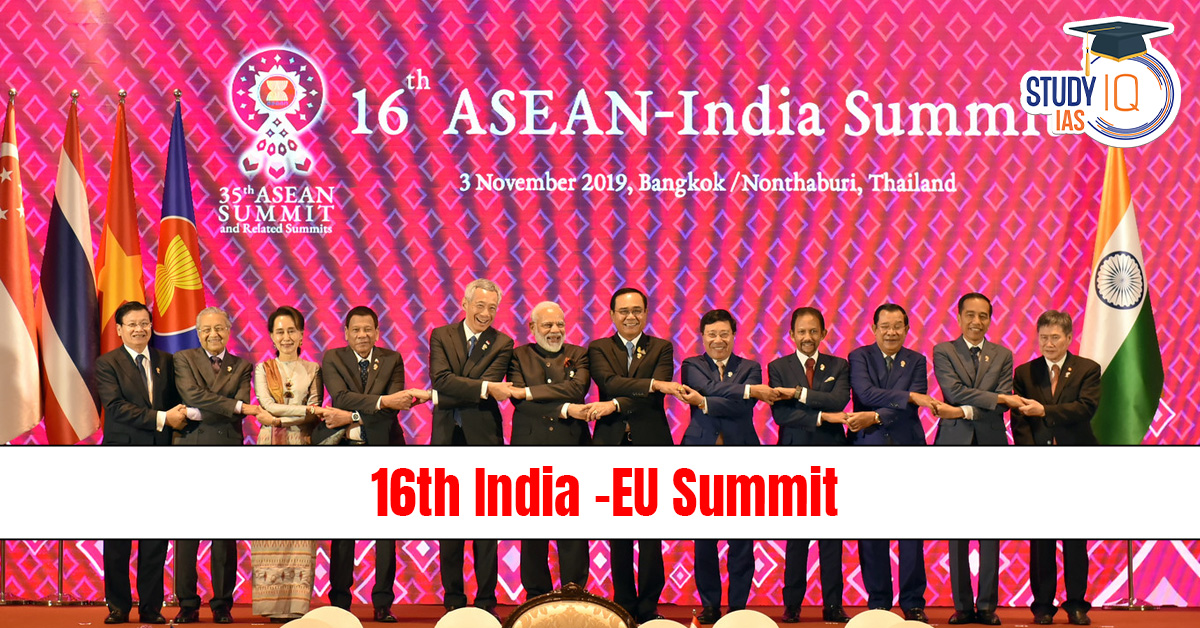
EU leadership led by Antonio Costa and Ursula von der Leyen visited India as Republic Day Chief Guests and attended the 16th India-EU summit.
16th India–EU Summit Outcomes
- Elevation of Strategic Partnership: Commitment to deepen partnership based on democracy, rule of law, human rights, multilateralism and UN-centric global order.
- Business and Economic Engagement: Leaders addressed the India–EU Business Forum, urging private investment in critical and emerging sectors.
Economic and Trade Cooperation
- India–EU Free Trade Agreement (FTA): Successful conclusion of FTA negotiations aimed at boosting trade, investment, resilient supply chains and inclusive growth.
| Important aspects of FTA
Tariffs Liberalisation
- EU will eliminate tariffs on over 90% tariff lines (99.3% by value).
- India will eliminate tariffs on 86% tariff lines (96.6% overall liberalization).
- Remaining lines are partially liberalised to protect sensitive sectors.
Sectoral Gains
- EU gains: agri-food, chemicals, pharmaceuticals, machinery, medical devices, automobiles.
- India gains: fisheries, textiles, footwear, chemicals, and pharmaceuticals.
Rules of Origin
- Only goods substantially produced or processed in India/the EU get tariff benefits.
- The self-certification system simplifies compliance, especially for SMEs.
- Customs verification is done through administrative cooperation.
Sanitary & Phytosanitary (SPS) Measures
- EU’s strict food safety, animal and plant health rules remain unchanged.
- Clear timelines for approvals, audits, certifications and inspections.
- SPS disputes are covered under the FTA dispute settlement.
Trade Remedies
- Retains the right to use: Anti-dumping, Anti-subsidy and Safeguard measures
- Includes a bilateral safeguard mechanism against import surges.
Intellectual Property Rights (IPR)
- Strong IP protection aligned with Indian and EU laws.
- It covers: Copyrights, Trademarks, Designs, Trade secrets and Plant varieties
- Enforceable with Indian and EU laws to promote investment.
Competition, Subsidies & Mergers
- Competition law applies to public and private enterprises.
- EU can seek information on Indian subsidies if trade distortions arise.
Trade and Sustainable Development (TSD)
- Environment & Climate: The TSD chapter integrates trade with environmental protection by supporting climate action, biodiversity conservation and transition to low-carbon economies.
- Workers’ Rights: The agreement upholds core International Labour Organization principles to ensure fair, safe and non-discriminatory working conditions.
- Gender Equality: Trade provisions support women’s economic empowerment by promoting inclusive participation and cooperation aligned with international gender equality standards.
- Enforcement: Sustainable development commitments are legally binding and enforced through structured consultations involving experts and political decision-makers.
|
Future Economic Instruments
- Commitment to early conclusion of Investment Protection Agreement (IPA) and Geographical Indications (GI) Agreement.
- Promotion of trilateral cooperation and third-country investments under EU’s Global Gateway.
Security & Defence Partnership: Signing of the first-ever India–EU Security and Defence Partnership covering maritime security, cyber threats, space, defence technology and counter-terrorism.
Information Sharing
- Launch of negotiations on the Security of Information Agreement to enable classified information exchange.
Trade and Technology Council (TTC)
- TTC is reaffirmed as the main coordination platform for trade, technology and economic security.
- It helps India and the EU align policies instead of working in silos, especially during global disruptions.
Key Areas of Cooperation
- Semiconductors: Reducing dependence on limited suppliers.
- Artificial Intelligence & Quantum: Trusted and ethical tech development.
- 6G & Digital Public Infrastructure: Secure and interoperable digital systems.
- Clean tech: Technologies supporting green transition.
Research & Space Cooperation
- Science & Technology Agreement extended till 2030, ensuring continuity in joint research.
- Exploratory talks on Horizon Europe: Opens access to one of the world’s largest research funding programmes.
- India–EU Space Dialogue: Cooperation in satellite technology, space security and applications.
Clean Energy Transition
- India–EU Task Force on Green Hydrogen to promote clean fuel technologies.
- India–EU Wind Business Summit (2026) to boost renewable investments.
- Disaster Risk Management Arrangement to improve preparedness and response.
- EU engagement with CDRI and ISA strengthens global resilience and solar adoption.
Connectivity Initiatives
- Joint infrastructure projects under India–EU Connectivity Partnership.
- Alignment of EU’s Global Gateway with India’s MAHASAGAR vision.
Strategic Corridors
- Support for India-Middle East-Europe Economic Corridor (IMEC) to enhance trade and logistics.
- Aviation Dialogue and maritime cooperation to improve transport efficiency and safety.
Mobility Framework
- Adoption of the India–EU Comprehensive Framework on Mobility for legal and orderly migration.
- European Legal Gateway Office launched as a single window for skilled Indian workers, starting with ICT sector.
Education and Skills
- Launch of Education and Skills Dialogue (2026).
- Focus on recognition of qualifications, academic mobility and vocational training.
|
India-EU Relations
|
The EU-India Strategic Partnership was formalised in 2004, with sectoral dialogues on trade, climate, and security
-
Institutional Architecture
- India–EU Summit is the apex platform; 16 Summits held so far (first in 2000, Lisbon).
- India–EU Trade and Technology Council (TTC) (set up 2022) is the key mechanism on tech sovereignty, trade security and supply chains.
-
- The EU is India’s largest trading partner and a major source of investment and technology.
- Bilateral trade: $136.53 billion in 2024-25 (exports worth $75.85 billion and imports worth $60.68 billion), making it the largest trading partner for goods..
- Market share: The EU market accounts for about 17 per cent of India’s total exports.
- EU FDI in India (April 2000 – Sept 2024): $117.4 billion (16.6% of total FDI).
- Indian FDI in the EU: $40.04 billion (April 2000 – March 2024).
- FTA negotiations (re-launched 2022) have gained urgency; both sides aimed to conclude by end-2025, with tough bargaining on autos, wine/spirits, dairy, and India’s textiles/pharma/steel exports.
- Technology & Digital Cooperation
-
-
- India–EU S&T cooperation is guided by parity/symmetry, co-investment and shared IPR principles.
- Developing trustworthy AI: Both European AI Office and India AI Mission agreed to deepen cooperation
- People-to-People Ties
-
-
- 20% of EU Blue Cards (2023-24) issued to Indian professionals.
- 6,000+ Erasmus scholarships awarded to Indian students in 20 years.
- 2,700+ Indian researchers funded under Marie Sklodowska-Curie Actions.
- Defence & Security
-
-
- Maritime security cooperation under ESIWA+ programme.
- First joint naval exercise (2023) in the Gulf of Guinea.
- Collaboration on global security, piracy, counterterrorism, and disaster relief.
- Space Cooperation
-
- ISRO launched the EU’s PROBA-3 mission (Dec 2024).
- ISRO-ESA cooperation in Chandrayaan-3 and Aditya-L1 missions.
- Signed MoU for Gaganyaan mission cooperation.
Issue in India-EU relations
- CBAM (EU carbon tax): India sees it as extra tax on steel/cement, reducing export competitiveness.
- GDPR vs India data rules: EU wants free data flows; India prefers data localisation and sovereignty controls.
- IPR (TRIPS-plus): EU seeks stricter patent rules; India worries about higher medicine prices, weaker generics.
- Government procurement: EU wants access to Indian public tenders; India wants to protect domestic industry.
- Mode 4 visas: India wants easier EU work/business visas for professionals and service providers.
- EU services market access: EU firms seek more entry into banking, legal, auditing, and financial services
|
Sharing is caring!

 Scientific Cooperation in BRICS: Key Ini...
 Explained: India’s West Asia Reset Ami...
 Cholesterol Makes Cell Nuclei Squishy: H...






 WhatsApp





