
Table of Contents
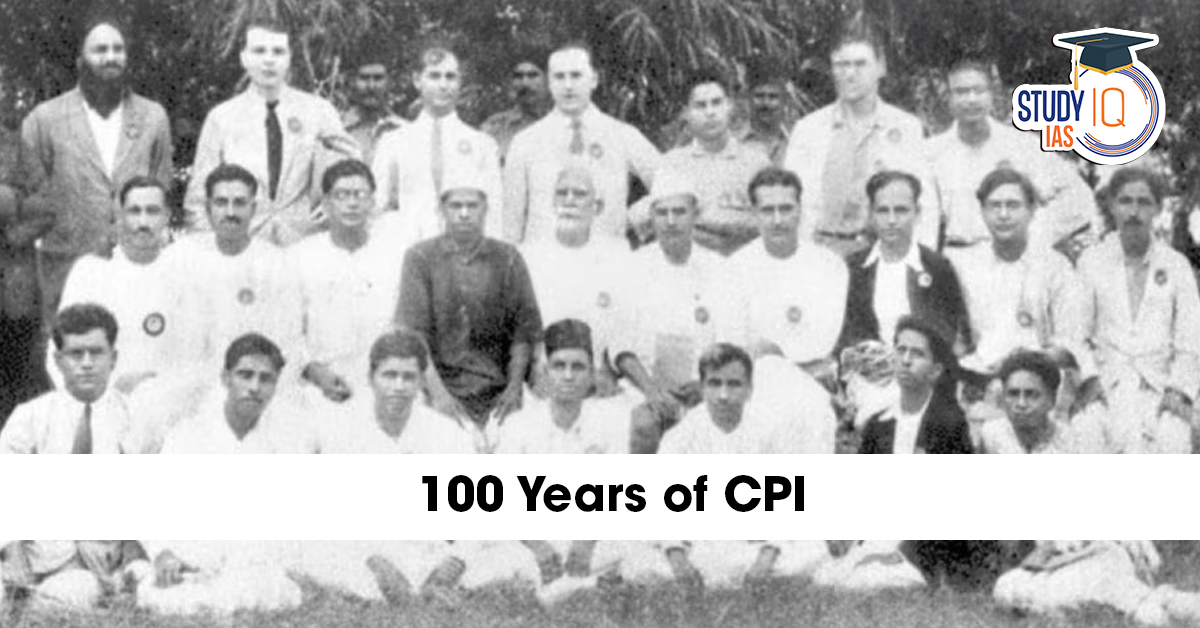
100 Years of CPI marks a significant milestone in India’s political and ideological history. Founded on December 26, 1925, at Kanpur, the Communist Party of India (CPI) has completed a century of existence. Over the last 100 years, the CPI has shaped labour movements, peasant struggles, constitutional debates, and India’s democratic left tradition. The centenary has revived discussions on how communism took root in colonial India, its global inspirations, internal debates, and long-term relevance.
100 Years of CPI: Latest News and Significance
In December 2025, the CPI officially commemorated 100 years since the Kanpur Conference of 1925, which is recognised as the first organised attempt to form an all-India Communist party on Indian soil. The centenary has renewed academic and political interest in:
-
The global and Indian origins of communism
-
The CPI’s role in the freedom struggle
-
Its contribution to social justice, labour rights and land reforms
-
The constitutional and parliamentary legacy of Indian communists
Global Antecedents of Indian Communism
French Revolution and the Rise of Left Ideology
The ideological roots of communism lie in Europe’s political transformation after the French Revolution (1789) and the Napoleonic Wars (1796–1815). These events divided European society into:
-
Right: defenders of monarchy and old hierarchies
-
Left: advocates of republicanism, equality and social change
Industrial Revolution and Class Inequality
The Industrial Revolution created unprecedented wealth but also severe inequality, urban poverty and labour exploitation. This socio-economic crisis provided fertile ground for socialist thought.
Karl Marx and Communist Ideology
Karl Marx, writing in the 19th century, argued that capitalism carried internal contradictions that would inevitably lead to its collapse and replacement by socialism. Though Marx expected revolutions in advanced capitalist societies, history unfolded differently.
Russian Revolution (1917): Turning Point
The Russian (Bolshevik) Revolution of 1917, led by Vladimir Lenin, became the first successful socialist revolution — not in industrial Europe, but in a backward, autocratic empire. Its:
-
Anti-feudal
-
Anti-capitalist
-
Anti-imperialist
character made it deeply attractive to colonised countries like India.
Three Political Strands Behind the Formation of CPI
Indian communism emerged from the convergence of three major political strands.
1. MN Roy and the Comintern Strand
-
MN Roy, an Indian revolutionary active in the US, Mexico, Berlin and USSR, became India’s representative at the Communist International (Comintern) in 1920.
-
The Comintern advised communists in colonial countries to:
-
Prioritise anti-imperialist struggle
-
Build temporary alliances with nationalist forces
-
-
Tashkent emerged as a hub for Asian revolutionaries.
-
Diasporic groups were also active in:
-
Berlin (Virendranath Chattopadhyay)
-
Kabul (Raja Mahendra Pratap)
-
2. Independent Left Groups in India
Simultaneously, socialist groups developed independently within India:
-
Bombay – S A Dange
-
Calcutta – Muzaffar Ahmad
-
Madras – Singaravelu Chettiar
-
Lahore – Ghulam Hussain
These groups shared a socialist outlook but lacked national coordination.
3. Worker–Peasant Organisations
By the early 1920s, labour and agrarian mobilisation had begun:
-
All-India Trade Union Congress (AITUC) formed in 1920
-
First president: Lala Lajpat Rai
-
These organisations linked socialism with mass struggles of workers and peasants.
All three strands eventually merged into the Indian communist movement.
Tashkent (1920) vs Kanpur (1925): The Origin Debate
Tashkent Meeting, 1920
-
Indian revolutionaries including MN Roy and Abani Mukherji formed a Communist Party under Comintern approval.
-
Aimed to overthrow British rule and establish socialism.
-
Limitations:
-
No mass base in India
-
No coordination with Indian Left groups
-
Kanpur Conference, 1925
-
Held on Indian soil in an industrial city with a strong working-class presence.
-
Coincided with the Indian National Congress session.
-
Resolved to formally establish the Communist Party of India.
-
Objectives included:
-
Ending British imperialism
-
Establishing a workers’ and peasants’ republic
-
Socialisation of means of production and distribution
-
CPI vs CPI(M) Interpretation
-
CPI: Kanpur (1925) is the foundation — symbol of Indianisation of communism
-
CPI(M): Tashkent (1920) marks the true beginning — emphasis on internationalism
Kanpur represents the Indian dimension, while Tashkent reflects the global communist link.
CPI and Social Reform Agenda
From its inception, the CPI linked national liberation with social transformation:
-
Strong opposition to caste oppression and untouchability
-
M. Singaravelu openly condemned caste discrimination at the Kanpur conference
-
First political organisation to bar members of communal bodies
-
Advocated women’s emancipation, workers’ dignity and peasant rights
This made CPI one of the earliest consistently secular and egalitarian parties in India.
Role of CPI in India’s Freedom Struggle
Early Mobilisation (1925–1928)
-
Expansion of workers’ and peasants’ movements
-
Formation of Workers’ and Peasants’ Parties (WPPs)
Meerut Conspiracy Case (1929)
-
British government cracked down on communists
-
Leaders arrested for allegedly organising railway strikes
-
CPI banned; leaders jailed or deported
United Front Politics (1930s)
-
Alliance with Congress Socialist Party (CSP) formed in 1934
-
Sought a united anti-imperialist front
-
Collapsed in 1939 due to ideological differences
Peasant Movements (1945–47)
-
Tebhaga Movement in Bengal
-
Telangana Peasant Rebellion in Hyderabad State
These movements demanded land redistribution and agrarian justice.
Exception: During 1942–45, CPI prioritised the global anti-fascist struggle over the Quit India Movement.
CPI and the Making of the Constitution
Communist ideas influenced debates in the Constituent Assembly, especially on:
-
Land reforms
-
Labour rights
-
Social and economic justice
-
Protection of backward and marginalised classes
Mass organisations associated with CPI helped embed constitutional values of:
Liberty, Equality, Fraternity and Justice in post-Independence India.
Post-Independence Trajectory of CPI
After 1947, Indian communism followed divergent paths:
-
One section adopted armed, insurrectionary strategies
-
The mainstream embraced parliamentary democracy
Communists formed elected governments in:
-
Kerala
-
West Bengal
-
Tripura
The ideological and strategic differences culminated in the CPI–CPI(M) split of 1964, influenced by:
-
Sino-Soviet split
-
Debate on relations with Congress
-
Limits of working within the Indian Constitution
Contemporary Relevance of CPI at 100
Despite criticism of:
-
Authoritarian tendencies
-
Electoral decline
-
Ideological rigidity
Communism remains relevant due to:
-
Persistent global inequality
-
Labour precarity
-
Agrarian distress
-
Concentration of wealth
As scholars argue, the world remains divided by a “social equator”, with beneficiaries above and victims below. Communism continues to stand as a moral critique of this inequality.
Conclusion
100 years of CPI is not merely the story of a political party, but of an idea that shaped India’s freedom struggle, constitutional values and social movements. From Kanpur in 1925 to parliamentary democracy today, the CPI’s journey reflects India’s larger experiment with equality, justice and democracy. While its political influence has fluctuated, its ideological imprint on Indian public life remains enduring.
 FATF Report on India’s Action on Virtu...
 India Pharma Expo 2026: Key Highlights, ...
 India–Arab League Relations: Cooperati...













 WhatsApp





